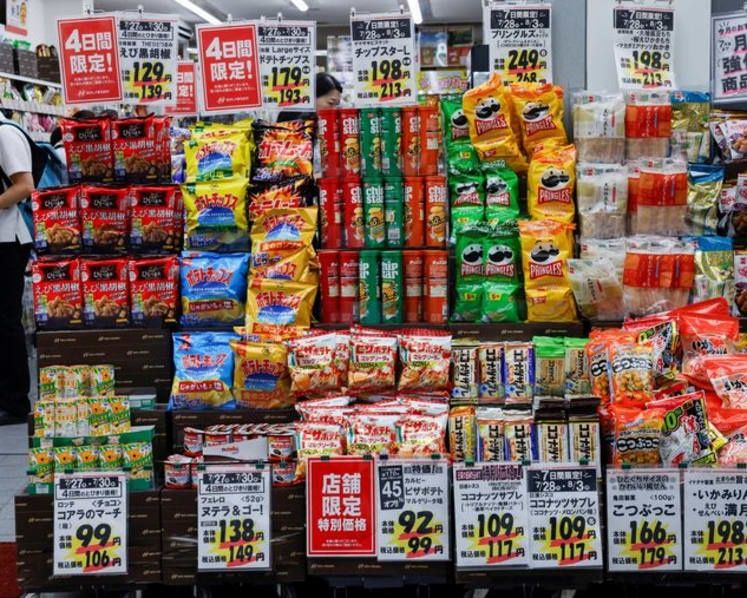
Japan will implement an unprecedented cut to consumption tax on food and beverages, reducing the rate from 8% to just 1% starting April 2025, Prime Minister Sanae Takaichi announced on Thursday. The temporary two-year measure represents the first reduction to the consumption tax since its introduction in 1989, marking a significant policy shift aimed at alleviating mounting inflationary pressures on Japanese households. After the two-year period ends, the tax rate will revert to 8% in April 2027, coinciding with the government's rollout of more targeted support mechanisms for lower-income citizens grappling with rising social insurance contributions.
The announcement underscores the administration's determination to address acute cost-of-living challenges that have intensified across Japan's economy. Inflationary pressures have been amplified by geopolitical tensions in the Middle East and the persistent weakness of the yen against major currencies, both factors that have driven up import costs and squeezed household purchasing power. By reducing the tax burden on essential food items, the government hopes to provide immediate relief at supermarket checkouts and dining establishments, where Japanese families spend a significant portion of their discretionary income.
Takaichi made this commitment a cornerstone of her political platform during February's lower house elections, and the policy resonated strongly with voters concerned about eroding living standards. Her resounding electoral victory provided a mandate to pursue aggressive anti-inflation measures, and this tax reduction represents the government's flagship response to public anxiety about purchasing power. The policy reflects broader political pressure across developed economies to shield citizens from price shocks on essentials, particularly food—a category that affects all income groups but disproportionately impacts vulnerable populations.
The fiscal cost of this initiative is substantial. Media estimates place the two-year revenue loss at approximately 10 trillion yen, equivalent to roughly USD 61 billion. This figure represents a significant hole in government finances at a time when Japan already carries one of the highest debt burdens among advanced economies. The nation's outstanding government debt exceeds twice its annual gross domestic product—a ratio unmatched by any other developed nation—raising questions about the long-term sustainability of such expansionary policies.
Yet the government has indicated it will attempt to offset these lost revenues without resorting to additional public borrowing. Takaichi stated that officials would carefully reassess existing tax exemptions and subsidy programmes to identify potential savings and reallocation opportunities. The administration aims to maintain market confidence by avoiding increased reliance on special government bonds, a strategy designed to prevent negative signals to international investors concerned about Japan's fiscal trajectory. This balancing act—providing relief while preserving fiscal credibility—presents a delicate challenge for policymakers.
The tapering of the tax cut in 2027 represents a transition to a more permanent support structure. Rather than simply restoring the full 8% rate, the government plans to introduce more refined subsidy mechanisms targeting lower-income households facing sharp increases in mandatory social insurance premiums. This two-phase approach attempts to shift the burden of support from broad-based tax reductions—which benefit all income groups—to more precisely targeted assistance for those most vulnerable to inflation. Such a transition acknowledges concerns that across-the-board tax cuts may prove fiscally unsustainable over the long term.
For Southeast Asian observers, Japan's inflation-fighting strategy carries important implications. As a major trading partner and investment source for the region, Japanese economic policy influences regional growth and currency markets. A weaker Japanese fiscal position or higher inflation could affect Japanese corporate investment decisions in Southeast Asia, while currency volatility stemming from Japan's macroeconomic challenges can impact regional export competitiveness and foreign exchange management. Additionally, Japan's struggle with inflation despite its advanced economy status demonstrates that price pressures are not confined to emerging markets, reflecting global rather than purely domestic economic disruptions.
The policy also highlights the political economy of inflation management in developed nations. Unlike emerging markets that often rely primarily on monetary policy tightening, wealthy governments can employ fiscal measures to shield populations from price shocks. Japan's approach privileges short-term relief over inflation control through demand destruction, betting that supply-side factors and currency stabilisation will eventually normalise prices. This contrasts with the more austere approaches sometimes imposed on developing economies by international institutions, revealing the different policy space available to high-income countries with deep capital markets and reserve currency advantages.
The implementation challenges ahead should not be underestimated. Retailers, restaurants, and government agencies must adjust point-of-sale systems, accounting procedures, and inventory management to accommodate the temporary lower rate. Merchants will need clarity on administrative procedures for reclaiming tax credits, while revenue agencies must develop compliance monitoring systems to prevent fraud or misclassification of goods. The complexity of implementing differential tax rates—where some food items qualify while others do not—requires careful definitional work and public communication to avoid confusion and disputes.
International observers will closely monitor whether this unconventional approach succeeds in sustaining consumer purchasing power without triggering further currency depreciation or asset price inflation. Japan's experience will provide valuable lessons for other developed economies contemplating similar measures. Success could vindicate demand-side policy responses to inflation, while failure might reinforce arguments that fiscal stimulus merely stokes prices without addressing underlying supply constraints. For Malaysia and the region, watching Japan navigate these challenges offers important context for understanding inflation dynamics and policy options in the post-pandemic global economy.

