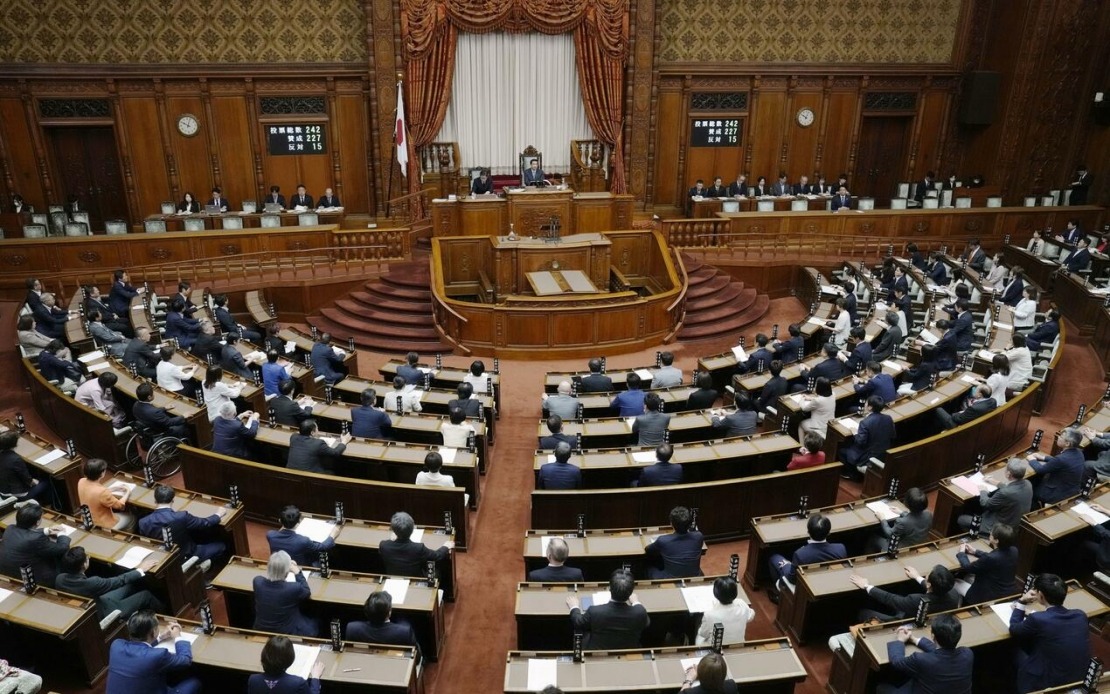
Japan's parliamentary process has cleared major defence legislation that signals the nation's growing commitment to space-based security operations in an increasingly contested regional environment. The House of Councillors approved restructuring measures that will formally integrate space operations into the Air Self-Defence Force's mandate, marking a significant institutional shift for Tokyo's military apparatus. The reorganisation reflects broader concerns across East Asia about the strategic importance of orbital capabilities and satellite-dependent systems that underpin modern defence and civilian infrastructure alike.
The new organisational structure takes effect during Japan's fiscal year ending March 2027, introducing a dedicated space operations group positioned under a lieutenant general's command. This command hierarchy mirrors the importance Japan assigns to the emerging domain, ensuring space defence receives strategic-level attention previously reserved for traditional air operations. The space operations group will concentrate on bolstering domain awareness capabilities, allowing Japan to monitor activities across orbital space with greater precision and responsiveness than current arrangements permit. Enhanced satellite surveillance competencies will provide Tokyo with independent intelligence gathering capacity, reducing reliance on allied intelligence sharing arrangements.
Defence Minister Shinjiro Koizumi framed the legislation as essential infrastructure modernisation rather than purely military expansion. During his press briefing, Koizumi emphasised that space systems have become inseparable from civilian life across Japan's economy and society. Satellite navigation systems guide everything from commercial logistics to personal navigation applications, while meteorological satellites provide critical weather forecasting data upon which agricultural planning and disaster preparedness depend. The smartphone mapping applications millions of Japanese users rely on daily are fundamentally dependent on space-based positioning infrastructure. This civilian-military integration argument carries particular resonance in Japan's political context, where defence spending faces scrutiny from pacifist constituencies.
The restructuring extends beyond space operations into higher-level defence administration. The legislation authorises appointment of a second senior vice defence minister position, effectively creating a deputy tier within Japan's defence ministry structure. This administrative expansion targets operational efficiency during crises, whether military contingencies or large-scale natural disasters that regularly challenge Japan's emergency response systems. The additional senior vice minister role will distribute workload responsibilities during major incidents while facilitating expanded defence dialogue with Washington and other security partners. The government expects to fill this position during summer months, suggesting Tokyo views the change as operationally urgent rather than routine bureaucratic adjustment.
Recognising persistent challenges in attracting and retaining military personnel, the legislation simultaneously addresses compensation structures that have increasingly disadvantaged Japan Self-Defence Forces recruitment efforts. The measure increases post-retirement benefits for SDF members, accounting for the reality that mandatory retirement ages across different SDF branches typically occur substantially earlier than civilian government service norms. This compensation adjustment directly responds to demographic pressures constraining Japan's workforce while defence responsibilities expand. Improving retirement provisions represents a non-controversial investment in personnel stability that strengthens force continuity without expanding operational capacity or raising regional tensions.
The southwestern islands dimension adds particular strategic significance for regional readers monitoring East Asian dynamics. Japan is simultaneously upgrading the Ground Self-Defence Force's 15th Brigade, currently based in Naha, Okinawa Prefecture, to full divisional status. This elevation reflects Tokyo's assessment that remote island territories require substantially enhanced defensive capabilities. China's expanding maritime assertiveness throughout the East China Sea and growing military capabilities in the region have prompted Japanese planners to prioritise southwestern island chain defences. The 15th Brigade's elevation acknowledges these islands' strategic importance as geographic buffers protecting Japan's core territory and major shipping lanes that funnel regional trade through waters where Japan maintains significant maritime interests.
For Southeast Asian observers, Japan's space defence investment carries implications extending beyond bilateral Japan-China dynamics. Regional nations depend heavily on the same space-based infrastructure systems Japan is now prioritising—satellite communications, weather monitoring, and positioning networks that enable everything from maritime navigation to telecommunications. Japanese investments in space domain awareness create technological precedents and operational doctrines that may eventually extend regional benefits through alliance frameworks or burden-sharing arrangements. Australia, South Korea, and other Washington-aligned nations pursue similar space capabilities, suggesting evolution toward collective space security arrangements within the broader Indo-Pacific alliance architecture.
The legislation's passage through Japan's bicameral parliament without apparent significant opposition suggests broad consensus around space defence priorities. Japanese defence policy traditionally navigates delicate constitutional constraints and public opinion dynamics that complicate military modernisation. The framing of space systems as civilian-dependent infrastructure alongside military applications proved politically effective in building legislative support. This approach offers lessons for other regional democracies attempting to modernise defence capabilities while maintaining public legitimacy and managing strategic debates around security spending and regional tensions.
Timing considerations matter considerably for understanding Japan's strategic calculus. The fiscal year 2027 implementation window allows Japan to synchronise space operations establishment with allied capability development and maintain coordination with United States Space Force operations and doctrine. Japan and the United States maintain extensive defence technology relationships that increasingly encompass space systems, from early warning satellites to precision positioning integration into weapons systems. Japanese space operations capability development supports interoperability objectives that Washington has prioritised as core to maintaining technological edge against peer competitors in the Indo-Pacific region.
The institutional elevation of space defence reflects fundamental shifts in how modern militaries conceptualise security threats and operational requirements. Traditional air superiority frameworks assumed dominance within Earth's atmosphere constituted decisive military advantage. Contemporary strategic analysis recognises that space systems enable everything from precision strike capabilities to real-time battlefield communications, making orbital denial or disruption catastrophic for military operations. Japan's structural integration of space operations into defence ministry apparatus signals acceptance that future conflicts will be fought across multiple domains simultaneously, requiring institutional arrangements that prevent space operations from remaining peripheral to force planning and strategic decision-making.
Regional military observers should monitor whether other East Asian nations—particularly South Korea and Taiwan—follow Japan's institutional model for space defence integration. Seoul and Taipei face analogous security environments where space-based systems provide critical military advantages, yet their smaller defence budgets and different strategic circumstances may produce different institutional solutions. Japan's experience will provide case study material for evaluating whether dedicated space operations commands genuinely improve responsiveness or whether integrating space operations into existing military service structures proves more efficient. The coming years will test whether Japan's institutional investments translate into measurable operational improvements in space domain awareness and tactical responsiveness.

