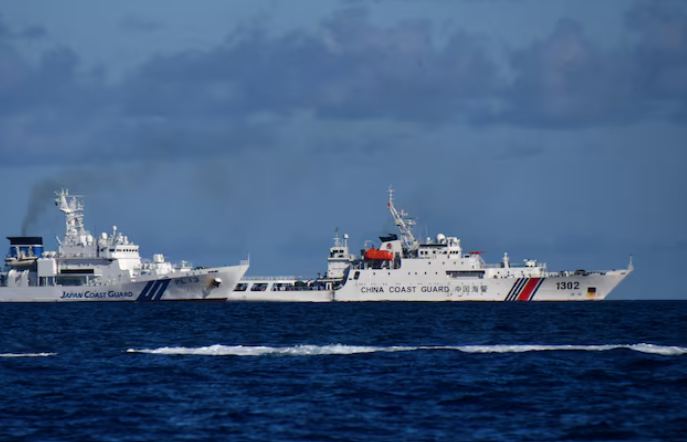
Japan's coast guard successfully expelled two Chinese coast guard vessels from waters it claims jurisdiction over near the Senkaku Islands on Tuesday, marking another flashpoint in the two countries' enduring maritime dispute. The Chinese ships were forcibly removed from Japanese territorial waters at approximately 9:20am local time after attempting to approach a Japanese fishing vessel operating in the area, according to a statement from Japan's coast guard.
The Senkaku Islands, referred to as the Diaoyu by China, remain one of Asia's most contentious territorial flashpoints. Located between Taiwan and Japan's Okinawa prefecture, the uninhabited rocky outcrops have anchored bilateral tensions for decades, with both Tokyo and Beijing asserting sovereignty over the strategically important location. The islands' position in the East China Sea, an area believed to contain substantial energy reserves, compounds their geopolitical significance beyond mere territorial pride.
While Chinese coast guard vessels regularly patrol waters surrounding the islands, the deliberate approach toward a Japanese fishing boat represents a notably aggressive manoeuvre. The Japanese coast guard not only issued orders for the intruding vessels to depart but also strategically positioned itself around the Japanese fishing vessel to guarantee its safety during the tense encounter. This protective deployment underscores the escalating risks faced by Japanese fishermen operating in the disputed zone and the necessity for heightened maritime security measures.
The latest incursion follows a previous Chinese presence in these waters on June 10, though that occasion did not involve direct contact with Japanese vessels. The presence of four Chinese ships in the vicinity, with two entering what Japan considers its territorial waters, suggests a coordinated operation rather than an isolated incident. Such patterns of activity have become increasingly routine, with China regularly deploying its coast guard to patrol the contested region in what observers characterize as a slow-motion assertion of de facto control.
Japan's coast guard formally characterised the Chinese vessels' conduct as violating international law, a position backed by Tokyo's interpretation of maritime boundaries under international convention. The statement pledged that the coast guard would continue responding with measured but resolute action, balancing firmness with adherence to both international maritime law and Japan's domestic regulations. This measured rhetoric, however, masks the underlying anxiety in Tokyo about China's incremental expansion of its maritime footprint in the East China Sea.
The deterioration in Japan-China relations has accelerated notably since November, when Japanese Prime Minister Sanae Takaichi delivered remarks concerning Taiwan that provoked sharp condemnation from Beijing. Her statements appeared to suggest that Japan might intervene militarily should Taiwan face attack, a position that directly contradicts China's assertion of sovereignty over the self-ruled island and its refusal to renounce force as an option for unification. These comments struck at the heart of Chinese security concerns and triggered a coordinated response from the mainland.
Beijing's reaction to Takaichi's Taiwan comments extended well beyond diplomatic protests. China subsequently discouraged its citizens from travelling to Japan through official guidance and initiated trade restrictions targeting selected Japanese companies, economic measures that signal Beijing's willingness to weaponise commercial ties in response to political disagreements. These restrictions, albeit targeted rather than comprehensive, demonstrate how disputes over territorial and security issues increasingly spill into the economic sphere, affecting broader bilateral relations beyond the maritime domain.
The Senkaku dispute occupies particular importance for regional stability in Southeast Asia and beyond. Malaysia, Vietnam, the Philippines, and other nations with competing claims in the South China Sea observe Japan-China dynamics closely, recognising that the outcome of these disputes will establish precedents for how maritime territorial conflicts are resolved in the Indo-Pacific region. Should escalation occur near the Senkaku Islands, the reverberations could influence behaviour across multiple disputed maritime zones throughout East and Southeast Asia.
Chinese coast guard activities in the East China Sea represent part of a broader pattern of assertive maritime behaviour across multiple disputed waters. Beyond the Senkaku Islands, Chinese vessels have expanded operations into other contested areas, an approach that Japan has repeatedly protested without achieving measurable restraint. The persistence of these incursions, despite formal objections and international legal arguments, reflects China's strategic calculation that maintaining pressure and establishing habitual presence serves its long-term territorial objectives more effectively than accepting agreements that might limit future options.
The security situation surrounding Japanese fishermen operating near the disputed islands underscores the human dimension of abstract territorial disputes. These individuals, simply pursuing their livelihoods in traditional fishing grounds, find themselves caught between competing sovereignties and escalating military-style interactions. The Japanese coast guard's protective posture acknowledges this vulnerability and the responsibility to safeguard civilian maritime activities, a principle that becomes increasingly complicated as state coast guards assume quasi-military roles in territorial disputes.
Looking ahead, the trajectory of Japan-China maritime confrontations depends substantially on political developments regarding Taiwan and broader great-power competition in the Indo-Pacific. Should tensions over Taiwan intensify, incidents near the Senkaku Islands could multiply as China intensifies pressure on Japan across multiple domains simultaneously. Conversely, any moderation in rhetoric or a shift toward diplomatic engagement could reduce the frequency and intensity of such maritime encounters, though the underlying territorial dispute would persist absent a negotiated settlement.

