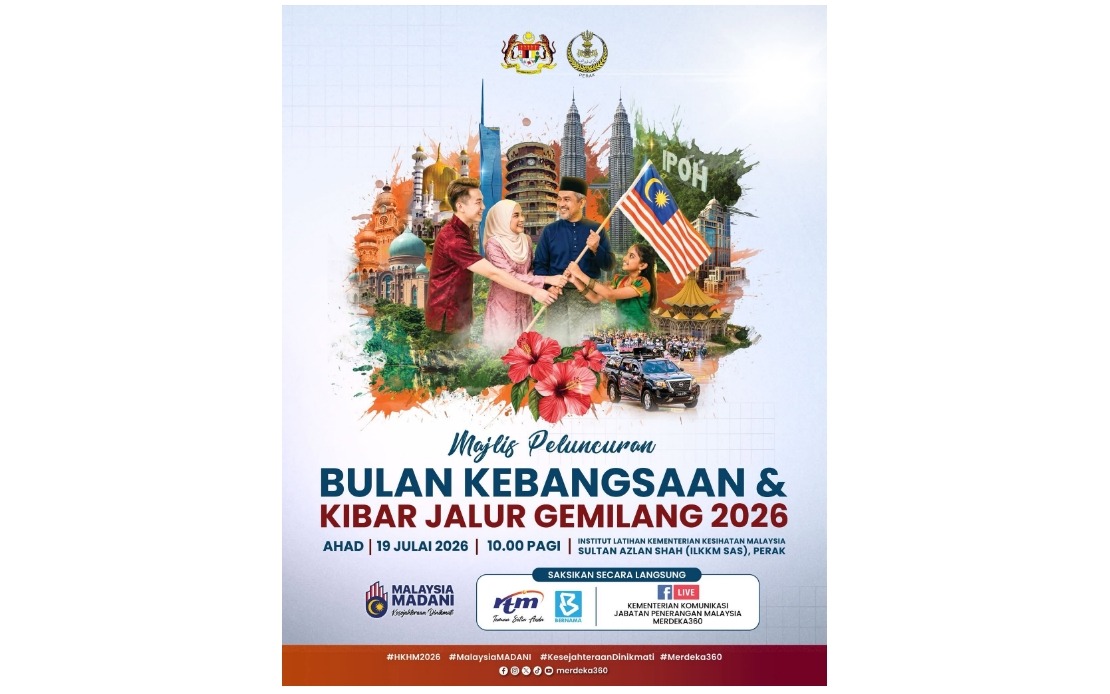
The ceremonial launch of the National Month and Fly the Jalur Gemilang 2026 campaign will take place on July 19 at the Institut Latihan Kementerian Kesihatan Malaysia Sultan Azlan Shah in Perak, formally inaugurating Malaysia's observance of the nation's independence celebrations. Beginning at 10 am, this opening event represents a nationwide effort to revitalise patriotic sentiment across Malaysian communities ahead of the traditional August 31 and September 16 commemorations.
Broadcast coverage will extend across multiple platforms to maximise public engagement, with Radio Televisyen Malaysia, BERNAMA TV, and digital streams on Facebook delivering live feeds to audiences nationwide. The Ministry of Communications and Department of Information Malaysia will amplify messaging through their official social media channels, ensuring that even remote regions can participate in the symbolic ceremony. This multimedia approach reflects the government's recognition that contemporary civic engagement requires simultaneous presence across traditional and digital media ecosystems.
Citizens and organisations seeking to participate in the patriotic initiative can access comprehensive resources through the dedicated Merdeka360.my portal. The platform provides official logos, patriotic compositions, and promotional materials designed specifically to assist community groups, government agencies, and private sector organisations in crafting localised celebrations. This democratisation of campaign assets ensures that National Month observance need not depend solely on centralised arrangements, enabling grassroots participation across Malaysia's diverse communities.
The overarching theme selected for this year's National Day and Malaysia Day festivities—"Malaysia MADANI: Kesejahteraan Dinikmati"—encapsulates the government's policy vision of shared prosperity benefiting all citizens. The Malaysia MADANI branding, retained as the official emblem through 2026, continues to anchor national celebrations in the framework's foundational principles of justice, humanity, and welfare-centred governance. This thematic consistency across consecutive years reinforces messaging around the administration's commitment to inclusive development that transcends socioeconomic divides.
The philosophical underpinning of the chosen theme reflects substantive policy commitments rather than ceremonial rhetoric. By emphasising that national prosperity must be "enjoyed fairly and comprehensively by all Malaysians without exception," the campaign articulates a governance philosophy that prioritises equitable distribution of development benefits over purely aggregate economic growth. For Malaysian observers, particularly those from lower-income backgrounds, this messaging signals official recognition that national progress requires tangible improvements in living standards for all demographic cohorts, not merely elite constituencies.
Communications Minister Datuk Seri Fahmi Fadzil has confirmed that the primary National Day celebration on August 31 will occur at Dataran Putrajaya, emphasising a measured yet spirited observance rather than elaborate pageantry. This deliberate tonal choice contrasts with past celebrations characterised by large-scale productions and considerable public expenditure. The decision to pursue a modest approach while maintaining celebratory energy suggests budgetary consciousness alongside recognition that patriotic sentiment requires authenticity rather than extravagant spectacle.
Malaysia Day 2026 will constitute a geographically significant occasion, with Sarawak hosting the September 16 festivities. This selection carries symbolic weight for East Malaysian constituencies, affirming their integral role within the Malaysian federation and acknowledging the distinctive constitutional position that Sabah and Sarawak occupy. For Sarawak specifically, the assignment represents formal recognition of the state's historical importance to Malaysian nationhood, dating to the 1963 formation of the Federation.
Seven complementary programmes will scaffold the broader HKHM2026 celebrations throughout Malaysia's states and territories. Kembara Bahasa HKHM will promote linguistic unity through Malay language engagement, while Quran Hour addresses the Muslim majority's spiritual observance during the national period. Ambang Merdeka, the Merdeka Countdown, and RIUH Merdeka will provide structured opportunities for public participation across age groups and community types. The National Statesmen Commemoration Ceremony will anchor celebrations in historical reflection, honouring figures instrumental to Malaysia's independence and nation-building trajectory.
These supporting initiatives collectively construct a multifaceted patriotic programme that accommodates Malaysia's religious, linguistic, and cultural pluralism. Rather than imposing uniform celebration templates, the seven-programme structure enables different constituencies to engage patriotically through culturally resonant channels. For instance, Quran Hour respects Islamic observance while Kembara Bahasa prioritises shared linguistic identity—twin pillars that reinforce national cohesion without demanding cultural homogenisation.
The Jalur Gemilang 2026 campaign represents the Malaysian government's strategic effort to maintain patriotic consciousness during an extended period of complex domestic politics. By initiating public mobilisation well in advance of the August-September celebration window, authorities provide adequate opportunity for grassroots organisations, state governments, and civil society bodies to develop complementary activities. This extended preparation horizon contrasts with compressed timelines that characterise some previous National Month observances.
For Southeast Asian observers, Malaysia's approach illustrates how electoral democracies manage national identity affirmation amid political competition. The emphasis on inclusivity through the Malaysia MADANI framework, combined with decentralised participatory mechanisms via Merdeka360, reflects contemporary understanding that top-down nationalism often fails to resonate authentically. By offering resources and thematic scaffolding while permitting substantial local variation, Malaysian authorities accommodate legitimate diversity in patriotic expression.
The Jalur Gemilang 2026 initiative additionally positions Malaysia within a regional context where other Southeast Asian nations similarly prioritise national unity commemorations. Thailand, Indonesia, and Vietnam maintain comparable national day observances emphasising historical consciousness and civic solidarity. Malaysia's multi-platform approach and explicit commitment to inclusive prosperity messaging positions the country within progressive practices concerning how contemporary nations construct patriotic narratives that acknowledge internal diversity.

