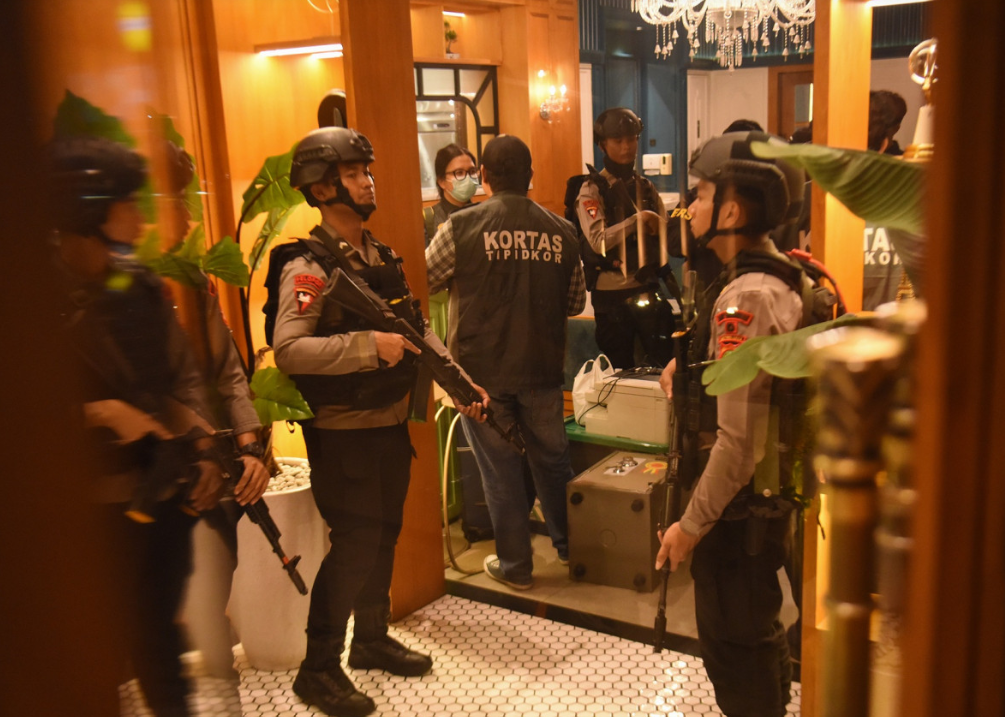
Patrons at de'Clan Signature in the Cipete district of South Jakarta experienced an unusual afternoon when heavily armed police descended on the restaurant last Wednesday. Officers from Jakarta's metropolitan police and the National Police's anti-corruption division, accompanied by Mobile Brigade members in tactical gear and carrying automatic weapons, forced their way past the ordinary lunch crowd to access a two-metre-high safe concealed behind cabinetry. What they discovered—documents and cash in multiple foreign currencies totalling millions of dollars—marked the opening salvo in one of the most dramatic law enforcement operations Jakarta has witnessed in years.
The restaurant raid was merely the starting point of a coordinated sweep that would eventually encompass at least a dozen locations across the capital and surrounding suburbs. Officers moved systematically from Cipete to an adjacent money changer, Koin Money Changer, where they opened additional safes containing hundreds of thousands of dollars more in Indonesian rupiah. As the operation unfolded over the following hours and into the early Thursday morning, police seized mobile phones, photographs, and extensive document collections from residential addresses and commercial premises throughout the metropolitan area. Yet the most spectacular discovery awaited searchers who travelled south of the city.
In the hillside community of Sentul, an upscale suburban enclave roughly an hour's drive from Jakarta's city centre, police entered a high-end residence and found seven suitcases. Inside were 74 kilograms of gold bars alongside cash denominated in various currencies. When authorities inventoried the complete haul from all raided locations, the estimated total reached US$26.3 million. The photographs released to the media—rows of gleaming bullion and bound stacks of colourful banknotes displayed under official supervision—became the indelible images defining one of Indonesia's most significant law enforcement scandals in recent memory.
The Sentul property belongs to Febrie Adriansyah, who until his sudden resignation over the weekend had served as deputy attorney general for special crimes for more than four years. Febrie has been named as a suspect in corruption and money-laundering investigations, though authorities have not detained him. In statements following the raids, he acknowledged ownership of the Sentul residence but contested the government's characterisation of the seized assets, claiming they were not his personal property. He suggested that the origin and legality of the materials would emerge through the formal judicial process, a statement that has done little to quell intense public scrutiny.
Investigators expanded their net beyond Febrie's properties. Searches extended to a luxury apartment at Pacific Place, a prestigious residential tower situated near Jakarta's stock exchange, as well as to multiple commercial offices throughout the metropolitan region. Police also targeted a residence in the Gandaria neighbourhood of South Jakarta linked to Don Ritto, a lawyer who has similarly been named as a suspect and reportedly detained. Corporate records cited by local news outlets indicate that Ritto maintains business interests in companies associated with both the raided restaurant and the money changer, suggesting a possible web of financial relationships underlying the investigation.
The scale and visibility of the operation have sparked intense debate within Jakarta's legal and political circles about what the discovery signifies for Indonesia's anti-corruption apparatus. Some observers view the raids as evidence that institutional safeguards are functioning properly—that serious financial crimes perpetrated by high-ranking officials can still be detected and addressed through proper investigation. Others interpret the succession of major scandals ensnaring senior law enforcement personnel as symptomatic of a deepening, systemic corruption problem that extends into the very institutions supposedly tasked with preventing it.
This interpretive divide has taken on urgent practical significance following a procedural decision to transfer the investigation from the police to the Attorney General's Office. Mahfud MD, a prominent constitutional law scholar, former chief justice of Indonesia's Constitutional Court, and former coordinating minister for political, legal and security affairs, publicly challenged the legality of this transfer via his YouTube channel. Drawing on his expertise in constitutional law, Mahfud argued that the transfer lacks foundation in Indonesia's criminal procedure code and could provide grounds for a pretrial challenge that might derail the entire prosecution.
Mahfud's intervention carries particular weight given his extensive background in Indonesia's highest judicial institutions and his visibility as a public intellectual. His assertion that the case should instead be transferred to the Corruption Eradication Commission—an independent state body specifically created to investigate high-level corruption—reflects broader concerns about whether the Attorney General's Office can conduct an impartial investigation into a case involving the office's own former deputy. The constitutional implications of investigative jurisdiction in high-profile corruption cases involving senior government officials remain unsettled in Indonesian jurisprudence, and Mahfud's intervention suggests that the Febrie case may generate significant legal precedent.
For Malaysian observers, the Jakarta situation carries instructive dimensions. Both nations have grappled with high-profile corruption cases involving senior law enforcement and judicial officials, and both have wrestled with questions about whether independent anti-corruption bodies or politically connected institutions should lead sensitive investigations. The Indonesian case demonstrates how procedural choices—which agency investigates, how evidence is handled, whether investigative transfers comply with statutory requirements—can become as consequential as substantive guilt or innocence determinations in shaping public confidence in the anti-corruption system itself.
The visual evidence from the Sentul raid—photographs of gold bars and bundled banknotes—has circulated widely through Indonesian social media, creating a powerful symbolic backdrop to questions about institutional integrity. Whether the investigation proceeds through the Attorney General's Office or ultimately reaches the Corruption Eradication Commission, the images themselves have already served to crystallise public concern about the financial stakes involved in high-level corruption and the apparent ease with which such vast sums can accumulate under official oversight.

