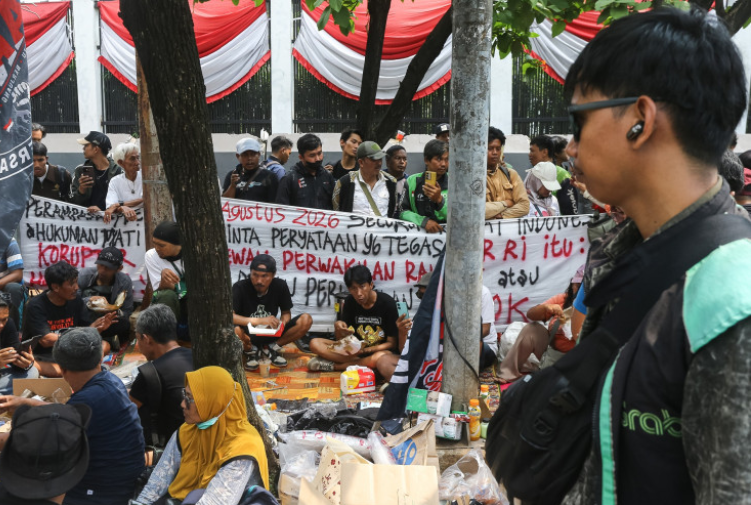
Thousands of demonstrators descended on the Senayan Legislative Complex in central Jakarta on Thursday morning, pressing lawmakers to accelerate deliberations on legislation designed to seize assets linked to corruption while simultaneously calling for capital punishment of graft offenders and relief from soaring everyday expenses. The convergence marked an escalating campaign by civil society groups to force parliamentary action on an issue that has languished for years despite broad public support for stricter anti-corruption measures.
Among the most visible contingents were activists from Pati in Central Java, who travelled under the umbrella of the United Pati People's Alliance (AMPB). This coalition had systematically mobilised supporters across several weeks, chartering buses to transport demonstrators to the capital for the coordinated day of action. The movement reflected growing grassroots frustration with the perceived sluggishness of anti-corruption efforts and government responsiveness to citizen demands for economic relief.
Authorities sought to constrain the rally's scale and disruption through multiple intervention points. Police reportedly halted buses carrying Pati residents while en route to Jakarta, while Bank Mandiri froze the account of AMPB coordinator Supriyono without immediate public explanation. These moves backfired strategically when news of the bank account blockage sparked public outcry and prompted calls for consumer boycotts of the state-owned financial institution. Rather than dampening momentum, the heavy-handed response galvanised supporters and underscored for many Indonesians the interconnection between institutional power and resistance to accountability.
The blocking measures failed to suppress participation. Supriyono announced on Wednesday afternoon that five additional buses would depart for Jakarta, funded by public donations that had flowed in following the account freeze. This spontaneous outpouring of grassroots financial support demonstrated the depth of public sentiment around both the asset forfeiture legislation and the perceived overreach of security forces attempting to obstruct protest activities.
The response from law enforcement illustrated the tension between maintaining public order and accommodating democratic expression. Jakarta Police implemented extensive traffic diversions throughout the capital on Thursday morning, cordoning off roads including both directions of Jalan Gatot Subroto from Senayan Park to the parliamentary building entrance. Dozens of armed personnel were stationed throughout the vicinity. Yet police leadership insisted they were equipped to facilitate peaceful demonstration while preserving normal commercial and educational activities in surrounding areas, with spokesman Sr. Comr. Budi Hermanto publicly appealing to protesters to avoid property damage and maintain the security and stability Indonesians depend upon.
Police estimates suggested at least 500 participants would gather, though organisers anticipated significantly higher turnout as groups beyond Pati aligned themselves with the cause. The expanding coalition reflected how the asset forfeiture issue had transcended its origins as a technical legal matter to become a focal point for broader anxieties about official corruption, economic hardship, and institutional accountability.
The asset forfeiture legislation itself represents a decades-long effort to equip Indonesian authorities with preventive tools against organised corruption. First introduced in 2008, the bill would empower the state to confiscate property suspected of deriving from criminal activity—critically, without waiting for conviction. This reversal of normal evidentiary burdens promises faster asset recovery but has alarmed legal scholars who warn of risks to due process and the potential for politically-motivated confiscation targeting opponents or enabling extortion schemes by unscrupulous officials.
Parliamentary momentum has shifted considerably since January, when the House of Representatives formally commenced drafting deliberations. By Monday, legislators had already received and met with delegations of Pati residents at Senayan, reassuring them that passage would occur by December at the latest. Habiburokhman, a Gerindra Party member chairing House Commission III with responsibility for legal affairs, publicly stated on Tuesday that the bill's remaining deliberative process would require approximately eight weeks of work, suggesting a compressed timeline compared to Indonesia's typically protracted legislative procedures.
The Prabowo Subianto administration has signalled active support for accelerated passage, with Government Communications Agency head Muhammad Qodari framing the matter as now residing squarely within the legislature's domain. This positioning allows the executive to appear responsive to anti-corruption demands while placing implementation responsibility on parliament, which faces escalating popular pressure to deliver results. For Malaysian observers, the scene illustrates how Southeast Asian publics increasingly expect their governments to translate anti-graft rhetoric into concrete legislative action, reflecting regional shifts in governance expectations and democratic participation.
The convergence of demands at Senayan—encompassing capital punishment for officials, rapid asset forfeiture legislation, and cost-of-living relief—reveals how Indonesians are linking corruption broadly to their economic welfare. Protesters view unaccountable graft as directly perpetuating poverty and inflation, making anti-corruption action inseparable from their immediate material circumstances. This cognitive linkage explains the bill's magnetic power as a protest focal point and the willingness of ordinary citizens to invest time and resources in parliamentary advocacy, even when facing official obstruction. The rapid mobilisation suggests that if parliament does not deliver on asset forfeiture passage by year-end, broader political pressure for accountability could intensify significantly.

