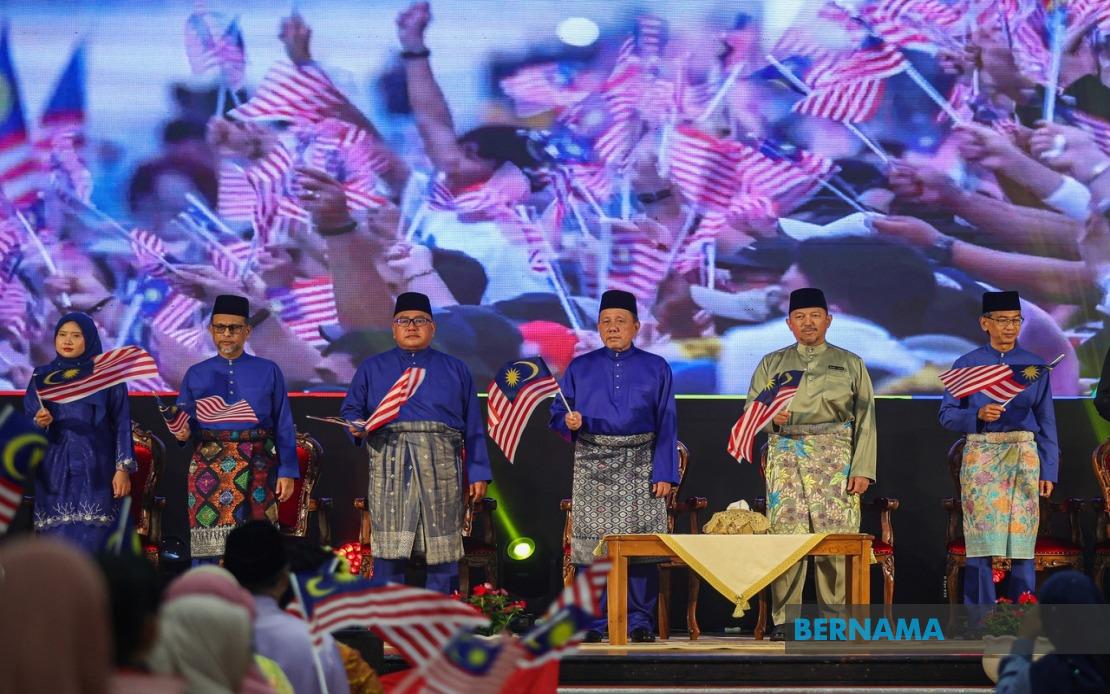
Negeri Sembilan Menteri Besar Datuk Ismail Lasim has articulated a comprehensive governing framework centred on three interconnected pillars—stability, progress and prosperity—designed to steer the state's administrative machinery and enhance service delivery across all sectors. Speaking at the state-level assembly of public servants and the launch of the Jalur Gemilang campaign in Seremban, Ismail positioned these principles as foundational to addressing the diverse needs of the state's 1.2 million residents while fostering an environment conducive to both public confidence and investor interest.
The emphasis on stability extends beyond conventional notions of political dominance, according to Ismail's remarks. Rather, the administration seeks to anchor the state through robust institutional frameworks, sound administrative protocols and political coherence that safeguard not only government operations but also the Constitutional Monarchy and associated customs that form the state's constitutional bedrock. This framing suggests recognition that investor confidence and public trust depend fundamentally on predictable governance structures and respect for Malaysia's constitutional order, both critical for a state competing for attention and capital within an increasingly dynamic Southeast Asian region.
The progress pillar transcends narrow economic metrics, as Ismail articulated during his address. Rather than measuring advancement solely through gross domestic product figures—though Negeri Sembilan's GDP grew 2.6 per cent to RM55.8 billion in the previous year from RM54.3 billion—the administration prioritizes job creation, high-quality investments and geographically balanced development. This multidimensional approach acknowledges persistent urban-rural disparities that characterise many Malaysian states, with Ismail specifically highlighting the need for Felda settlements and peripheral agricultural zones to benefit from development momentum alongside established urban centres.
Prosperity, as conceived by the state leadership, represents a deliberate commitment to distributing development gains across all demographic and geographic segments. This principle directly challenges concentration of resources in high-visibility areas and reflects awareness among Malaysian policymakers that uneven growth generates resentment, undermines social cohesion and ultimately weakens governance legitimacy. By explicitly linking prosperity to inclusive development, Ismail signals intent to address structural inequalities that have long characterised Malaysian federalism, where rural constituencies frequently lag in infrastructure, services and economic opportunity.
Financial indicators offer a foundation for assessing state performance against these aspirational frameworks. Revenue generation has reached RM522.4 million to date, positioning Negeri Sembilan toward its ambitious RM1 billion target by 2030—a trajectory requiring sustained economic expansion and improved fiscal administration. The services and manufacturing sectors have driven recent GDP growth, reflecting broader Southeast Asian economic diversification away from primary industries. For Malaysia's smallest state by area, this sectoral composition suggests successful positioning within regional value chains, though vulnerability to global cyclical downturns remains inherent to export-oriented manufacturing.
The state's newly constituted Executive Council represents a deliberate reconfiguration of administrative leadership, bringing what Ismail describes as diverse experience, renewed expertise and generational energy to governance. This institutional renewal carries implications beyond Negeri Sembilan's borders, as state-level experimentation with new governance models frequently influences federal approaches and shapes how other Malaysian states structure their administrations. The coordination between executive leadership and the professional public service becomes critical to translating these three pillars into tangible policy outcomes affecting residents' daily lives.
Competitiveness in attracting investment constitutes a central operational objective within this governance framework. Malaysian states increasingly compete against each other and against regional alternatives for manufacturing relocations, technology sector expansion and service sector investment, particularly as geopolitical tensions reshape global supply chains. Negeri Sembilan's proximity to the Klang Valley, its existing industrial infrastructure and its positioning as a gateway to southern Malaysia render it strategically positioned, yet success requires demonstration of political stability, administrative efficiency and quality governance—precisely the outcomes Ismail's three pillars are designed to ensure.
Youth employment and agricultural sector revitalisation represent cross-cutting priorities within the prosperity agenda. Malaysia's demographic profile includes substantial youth cohorts requiring economically viable pathways, while agricultural communities remain economically vital despite broader economic transitions. Rural economic development, particularly within Felda schemes and traditional farming regions, demands targeted investment in value addition, market linkages and technology adoption. These sectors collectively employ significant portions of Negeri Sembilan's workforce and generate export revenues, yet require strategic development rather than reliance on subsidy or nostalgia.
The Jalur Gemilang campaign launch during National Day celebrations reflects broader efforts to cultivate civic attachment and national identity, themes frequently emphasised by Malaysian leadership across party lines. The deployment of public servants, local authorities, businesses and residents in this patriotic exercise embeds state administration within national ceremonial frameworks and reinforces connections between government action and national purpose. For Negeri Sembilan, this initiative carries particular significance given the state's historical identity and its contemporary role within Malaysia's federal architecture.
Implementing these three pillars requires sustained inter-agency coordination and alignment between state, local and federal initiatives. Negeri Sembilan's administration operates within Malaysia's federal system, meaning numerous policy domains remain either jointly administered or primarily federal responsibility. Education, healthcare, security, customs and major infrastructure planning involve federal agencies, necessitating collaborative rather than unilateral approaches to state development. The Menteri Besar's articulation of administrative philosophy must therefore translate into effective federal-state engagement and inter-departmental coordination.
The broader context for Negeri Sembilan's governance framework reflects evolving expectations regarding state capacity and service delivery across Malaysia. Citizens increasingly demand transparency, efficiency and tangible improvements in living standards, while simultaneously scrutinising government expenditure and holding elected officials accountable through electoral competition. The three pillars articulated by Ismail represent an attempt to establish clear criteria against which public performance can be measured, thereby facilitating accountability and enabling constituents to evaluate whether announced priorities translate into experienced improvements.
Looking forward, Negeri Sembilan's development trajectory will be shaped by how effectively leadership translates these aspirational pillars into concrete policies, resource allocation patterns and institutional reforms. Economic performance, fiscal sustainability and public service quality will determine whether the state achieves its RM1 billion revenue target and whether prosperity demonstrably reaches rural and disadvantaged communities. Simultaneously, institutional stability and constitutional respect will establish whether Negeri Sembilan maintains the political predictability necessary for long-term investment planning and economic dynamism within an increasingly competitive regional environment.

