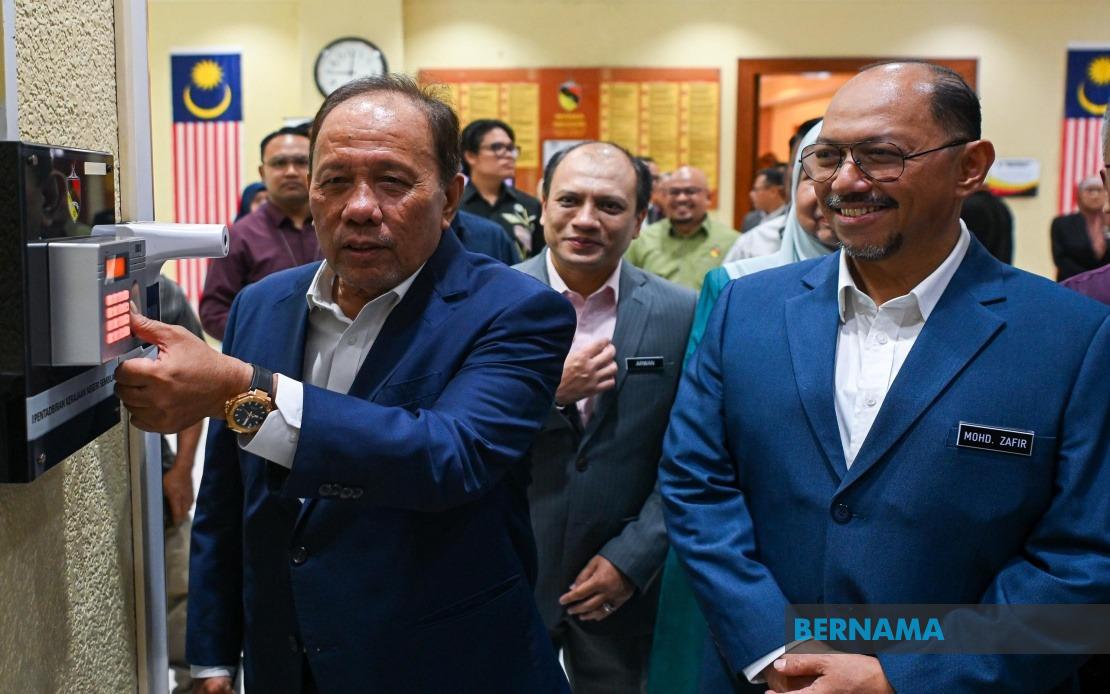
Datuk Ismail Lasim has moved swiftly to address concerns about his appointment as Negeri Sembilan Menteri Besar, asserting that the entire process adhered strictly to established protocols and constitutional requirements. Speaking shortly after assuming office at Wisma Negeri in Seremban on Monday, the newly appointed state leader expressed confidence that all procedural safeguards had been respected throughout his selection and swearing-in.
The assurance comes in response to criticism from prominent figures within the opposition camp. Tan Sri Rais Yatim, chairman of Wawasan, had publicly questioned the legitimacy of the appointment mechanism, raising allegations that external parties may have influenced decisions that should have remained within the purview of state governance and constitutional frameworks. Such challenges to the appointment process underscore the significant political sensitivities that continue to surround top government positions across Malaysian states.
Ismail's elevation to the Menteri Besar position represents a significant political development in Negeri Sembilan, a state that has traditionally served as a bellwether for broader political trends in Malaysia. The 36-seat state assembly election delivered a substantial mandate to the Barisan Nasional coalition, which secured 18 seats and established a commanding position within the legislature. This electoral outcome provided clear grounds for BN to lead the formation of the state government and select its preferred chief executive without requiring cross-coalition negotiations or support from rival political blocks.
The Perikatan Nasional coalition, which won seven seats in the same election, found itself in a considerably weaker bargaining position despite technically commanding sufficient numbers alongside BN to form a two-thirds supermajority. The distinction between these two outcomes—BN's commanding majority versus PN's peripheral role—carries important implications for understanding how Negeri Sembilan's political dynamics have evolved and what the result portends for national coalition strategies moving forward.
Ismail, who won the Juasseh state seat during the recent election, underwent formal ceremonial installation as Menteri Besar before Yang Dipertuan Besar of Negeri Sembilan Tuanku Muhriz Tuanku Munawir at Istana Besar Seri Menanti the previous Sunday. This constitutional ceremony represents the ultimate legitimising moment within Malaysia's constitutional monarchy system, where the Ruler's formal appointment provides the highest level of institutional sanction. The involvement of the Ruler in the selection process itself reflects a principle enshrined within Malaysia's constitutional architecture, whereby state Rulers retain custodial authority over appointments of this magnitude, acting as guardians of constitutional propriety.
The timing and manner of Ismail's appointment occurred against a backdrop of intensive political negotiations and coalition-building that characterised the post-election period. State elections in Malaysia frequently precipitate complex discussions among various political groupings regarding government formation, and Negeri Sembilan proved no exception to this pattern. That BN ultimately consolidated control and secured the Menteri Besar position without requiring external support reflected its clear electoral superiority across the state.
For Malaysian observers and particularly stakeholders within Negeri Sembilan itself, the controversy surrounding the appointment process raises broader questions about transparency and public confidence in governmental institutions. While Ismail's reassurances about procedural compliance may satisfy constitutional requirements, the mere fact that credible public figures felt compelled to question the process indicates lingering concerns about how top appointments are handled in contemporary Malaysia. Such concerns, even when ultimately unfounded, can subtly erode public trust in institutions and create perceptions of opacity around decision-making processes that ought to be above reproach.
The allegations of external interference, if substantiated, would represent a serious breach of constitutional conventions that insulate state governance from inappropriate influence originating beyond legitimate institutional channels. Malaysia's federal system presupposes that state governments retain autonomy over their internal affairs, subject only to the oversight functions provided by constitutional mechanisms and the Ruler's institutional role. Any circumventing of these established pathways—whether through informal pressure, financial inducements, or other coercive measures—would undermine the federalist principles embedded within Malaysia's constitutional design.
From a broader Southeast Asian perspective, the Negeri Sembilan succession dynamics warrant attention as an indicator of institutional resilience within Malaysian democracy. The manner in which states manage transitions of power, handle allegations of procedural impropriety, and maintain transparency in governance choices reflects upon the region's political maturity. Malaysia's established democratic institutions have generally weathered similar challenges effectively, but sustaining public confidence requires consistent adherence to procedural norms and genuine accountability mechanisms.
Ismail Lasim's tenure as Menteri Besar will likely be scrutinised closely by both supporters and critics seeking to validate or refute claims about the legitimacy of his appointment. His performance in office and demonstrated commitment to constitutional governance will provide tangible evidence regarding whether procedural concerns were merely partisan posturing or whether substantive governance questions exist. For a state that has historically occupied an important position within Malaysia's political economy and regional standing, the quality of leadership and institutional integrity will prove consequential for Negeri Sembilan's trajectory across the coming years.

