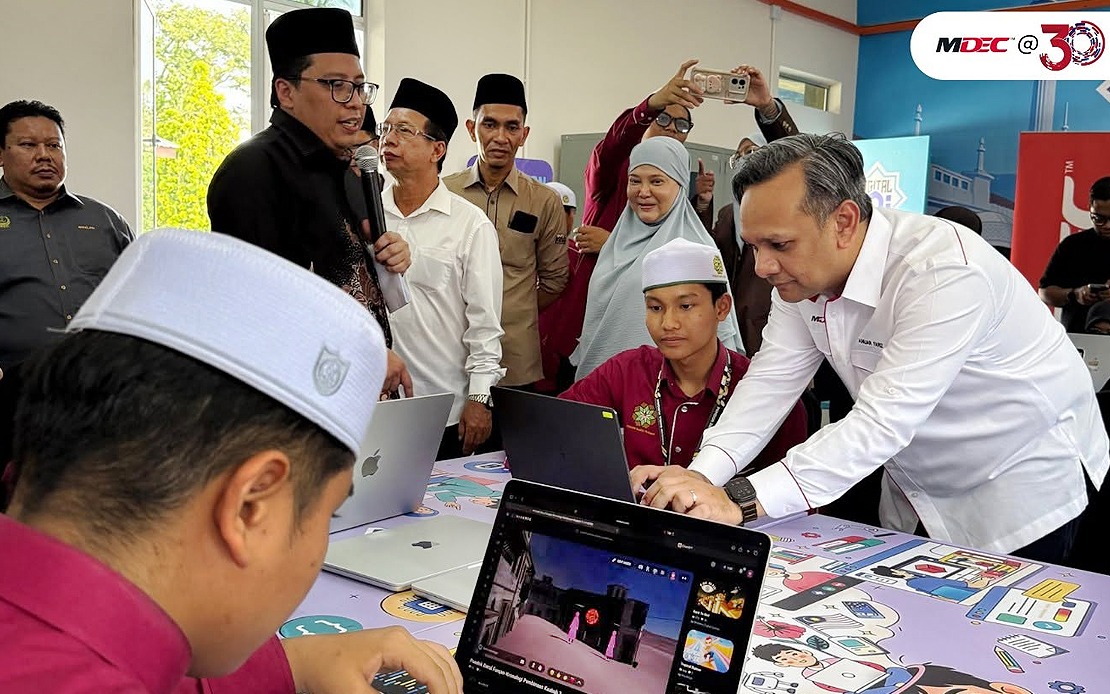
The Malaysia Digital Economy Corporation (MDEC) has formally inaugurated a Digital Maker Hub at Pondok Darul Furqan in Tambun, Ipoh, marking a significant milestone in the country's push to democratise access to modern digital capabilities within the Islamic education sector. The facility represents a strategic investment in ensuring that students and educators in religious institutions are no longer sidelined from the technological revolution reshaping Malaysia's economy and workforce landscape.
The newly established hub functions as a comprehensive learning environment outfitted with modern computing infrastructure, including personal computers, robust internet connectivity, interactive smartboards, robotics equipment, and microcontroller systems. These resources are deliberately curated to enable hands-on engagement with emerging technologies, moving beyond theoretical instruction to practical experimentation and skill acquisition. MDEC chief executive officer Anuar Fariz Fadzil underscored the importance of bridging the digital divide in educational settings, noting that meaningful participation in Malaysia's digital economy hinges on widespread exposure to technological tools from early stages of learning.
This initiative sits within the Islamic Education Institution Digital Transformation Programme, commonly referred to as Digital IPI, a collaborative framework established between MDEC and the Department of Islamic Development Malaysia (JAKIM). The programme reflects a deliberate policy choice to view Islamic education not as separate from but integral to Malaysia's broader economic modernisation goals. By embedding digital competencies into religious education frameworks, policymakers aim to create a generation of learners equipped to navigate both spiritual and technological dimensions of contemporary society.
Malaysia's strategic objective of achieving Artificial Intelligence nation status by 2030 has animated much of the government's recent digital policy architecture. However, realising this ambition requires talent development that spans all segments of the population, not merely secular institutions or urban centres. The Digital IPI programme addresses a recognised gap: Islamic education institutions, which serve tens of thousands of Malaysian students, have historically received less targeted support for technology integration compared to mainstream schools. MDEC's commitment to expanding technological access to these communities reflects a more inclusive interpretation of what nation-building in the digital age demands.
At Pondok Darul Furqan, thirty students and five teachers recently completed a two-day immersive experience through the MetaSkool Metaverse Programme, an initiative designed to introduce virtual reality and metaverse technologies in ways that emphasise creative exploration and collaborative problem-solving. Rather than treating these advanced technologies as abstract concepts, the programme employs experiential learning methodologies where participants directly engage with metaverse environments, fostering intuitive understanding and encouraging innovative thinking. This pedagogical approach mirrors global best practices in technology education, where learning emerges from doing rather than passive information reception.
The pilot phase of the Digital IPI programme extends beyond Ipoh, with five additional Islamic education institutions in Kedah, Kelantan, Negeri Sembilan, Pahang, and Penang designated to receive identical Digital Maker Hub installations. This geographic distribution across Malaysia's peninsular regions suggests a deliberate strategy to ensure equitable access rather than concentrating resources in economically developed urban areas. The multi-state rollout also acknowledges the linguistic and cultural diversity within Malaysia's Islamic education ecosystem, with different institutions serving distinct communities and potentially requiring customised support.
Prime Minister Datuk Seri Anwar Ibrahim launched the broader Digital IPI framework in March, signalling executive-level commitment to this educational transformation agenda. The programme operates at substantial scale, targeting more than three thousand students and fifty educators through structured curricula addressing multiple competency domains. Training modules encompass digital literacy fundamentals alongside artificial intelligence awareness, digital creativity techniques, immersive technology applications, metaverse platforms, and digital content production. This multi-faceted approach recognises that technology readiness involves both foundational competencies and emerging-frontier skills.
The integration of values-based learning with technological instruction represents an important philosophical dimension of Digital IPI. Rather than presenting technology and religious education as potentially conflicting domains, the programme explicitly seeks to harmonise them through principles such as trustworthiness and ethical practice. This values-infused approach to digital transformation acknowledges that sustainable technological adoption requires not merely technical proficiency but also moral reasoning about technology's purposes and impacts. For Islamic education institutions, embedding these value dimensions into digital learning creates coherence with their foundational missions.
For Malaysia's broader digital economy aspirations, the expansion of technological literacy within Islamic education institutions carries significant implications. These schools and pesantren represent reservoirs of student talent that have historically been underutilised in discussions of Malaysia's digital workforce pipeline. By investing in digital capability-building among these populations, the country expands its pool of potential talent for technology-driven sectors and entrepreneurship. Moreover, students from Islamic education backgrounds who gain genuine fluency with advanced technologies can better challenge stereotypes and contribute diverse perspectives to Malaysia's technology communities.
The Digital Maker Hub model also suggests possibilities for knowledge-sharing and resource efficiency across Malaysia's fragmented education landscape. Rather than expecting every institution to independently procure and maintain sophisticated equipment, the hub approach allows concentrated investment in shared facilities that can serve cohorts of learners. This is particularly practical for Islamic education institutions, many of which operate with constrained budgets and face genuine infrastructure limitations. The MDEC partnership effectively transfers some financial burden from individual institutions to the national digital economy agenda.
Looking forward, the success of Digital IPI at institutions like Pondok Darul Furqan will likely influence how Malaysia approaches technology integration across other specialised education sectors, from vocational training to alternative schooling models. The programme demonstrates that meaningful digital transformation requires tailored approaches acknowledging institutional context rather than one-size-fits-all solutions. Southeast Asian neighbours observing Malaysia's Islamic education digitalisation effort may similarly recognise opportunities to extend technology access to religious education systems within their own countries, potentially creating regional momentum for more inclusive digital development.
The initiative ultimately reflects an understanding that Malaysia's competitiveness in regional and global digital markets depends not on concentrating technological advantage among privileged populations but on building genuinely broad-based digital capability. Students and teachers at Pondok Darul Furqan and partner institutions now possess tangible tools and knowledge to participate actively in Malaysia's digital economy, translating national strategic ambitions into lived educational reality.

