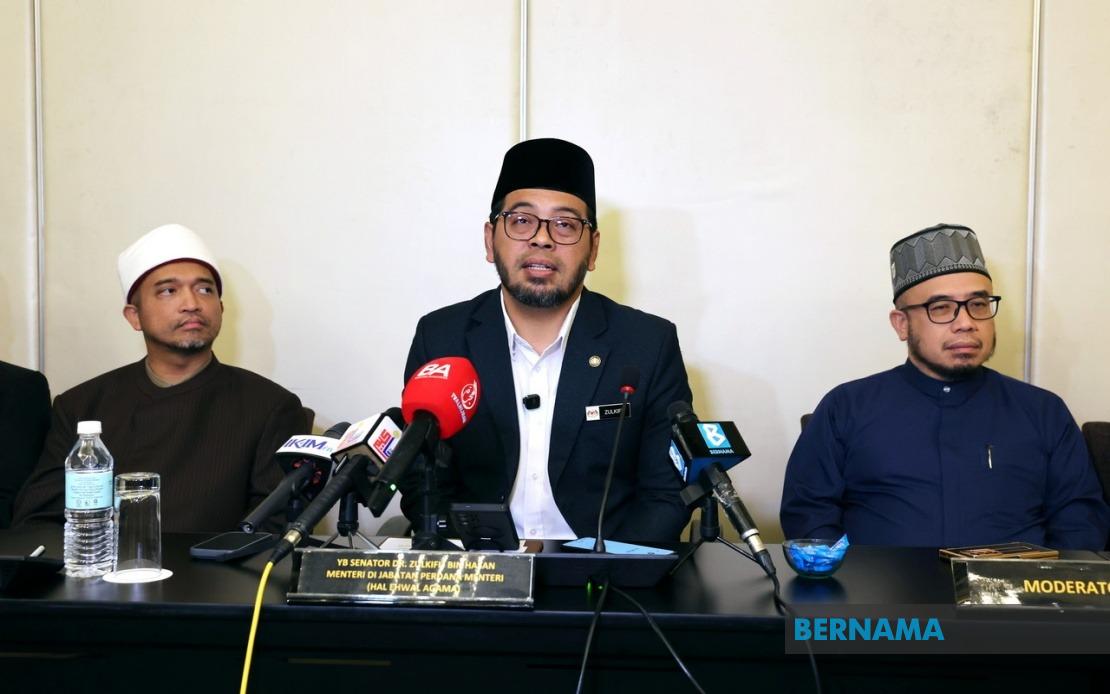
Dr Zulkifli Hasan, Minister in the Prime Minister's Department (Religious Affairs), has moved to curtail the application of the Islamic legal term 'kafir harbi' within Malaysia, asserting that the designation carries no legitimate place in a nation where citizens are bound together by constitutional frameworks and common civic duty. His statement came following a structured roundtable discussion convened in Putrajaya specifically to examine the controversial terminology and its implications for Malaysian society.
The minister's position reflects a broader governmental stance that citizenship itself creates an overarching bond transcending religious categorisations. Since all Malaysian citizens operate within the jurisdiction of the Federal Constitution, Zulkifli argued, the historical Islamic legal classification—which traditionally refers to non-Muslims in territories at war with Islamic states—becomes conceptually and legally redundant. This framework emphasises that national identity and constitutional compliance form the primary basis for rights, responsibilities, and social standing in Malaysia rather than religious status.
Zulkifli elaborated on the consensus emerging from the roundtable, stressing that participants concluded the terminology fundamentally misaligns with contemporary Malaysian reality. The discussion encompassed multiple stakeholder perspectives, generating what he characterised as broad agreement that such categorisations undermine the integrated national identity Malaysia has constructed since independence. His assertion that "we are all part of one society and fellow citizens sharing the same homeland" encapsulates the governmental argument that internal distinctions based on religious law have no validity within the Malaysian constitutional order.
The minister's emphasis on shared responsibility for national development and defence signals an attempt to reframe national belonging around concrete contributions to the country rather than theological classifications. By highlighting that Malaysians collectively bear responsibility for "defending and developing this nation," Zulkifli positioned citizenship as an active, unifying principle that supersedes sectarian divisions. This approach seeks to anchor national cohesion in tangible, secular frameworks of governance and mutual obligation rather than religious jurisprudence.
Recognising that religious terminology cannot be effectively countered through religious discourse alone, Zulkifli announced that the Department of Islamic Development Malaysia (JAKIM) would coordinate with multiple government agencies and ministries to mount an information campaign addressing the issue. This inter-agency strategy acknowledges that clarifying Malaysia's constitutional and social position requires sustained effort across institutional boundaries, not merely pronouncements from religious authorities. The collaborative mechanism signals governmental determination to ensure that such terminology does not gain institutional acceptance or wider societal circulation.
The minister stressed that public awareness initiatives must operate across sectoral lines, extending beyond religious institutions into broader civil society structures. This approach recognises that efforts to strengthen national integration cannot succeed if confined solely to the religious establishment; instead, education ministries, local authorities, media regulators, and community organisations all require involvement in articulating Malaysia's constitutional identity. The emphasis on comprehensive implementation underscores official concern that piecemeal or isolated responses might prove insufficient against the spread of divisive terminology.
Zulkifli's call for Malaysians to intensify unity-building efforts framed the initiative within a positive vision of national development rather than as mere prohibition. By appealing to shared aspirations for "stronger unity" and mutual respect across religious and cultural boundaries, the minister attempted to position the rejection of 'kafir harbi' categorisation as part of a constructive national project rather than as religious censorship. This rhetorical strategy seeks to gain broader acceptance by connecting the terminology issue to widely-held aspirations for social cohesion.
The underlying tension revealed by this statement concerns competing visions of Islamic authority and practice within a multi-religious constitutional democracy. While some Islamic scholars and activists may maintain that 'kafir harbi' represents legitimate Islamic jurisprudential categories applicable regardless of jurisdiction, the government's position asserts that constitutional citizenship creates a framework within which such classical Islamic legal categories lose practical relevance. This constitutes a significant statement about how Malaysia reconciles Islamic religious law with secular constitutional governance.
The timing and prominence of Zulkifli's remarks suggest that usage of 'kafir harbi' terminology had become sufficiently prevalent or concerning to warrant high-level governmental intervention. The formality of a structured roundtable discussion and subsequent public statement indicates that this was not merely a passing controversy but reflected genuine concern about the terminology's potential to inflame communal tensions or undermine official narratives of constitutional unity.
For Malaysian citizens and observers of Southeast Asian religious politics, this development illustrates how governments navigate tensions between protecting religious expression and maintaining secular constitutional frameworks. Zulkifli's position does not ban the term outright but rather delegitimises its application within the Malaysian context through appeals to constitutional principle and shared citizenship. This softer approach may prove more durable than outright prohibition, as it grounds the rejection of divisive terminology in fundamental constitutional principles that command broader consensus. The initiative reflects Malaysia's ongoing effort to construct a national identity wherein religious diversity coexists with stable, secular governance structures—a challenge shared across the region.

