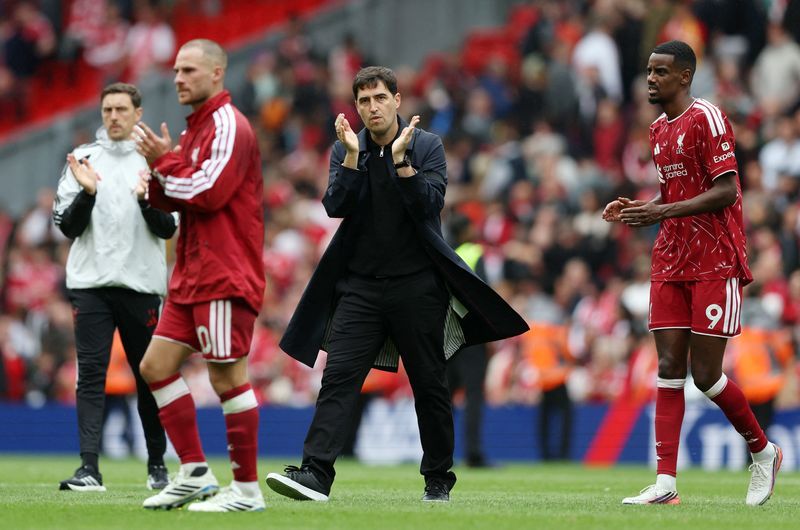
Andoni Iraola has yet to secure a Premier League victory since taking the Liverpool helm this summer, but the Spanish tactician drew encouragement from his team's performance in Saturday's 2-2 stalemate against Nottingham Forest, believing the architectural foundations of his ambitious remodelling project are beginning to solidify. The former Bournemouth manager arrived at Anfield tasked with reviving a club that endured a humbling season last year, finishing fifth despite unprecedented investment of £446 million in new talent, a sharp decline from their previous domestic championship-winning campaign.
Liverpool's trajectory under Iraola represents a marked philosophical departure from the methodical, deliberate approach of his predecessor. Where the previous regime emphasised control and precision, Iraola advocates for aggressive pressing, rapid ball circulation, and sustained attacking pressure—a strategic framework that harks back to the intensity supporters experienced during Juergen Klopp's reign. This stylistic pivot is not merely cosmetic; it reflects a fundamental belief that Liverpool's recent underperformance stemmed partly from a loss of the relentless competitive edge that once made Anfield an intimidating destination for visiting teams across Europe.
However, the transition from theory to consistent execution remains incomplete. Against Forest, Liverpool's defensive vulnerabilities were exposed early when Dan Ndoye capitalised on a direct counterattack to put the visitors ahead. The opening half saw prolonged passages of laboured play that clearly frustrated Iraola from the technical area, with his side appearing disjointed and lacking the urgency he demands. The manager's post-match analysis was characteristically direct, acknowledging that his players' passive approach without possession was the principal culprit behind their sluggish start.
The transformation in the second period, by contrast, vindicated Iraola's blueprint and provided genuine hope for supporters anxious about their club's faltering campaign. Liverpool's intensity markedly increased, creating a noticeably faster tempo and more purposeful build-up play. Alexander Isak restored parity shortly after the hour, before substitute Victor Munoz delivered an improbable late equaliser to secure the draw. The recovery from a losing position echoed Liverpool's previous outing against Newcastle six days earlier, when Munoz had struck the crucial penalty that salvaged another 2-2 outcome.
Munoz's early impact has not gone unnoticed by Iraola, who lavished praise on the winger's tireless running and offensive threat despite the imperfection of his performances. The manager highlighted both Munoz's attacking contributions and his defensive work rate as emblematic of the mentality he is attempting to instil throughout the squad. This willingness to defend from the front—a cornerstone of modern pressing systems—signals the cultural shift Iraola hopes to embed at a club seeking to reclaim its place among English football's elite.
Beyond individual performances, Iraola has identified a systemic pattern that must be rectified: Liverpool's propensity for sluggish starts. This concerning habit, inherited from last season's disappointing campaign, poses a significant tactical challenge that extends beyond personnel changes. The manager's analysis suggests the problem originates from passive positioning when Liverpool do not control the ball, with players maintaining excessive distance from opponents and becoming complacent in their marking responsibilities. Only when Iraola's intensity demands are executed—through aggressive pressing that disrupts possession and generates more turnovers—does Liverpool's attacking productivity flourish.
Despite the absence of victories, tranquility prevails at Anfield rather than panic. Iraola has repeatedly communicated that his tactical system requires an acclimatisation period, with players needing time to absorb and execute the physical and mental demands of high-pressing football. Three points remain the ultimate currency in professional football, yet even Iraola acknowledges the growing entertainment value and structural improvements evident in recent displays, particularly second-half performances where his methods have borne fruit through sustained attacking pressure and recovered positions.
Reinforcement through the transfer market is anticipated to accelerate Liverpool's integration of Iraola's philosophy. British media outlets report that Liverpool have finalised terms to acquire France international Bradley Barcola from Paris Saint-Germain, with the 23-year-old winger's explosive pace and direct running style considered ideally suited to the manager's high-tempo attacking approach. Barcola's directness should alleviate some of the laboured build-up play that characterised Liverpool's first-half struggles against Forest, offering an additional avenue for penetrative, quick transitions.
The challenge facing Iraola remains one of sustaining second-half intensity across full matches rather than merely improving after half-time adjustments. While his tactical vision appears sound and player recruitment continues to align with his requirements, the manager must convince his squad that the aggressive, relentless press from minute one yields superior results to gradual escalation. For Malaysian and Southeast Asian observers of the Premier League, Iraola's early tenure exemplifies the broader challenge facing ambitious managers attempting to implement systemic change at elite institutions: patience and incremental improvement must eventually translate into tangible success, or even well-intentioned tactical evolution risks becoming perceived as insufficient.
Iraola's frustration was evident in his post-match remarks, capturing the tension between encouraging signs and disappointing outcomes. Two consecutive draws represent only marginal progress on the points table, yet the philosophical framework and attacking urgency displayed in second halves suggest the architecture of future success is gradually materialising. Should Liverpool fail to convert improved performances into victories in coming weeks, however, the goodwill granted to managers undertaking structural overhauls can erode swiftly in the unforgiving environment of elite-level football.

