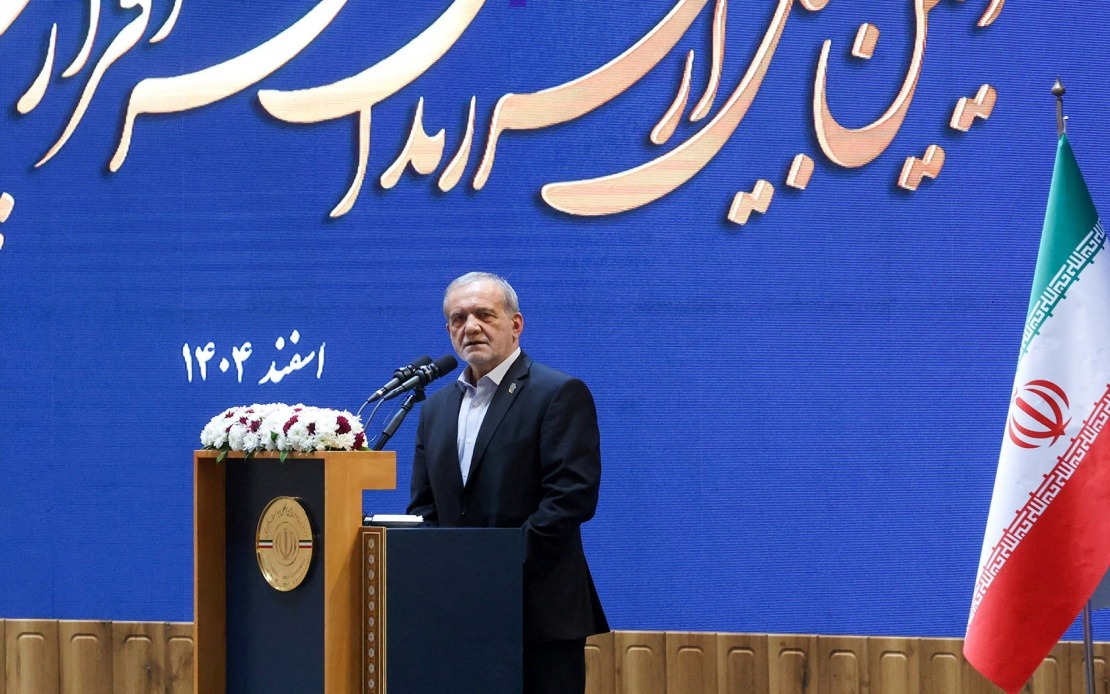
Iranian President Masoud Pezeshkian has rejected suggestions that his government would surrender ground in negotiations, instead calling for an urgent resolution to the prolonged uncertainty that has gripped the region since early this year. Speaking at an event in Istanbul on Saturday, Pezeshkian characterised Iran's predicament as a fraught middle ground between war and peace—one that offers the worst of both scenarios while benefiting neither the country's security nor its economic prospects.
The Iranian leader framed the current standoff as economically corrosive, emphasising that the perpetual threat of renewed conflict deters foreign investors and undermines confidence in Iran's stability. His remarks suggest that while Tehran remains committed to defending its interests and deterring potential adversaries, it recognises that prolonged brinkmanship carries substantial costs that extend far beyond military considerations. This acknowledgment reflects a pragmatic assessment of how geopolitical tension intersects with Iran's broader development challenges at a time when the country faces international sanctions and capital constraints.
Pezeshkian stated that Iranian officials engage in near-constant deliberation on pathways beyond the present quagmire, with an eye toward reaching accommodations that would safeguard Iran's core principles and values while simultaneously raising the costs for any actor considering military action against the Islamic Republic. This dual objective—protecting sovereignty while opening space for dialogue—represents a calibrated approach to negotiations that balances deterrence with openness to resolution. The president's framing suggests that Tehran views strength and negotiation not as contradictory but as complementary dimensions of statecraft.
The context for these remarks centres on a memorandum of understanding that Iran and the United States concluded in June, mediated through the diplomatic channels of Pakistan and Qatar. That agreement marked a pause in hostilities that had escalated sharply in February, introducing a temporary ceasefire while signalling willingness to pursue a more comprehensive accord. However, the mechanism has proven fragile, with implementation disputes and disagreements over shipping security arrangements in the Strait of Hormuz—a chokepoint through which roughly one-fifth of global maritime oil and gas traffic transits—stalling further progress.
For Malaysian and Southeast Asian observers, the significance of these developments lies partly in the Strait of Hormuz's criticality to regional energy security and supply-chain stability. Disruptions or renewed conflicts in that waterway ripple through global energy markets and shipping logistics, affecting economies across Asia that depend on uninterrupted supplies of hydrocarbons and manufactured goods. Malaysia, as an energy-producing nation itself and a major maritime trader, has a vested interest in regional predictability and the safe passage of vessels through international waters.
Pezeshkian took pains to defend the June memorandum against what he characterised as mischaracterisations, asserting that the agreement imposed no surrender of Iranian positions and demanded no substantive concessions from Tehran. This defensive posturing reflects sensitivity within Iran's political establishment to domestic criticism that any negotiated settlement might be perceived as weakness or betrayal of revolutionary principles. By publicly insisting that the memorandum preserves Iranian agency and interests, Pezeshkian is signalling both to international interlocutors and to domestic constituencies that his government negotiates from conviction, not capitulation.
The stalling of talks over implementation details and maritime security arrangements highlights the technical and political complexity of translating broad ceasefire agreements into binding protocols. Disputes over how shipping through the Strait of Hormuz would be monitored, secured, and governed reflect deeper asymmetries in how Iran, the United States, and Gulf states view regional order and mutual assurance. These frictions suggest that moving from temporary de-escalation to durable settlement requires not merely political will but also creative institutional design and confidence-building measures that have thus far proven elusive.
Iran's insistence on deterrence and strength as preconditions for stability reflects its historical experience of vulnerability and external intervention. From Tehran's perspective, a credible defensive capability is not an obstacle to peace but a prerequisite for it, because without such capability any agreement could be voided by adversarial action. This logic underpins the apparent paradox in Pezeshkian's position: rejecting concessions while simultaneously advocating for resolution. The presidency views these not as contradictory but as essential components of a stable regional order.
The economic dimension that Pezeshkian emphasised deserves particular attention, as it reveals how prolonged geopolitical tension erodes state capacity independent of actual warfare. Capital flight, currency instability, and reluctance by foreign firms to invest or operate in Iran compound the effects of international sanctions and structural economic challenges. A government that can restore predictability and reduce the perceived risk of renewed conflict would unlock investment opportunities and potentially ease some inflationary pressures stemming from currency volatility and capital constraints.
Looking ahead, Pezeshkian's rhetoric suggests that Iran may be signalling readiness for intensified diplomatic engagement, provided that Western parties—particularly the United States—match Iran's willingness with concrete movement. The president's framing of the status quo as untenable for all parties involved constitutes an implicit appeal for reciprocal compromise, though without specifying what concessions Tehran itself might entertain. The challenge for international mediators and the parties directly involved remains bridging the gap between these broad statements of principle and the specific, often technical agreements that would constitute a genuine settlement.

