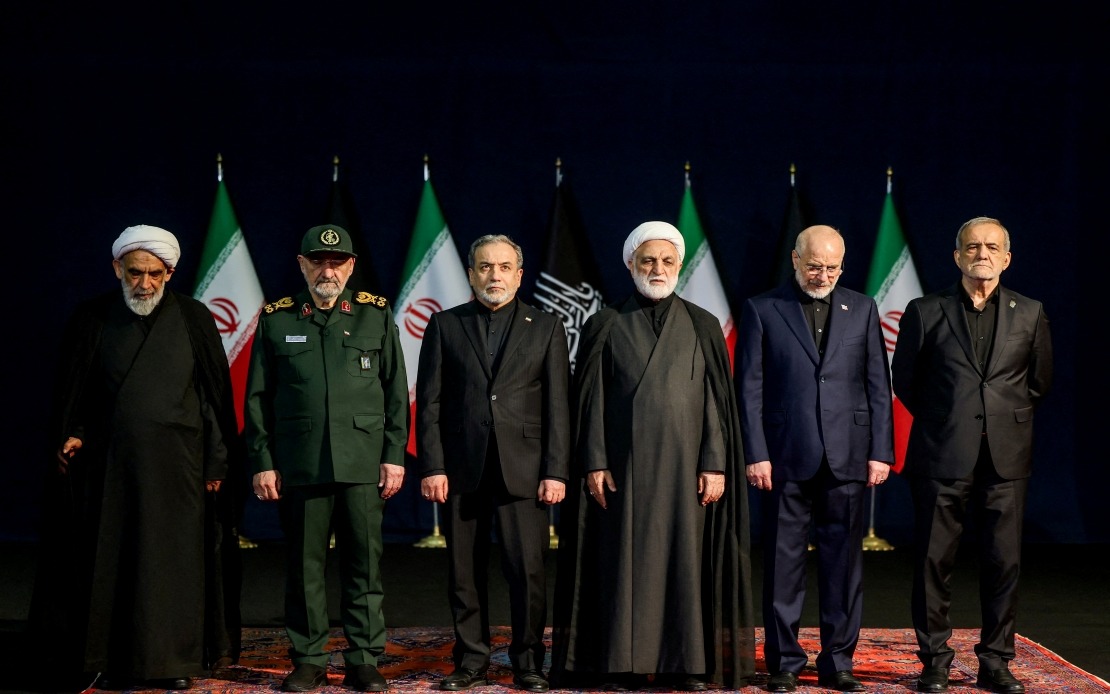
Tehran's Imam Khomeini Mosalla prayer hall filled with dignitaries and mourners on Friday as Iran began its formal farewell to Supreme Leader Ayatollah Ali Khamenei, whose death has triggered a succession of significant political and diplomatic moments across the Middle East and beyond. The tribute ceremony, which extended throughout the day, drew an unusually broad spectrum of international attendees, underscoring the regional importance of Iran's leadership transition and the geopolitical implications rippling outward from Tehran.
Iran's own power structure was represented at full strength. President Masoud Pezeshkian, Parliament Speaker Mohammad Baqer Qalibaf, Judiciary Chief Gholamhossein Mohseni-Ejei, and Sadeq Amoli Larijani, who chairs the Expediency Discernment Council, all attended the ceremony. Their unified presence signalled institutional continuity and a consolidated domestic response to the succession crisis, even as the Iranian system undertook one of its most consequential transitions since the 1979 revolution.
The international delegation reflected Iran's complex web of regional and great-power relationships. Pakistan sent its Prime Minister Shehbaz Sharif alongside Chief of Army Staff Field Marshal Syed Asim Munir, demonstrating Islamabad's strategic interest in stabilising ties with its neighbour and competitor. Armenia's Prime Minister Nikol Pashinyan, Georgian President Mikheil Kavelashvili, and Iraqi President Nizar Amedi all travelled to Tehran, each representing distinct diplomatic calculations rooted in their respective proximity and interests in Iran's stability. Tajikistan's President Emomali Rahmon and Nechirvan Barzani, who leads Iraq's Kurdistan Region, similarly recognised the symbolic importance of the moment.
Perhaps most notably, senior delegations from China and Russia attended, reinforcing the strategic partnerships that have deepened in recent years amid mutual isolation from Western-led international frameworks. For Beijing and Moscow, the ceremony represented an occasion to demonstrate solidarity with Tehran at a moment of perceived vulnerability, while simultaneously signalling their commitment to a multipolar global order resistant to Western dominance. Religious scholars, clerics, and tribal leaders rounded out the attendees, reflecting the deeply rooted role of religious authority within Iran's political and social fabric.
The circumstances surrounding Khamenei's death remain a matter of acute regional sensitivity. Iranian authorities attribute his killing to a joint United States and Israeli military strike that occurred in Tehran on February 28, an assertion that underscores the intense security pressures Iran faces and the direct role played by external powers in shaping its political trajectory. The strike itself represented a dramatic escalation in the long-running conflict between Iran and its adversaries, particularly Israel, and highlighted the vulnerability of even the most senior Iranian leaders despite the country's sophisticated security apparatus.
The succession mechanics have already advanced with striking speed. In March, Mojtaba Khamenei, the late Supreme Leader's son, was selected to assume the position. This dynastic succession, while maintaining institutional continuity within Iran's clerical establishment, also raises questions about legitimacy and the extent to which the Islamic Republic's founding principle of rule by the most qualified religious scholar remains operative. For regional observers, including Southeast Asian nations with expanding ties to Iran, the question of how the new leadership will recalibrate foreign policy remains open.
Iran has structured the mourning period to extend through July 9, with carefully choreographed processions planned for Tehran, Qom, and Mashhad—three cities of immense religious and symbolic importance within Iranian Shia Islam. Additional rites will be conducted in Iraq, where Iran maintains substantial religious, political, and military influence. These multi-city ceremonies serve both domestic and external audiences: they allow the Iranian population to collectively process the loss of a figure who shaped their national life for decades, while simultaneously projecting to the international community an image of institutional resilience and religious legitimacy.
Tehran and Mashhad have already been placed under public closure orders and airspace restrictions on designated dates, with Thursday declared a national day of mourning. Such measures illustrate the gravity with which the Iranian state treats this transition and its concern for managing the emotional and security dimensions of a succession that touches not merely governmental mechanics but the spiritual foundations of Iran's political system. The restrictions also reflect practical security concerns, given the international tensions surrounding Iran's leadership and the potential for hostile actions during a period of internal focus and vulnerability.
For Malaysia and other Southeast Asian nations, Iran's succession carries implications primarily through energy markets, shipping lanes, and the broader regional stability upon which global commerce depends. As ASEAN members navigate complex relationships with both Iran and its Western adversaries, understanding how Mojtaba Khamenei and his advisors recalibrate Iran's strategic posture—whether toward greater assertiveness or pragmatic accommodation—will shape diplomatic calculations and economic planning across Southeast Asia in coming years. The breadth of international attendance at this ceremony suggests that the international community, while divided on many Iranian questions, shares a common interest in ensuring an orderly and stable transition at Iran's helm.

