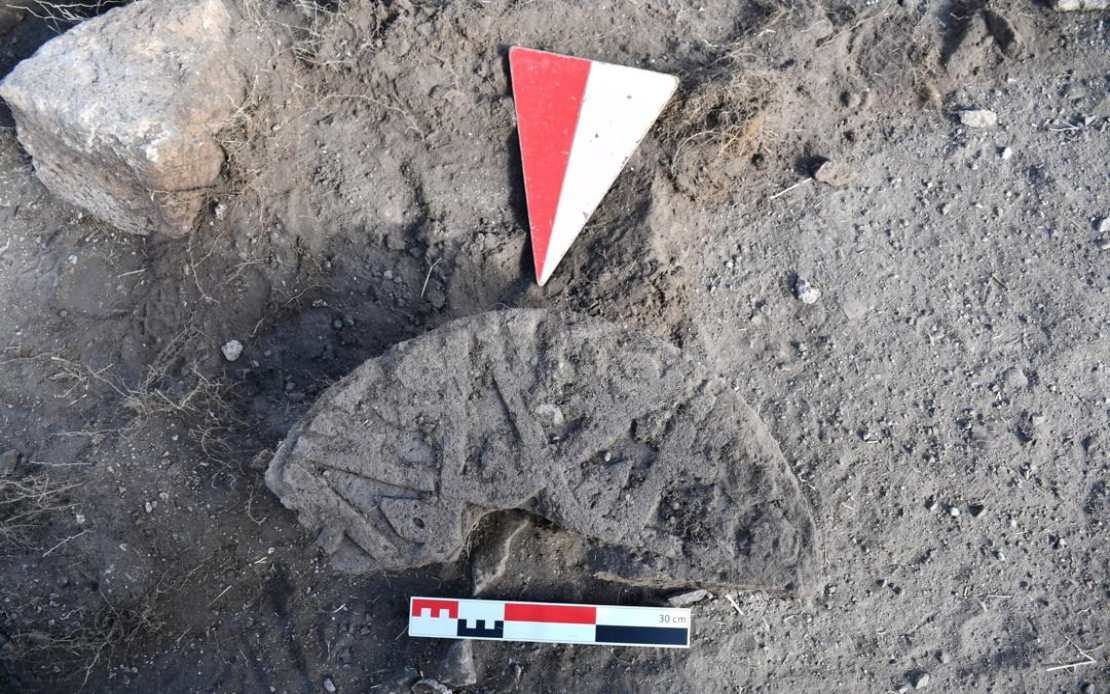
Archaeologists working at Ani, one of Türkiye's most significant historical sites, have uncovered a stone artefact of considerable religious and historical importance bearing multiple inscriptions of Prophet Muhammad's name. The discovery, made during ongoing excavations in a Seljuk cemetery, represents a notable addition to the body of evidence documenting the region's rich Islamic heritage. Turkish Culture and Tourism Minister Mehmet Nuri Ersoy announced the finding through social media, highlighting the artefact's intricate calligraphy and its contributions to understanding medieval settlement patterns in this strategically important area.
The inscribed stone displays the sacred name rendered in Kufic script, one of the earliest and most revered forms of Arabic writing. According to Ersoy's description, six instances of the name appear across the surface, with three carved into an ornate band that encircles an eight-pointed star, a geometric motif commonly found in Islamic art. The remaining three inscriptions presumably occupy other sections of the stone, though fuller technical details have yet to be released by Turkish authorities. This decorative arrangement suggests the artefact served a ceremonial or commemorative function rather than purely practical purposes.
The stone is thought to have originated from a Seljuk tomb tower, a vertical structure built as a burial monument for elite members of society. Such towers, which became prevalent across the Seljuk empire stretching from central Asia to the Mediterranean, frequently bore religious inscriptions and architectural ornamentation that reflected both the status of the deceased and the broader cultural values of the period. The Seljuk dynasty, which dominated Anatolia from the late eleventh century onwards, was known for synthesising Byzantine, Persian, and Arab architectural and artistic traditions into a distinctive regional style.
The discovery emerged from systematic archaeological work at a Seljuk cemetery that researchers have been studying since 2021. This multi-year project reflects the Turkish government's sustained commitment to documenting and understanding the medieval layers of the Ani site. Cemeteries are particularly valuable to archaeologists because they contain multiple burial contexts that can be examined in sequence, allowing scholars to track changes in burial practices, religious expression, and social hierarchies across generations. The continuous nature of this research programme suggests further significant finds may yet emerge.
Ani itself occupies a position of exceptional historical importance for understanding medieval Eastern Anatolia and the broader Silk Road network. Situated in Kars province near the Turkish-Armenian border, the settlement commanded a crucial junction for trade routes connecting the Mediterranean world with Central Asia, China, and the Indian subcontinent. The city flourished most notably during the tenth and eleventh centuries when it served as the capital of the Bagratid Armenian kingdom, a period during which its population may have exceeded 100,000 people, making it one of the world's great medieval cities. The architectural remains from this Armenian period represent some of the finest examples of medieval Armenian church building.
Following the decline of Bagratid Armenian rule, Ani experienced successive waves of conquest and settlement. Byzantine forces annexed the city in the eleventh century, but Seljuk Turkish armies wrested control in 1064, beginning an extended period of Islamic rule. The Seljuks maintained Ani as an administrative and commercial centre, though its importance gradually diminished as trade routes shifted and new urban centres emerged. Ottoman control eventually followed, and the city was ultimately abandoned, probably in the early modern period due to a combination of economic decline and environmental stresses.
The archaeological significance of the discovered stone extends beyond its artistic qualities to what it reveals about religious practice and cultural identity during the Seljuk era. Inscriptions bearing Prophet Muhammad's name on tomb structures served multiple functions: they invoked divine blessing upon the deceased, demonstrated the family's piety and integration into Islamic society, and created a permanent record of religious commitment visible to living visitors. The sophistication of the carving indicates access to skilled craftsmen familiar with Islamic calligraphic traditions, suggesting the deceased held considerable wealth or status within Seljuk Ani's social hierarchy.
The artefact also carries significance for contemporary understanding of religious coexistence in medieval Anatolia. Although Seljuk rule was Islamic, Armenian Christians and other religious communities continued inhabiting Ani and contributing to its material culture. The discovery of this Seljuk religious monument thus illustrates how different communities, while maintaining distinct identities and traditions, inhabited shared urban spaces and participated in a complex medieval society. This archaeological evidence counters simplistic narratives of religious conflict and demonstrates the genuine multicultural character of medieval cities.
Ani received designation as a UNESCO World Heritage Site in 2016, recognition that reflected international acknowledgment of its extraordinary historical and architectural value. This status has elevated the profile of archaeological work at the location and secured increased resources for research and conservation. The recent discovery demonstrates how UNESCO designation can catalyse more intensive scholarly investigation, as the protection and international attention associated with World Heritage status encourages comprehensive documentation of remaining structures and deposits.
For Malaysian and Southeast Asian audiences, this discovery carries relevance beyond academic interest in medieval Islamic art and history. It exemplifies how archaeological investigation reveals the deep historical roots of Islamic civilisation in regions far removed from the Arabian Peninsula, illuminating how Islamic traditions spread and were adapted across diverse geographical and cultural contexts. The Seljuk empire's achievements in synthesising multiple cultural traditions offer lessons in cultural exchange and adaptation that resonate with Southeast Asia's own experience as a region where different religious and cultural influences have historically coexisted and merged.
The find also underscores Türkiye's continued investment in archaeological research and heritage preservation. As a nation positioned at the intersection of European and Asian history, Türkiye recognises that its archaeological wealth attracts international scholarly attention and supports cultural tourism. The systematic excavation programmes at sites like Ani generate not only academic publications and museum exhibits but also sustained public engagement with history. For other nations in the Eastern Mediterranean and Islamic world regions, including Malaysia and Indonesia with their own rich archaeological heritage, the Turkish model of combining state support with international collaboration offers instructive approaches to heritage management.
Turkish authorities have indicated that additional artefacts from the Seljuk cemetery continue to emerge as excavations proceed. The methodical pace of the investigation, conducted over multiple seasons, reflects best practices in archaeological methodology that prioritise careful documentation and contextual analysis over rapid extraction of objects. This approach ensures that future researchers can examine not merely individual items but the broader patterns of settlement, belief, and social organisation that such artefacts illuminate. The inscribed stone, therefore, represents not merely an isolated discovery but part of an ongoing systematic effort to recover and interpret the material evidence of Ani's cosmopolitan medieval past.

