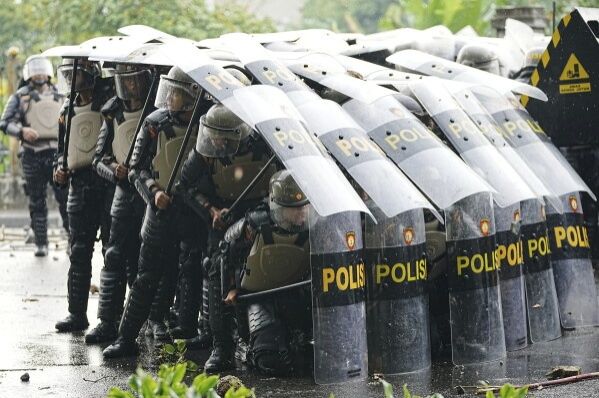
Indonesia's security establishment faces mounting scrutiny following coordinated police raids across Jakarta that have exposed deep institutional fissures, with the discovery of substantial assets at the residence of one of the country's most powerful anti-corruption prosecutors raising uncomfortable questions about oversight and accountability within the nation's leadership ranks. The raids, conducted this week across multiple locations in and around the capital, represent a significant escalation in investigations into corruption and money-laundering activities, drawing heightened attention to how Indonesia's fractious security agencies interact when high-profile cases demand their concurrent involvement.
The scope of the police operations has been substantial. Investigators recovered rupiah and foreign currency totalling more than $3 million from a concealed safe at a South Jakarta restaurant and an adjacent money-changer facility, according to state news agency Antara. More significantly, police discovered 74 kilograms of gold bars alongside cash and multiple foreign currencies—collectively valued at approximately $26.3 million—secured within seven suitcases at a house in South Jakarta belonging to Febrie Adriansyah, the Deputy Attorney General for Special Crimes. The scale of the seizures underscores the investigative momentum behind what officials have characterized as a multi-faceted corruption and money-laundering inquiry.
Febrie's position within Indonesia's judicial hierarchy makes the developments particularly consequential. As head of the Attorney General's Office unit responsible for high-profile graft prosecution, he has overseen investigations touching some of Indonesia's largest state enterprises and most prominent political figures. His mandate encompasses corruption probes into state miner Timah, Pertamina, Garuda Indonesia, and previously involved examinations of affairs connected to former education minister Nadiem Makarim and President Prabowo Subianto's flagship free-meals initiative. His professional standing rests substantially on the credibility and perceived independence of Indonesia's anti-corruption apparatus, making any personal scrutiny fraught with institutional implications.
The injection of military personnel into the situation has crystallized anxieties about institutional boundaries and civilian supremacy. Armed military forces subsequently deployed to Febrie's Jakarta residence, ostensibly at the Attorney General's Office's request and purportedly justified by protective protocols for prosecutors. This move has ignited concern among observers and human rights advocates, who worry that military involvement in civilian law enforcement operations—particularly those targeting senior government officials—represents a troubling precedent that could undermine the separation of powers that theoretically governs Indonesia's security sector.
Febrie has responded by acknowledging ownership of the property where assets were discovered whilst categorically denying any connection to the seized materials. He has indicated that the Attorney General's Office respects the investigative process and anticipates police findings. His statement emphasizes the importance of preserving the presumption of innocence and cautions against premature conclusions drawn from media reportage or social media speculation. This careful rhetorical positioning reflects the delicate institutional position in which he finds himself—simultaneously maintaining professional authority whilst facing investigative scrutiny.
The police have framed their operations as evidence-gathering across three distinct investigative tracks. The first concerns alleged irregularities in coal procurement and supply arrangements with power plants—investigations that reportedly connect to recent electricity blackouts that have affected Indonesia's industrial output. The second involves suspected misconduct in how state insurers Asabri and Jiwasraya have managed legal matters, institutions that have themselves been central to Indonesia's recent corruption scandals. The third encompasses debt settlement issues tied to companies associated with Krakatau Steel, the state-owned steelmaker that has struggled with operational and financial challenges.
President Prabowo appeared to address the tensions indirectly during Friday's inauguration of a dam on Lombok island, delivering remarks that seemed calibrated to discourage further escalation. Speaking to officials, military personnel, police officers, and prosecutors collectively, Prabowo reminded them of their subordinate relationship to the public and the provisional nature of their authority and institutional positions. His invocation of accountability—noting that their authority derives from and ultimately serves the people—appeared designed to establish moral and institutional boundaries that should constrain security agencies from internal conflicts.
Military officials have sought to characterize their deployment as entirely consistent with law enforcement protocols, with a military spokesman asserting on Thursday that security arrangements do not interfere with investigative processes and denying any institutional conflict. The statement reaffirmed military support for all law enforcement actions, presumably intended to assuage concerns that the armed forces were obstructing rather than facilitating investigations. However, such reassurances have done little to quiet concerns about the implications of military presence during civilian investigations targeting senior government figures.
Human rights observers have sounded more pointed alarms. Amnesty International Indonesia cautioned that troop deployment could corrode civilian authority and undermine confidence in law enforcement institutions, whilst calling for explicit guarantees that investigators would face no obstacles or pressure during their inquiries. These warnings reflect longstanding anxieties in Southeast Asia regarding military assertiveness in civilian governance matters, particularly in contexts where institutional checks remain contested.
Analysts have positioned the standoff within Indonesia's broader trajectory of institutional deterioration. Nicky Fahrizal of the Jakarta-based Center for Strategic and International Studies characterized the situation as symptomatic of deeper institutional breakdown, warning that continued escalation risks intensifying what he termed "creeping militarization" of civilian law enforcement. His assessment suggests that permitting military deepening into police investigative matters could fundamentally compromise Indonesia's rule-of-law architecture, potentially triggering investor skepticism and public loss of confidence in institutions.
For Malaysia and the wider Southeast Asian region, Indonesia's institutional tensions carry significance beyond Jakarta's borders. Indonesia's economic weight and regional influence mean that credibility crises within its security and judicial apparatus can affect cross-border cooperation on financial crimes, investment decisions, and regulatory confidence. The optics of high-level officials ensnared in corruption investigations, combined with visible institutional discord, risk reinforcing perceptions that corruption remains deeply embedded within Indonesia's state apparatus—perceptions that complicate both private investment flows and regional governance initiatives.
The coming weeks will prove crucial in determining whether Indonesia's security agencies can navigate this moment without permanent damage to institutional relationships. The investigation's trajectory, Febrie's ultimate legal status, and the extent to which military involvement persists will collectively signal whether Indonesia is consolidating or fragmenting its institutional capacity for accountability. That signal will reverberate not only through Jakarta's corridors of power but across Southeast Asia's investment and governance communities.

