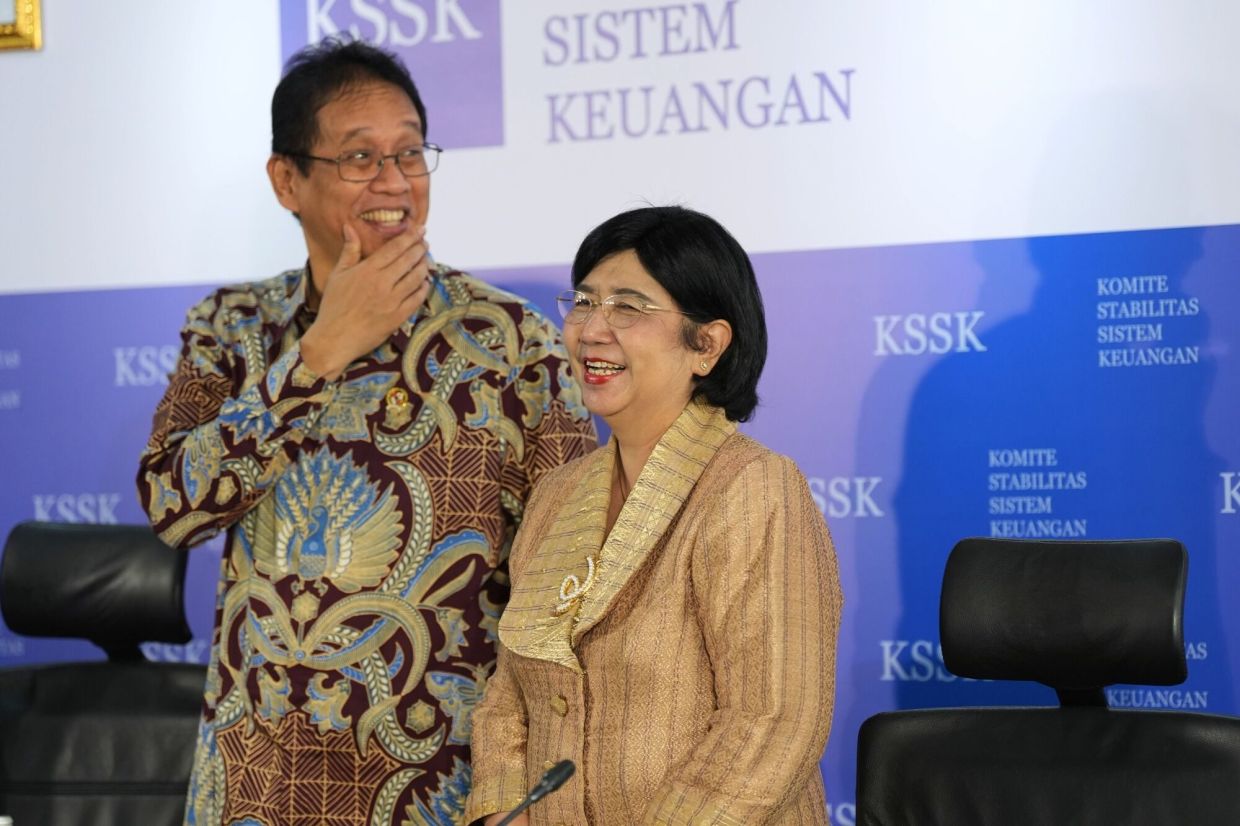
Destry Damayanti's appointment as Indonesia's acting central bank governor just fortnight ago signalled an immediate shift in the relationship between the nation's monetary authority and the government. Within hours of her appointment, she made a ceremonial stop at Finance Minister Purbaya Yudhi Sadewa's office before proceeding to the presidential palace—a deliberate choreography that communicated her commitment to closer coordination between monetary and fiscal authorities. The two subsequently appeared together at a public press briefing, their relaxed demeanour and handshakes projecting unity in purpose.
This collaborative posture represents a marked departure from her predecessor's approach. Perry Warjiyo, who led Bank Indonesia until recently, maintained a more formal distance from the finance ministry, conducting most substantive discussions within the broader institutional framework of the presidential palace or regulatory committees. The contrast is striking: during Warjiyo's tenure, only one publicly documented one-on-one meeting with the finance minister took place, and that occurred at central bank offices as recently as September 2025. Destry's willingness to engage directly and visibly with the finance ministry signals a different operational philosophy, one that President Prabowo Subianto appears to have deliberately encouraged through her nomination.
Prabowo's selection of Destry represents a calculated attempt to balance competing imperatives. He has nominated her as the sole parliamentary candidate for the permanent governorship, seeking an appointment that preserves technocratic credibility with international investors whilst remaining aligned with his administration's economic priorities. The president has made clear his ambition to accelerate Indonesia's growth trajectory toward 8 percent by 2029, a target that requires supportive monetary conditions alongside fiscal stimulus. Destry's challenge will be demonstrating to both the investment community and the president that these objectives need not be mutually exclusive—though history suggests the path is genuinely precarious.
Initial market reactions have been cautiously optimistic. When Destry's appointment was announced, the rupiah strengthened to its most resilient level in a month, outperforming most other Asian currencies and providing a brief respite from what has been a devastating year for Indonesia's currency. The rupiah has depreciated roughly six percent against the dollar in 2025, positioning it as Asia's weakest performer and reflecting investor anxiety about Prabowo's policy direction. This currency weakness sits at the intersection of two pressures: global interest rate trajectories that favour dollar holdings, and domestic policy uncertainty stemming from the president's interventionist measures, including subsidized school meal programmes and increased state control over commodity sectors.
Economists have generally welcomed Destry's elevation, viewing her background as reassuring for continuity and rupiah stability. Helmi Arman of Citigroup has noted that improved communication between Bank Indonesia and the government should be anticipated, though he cautiously observes that the broader institutional environment remains fluid. The economist community recognizes that her appointment could herald a modestly more accommodative monetary stance, given her demonstrated willingness to work collaboratively with fiscal authorities. Yet concerns persist about whether enhanced coordination might slide into problematic policy subordination—the distinction between consultation and capitulation that will define her tenure's success or failure.
Destry enters the role with substantial credentials. She holds an economics degree from the University of Indonesia and a master's in regional science from Cornell University. Before joining Bank Indonesia as deputy governor in 2019, she served as chief economist at PT Bank Mandiri, one of Indonesia's largest financial institutions, and previously held a commissioner role at the Indonesia Deposit Insurance Corporation—an agency that Purbaya once directed. Her deep familiarity with both the investment banking sector and government financial architecture means she understands the incentive structures operating on both sides of the central bank's institutional boundary. She is also well-known within the investor and analyst community, having maintained regular engagement on policy matters throughout her career.
The immediate challenge confronting Destry emerges from structural headwinds beyond any single official's control. Global interest rate pressures and a persistently strong dollar continue to exert downward force on the rupiah, even as domestic inflation remains comparatively contained. This disjuncture between external and internal pressures creates a genuinely difficult monetary policy environment: tightening rates would support the currency but potentially constrain the growth acceleration that Prabowo seeks, whilst easing could support credit expansion but allow the rupiah to depreciate further. Under Warjiyo's leadership, Bank Indonesia deployed a sophisticated toolkit that combined three interest rate increases since May with foreign exchange market interventions and targeted non-rate instruments designed to support credit and growth simultaneously. The question facing Destry is whether she will maintain the intellectual coherence of this approach or whether political pressure will gradually nudge the central bank toward subordinating stability considerations to growth objectives.
Investor attention will focus on whether Bank Indonesia maintains its willingness to raise interest rates when financial stability or rupiah weakness demand such action, and whether liquidity policy remains anchored to genuine economic assessments rather than political preferences. Irman Faiz, chief economist at PT Bank Danamon, has articulated the critical distinction clearly: coordination between monetary and fiscal authorities is essential and desirable, but monetary policy decisions must ultimately derive from the central bank's independent assessment of inflation dynamics, exchange rate pressures and financial stability requirements. The rupiah's weakness, combined with Moody's and Fitch Ratings placing Indonesia's sovereign credit on negative watch due to policy uncertainty, creates external accountability that partially constrains domestic political pressure.
Looking beyond immediate stability considerations, analysts suggest that Destry should view her mandate as transcending mere preservation of recent achievements. Fakhrul Fulvian of PT Trimegah Sekuritas Indonesia argues that the central bank must now translate whatever stability has been achieved into tangible improvements: normalised yield curves that reflect genuine market conditions, more robust monetary transmission mechanisms that translate policy adjustments into real economic responses, and restored private-sector confidence that has been eroded by policy uncertainty. These objectives require not capitulation to political pressure but rather sophisticated advocacy for the structural conditions that enable sustainable growth—a more demanding task than simply saying no to inappropriate demands.
Destry's appointment ultimately represents a test of whether institutional autonomy and political alignment can coexist. Her predecessor, Warjiyo, maintained greater distance from the government but arguably at some cost to policy coordination. Destry has chosen a different approach, signalling from day one her willingness to work constructively with fiscal authorities. The coming months will reveal whether this collaborative stance translates into improved overall economic management, or whether it gradually morphs into the kind of policy subordination that historically precedes currency crises and investor flight. For Malaysian observers and regional investors, Destry's performance will carry implications beyond Indonesia's borders, signalling whether Southeast Asia's largest economy can sustainably balance growth aspirations with monetary discipline.

