President Prabowo Subianto's signature free nutritious meal programme faces mounting pressure and scrutiny as intended beneficiaries—including mothers and children it was designed to help—say they would rather forgo assistance than accept substandard food. The mounting controversy reflects deeper concerns about how the multi-billion-dollar initiative, originally budgeted at Rp 335 trillion (US$18.74 billion) before being trimmed to Rp 268 trillion, is being executed across Indonesia's sprawling network of meal preparation kitchens.
The quality crisis became starkly visible when Nesti Nagari, a 29-year-old mother from Kediri in East Java, posted photographs on social media showing what was supposed to be a nutritious meal for her eight-month-old baby—a portion of clumped white paste she could barely identify. The post, garnering over 11,000 likes within 24 hours, encapsulated the frustration of many parents who feel the programme's promise is not being matched by delivery. Rather than feed the unappetizing meal to her child, Nagari gave it to her chickens, a choice that prompted her to reject subsequent meals from the scheme. She told The Jakarta Post she had never wanted to receive the meals in the first place, expressing openness to either a temporary suspension for evaluation or complete termination so the government could redirect resources to education and healthcare.
Similar grievances extend across multiple regions. Diah Farika, a breastfeeding mother in Semarang, Central Java, enrolled since May, documented repeated problems with her allocated meals, including unripe fruit and portions she deemed inadequately small. When she raised concerns with the nutrition fulfillment service unit (SPPG) responsible for preparing meals, she encountered dismissive responses. Rather than continue receiving substandard provisions, Farika declined further meals and advocated for a temporary programme halt to allow the National Nutrition Agency (BGN) to conduct comprehensive kitchen inspections. Her reasoning reflects a critical insight: the programme's design may be sound, but its execution depends entirely on the quality of individual kitchens managing meal preparation.
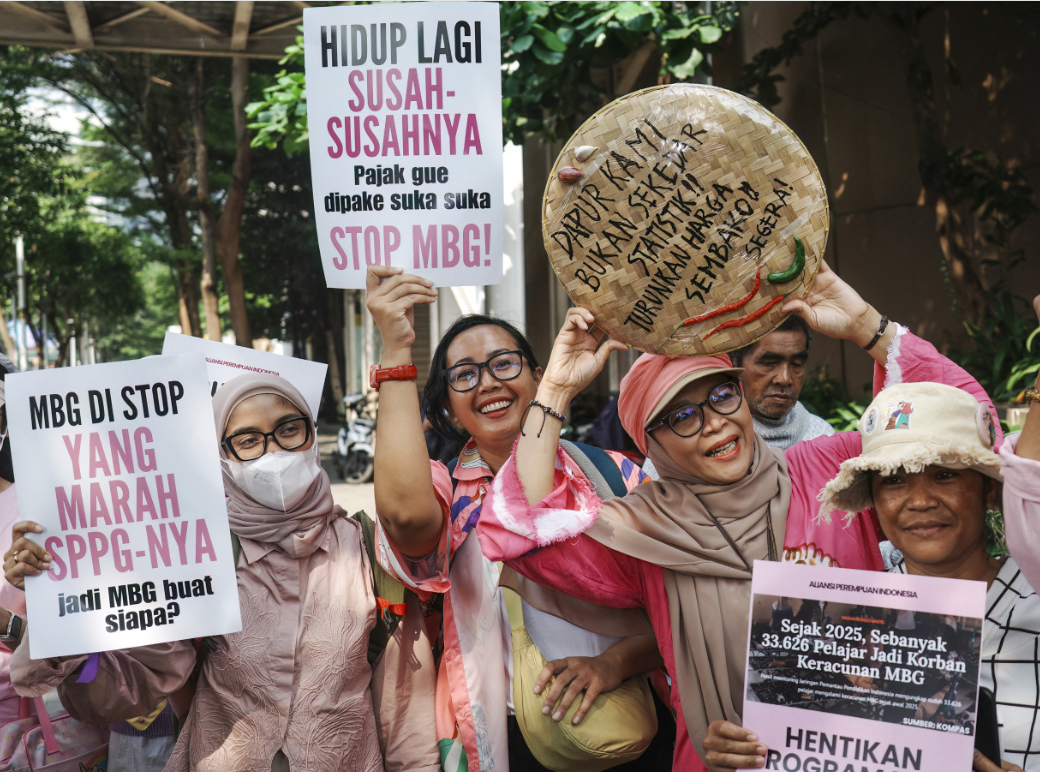
Beyond individual complaints, the movement for programme review has gained institutional momentum. In mid-June, dozens of women and rights activists organised under the Indonesian Women's Alliance staged a rally in Central Jakarta, publicly demanding that authorities halt and comprehensively review the initiative. These organised voices join thousands of mothers expressing concerns through social media and community networks, creating political pressure that authorities cannot easily dismiss.
However, the programme confronts complex pressures from multiple stakeholders with conflicting interests. Approximately 27,000 kitchens currently operate under the SPPG network, and investors who have poured hundreds of billions of rupiah into building these facilities have reportedly visited BGN offices demanding assurances about their investment returns should the programme face restructuring. In early June, several SPPGs temporarily closed due to delayed government funding, though some have since reopened. These funding disruptions reveal systemic implementation challenges beyond mere quality control.
The credibility of the programme has been further eroded following a recent corruption scandal involving former BGN leaders, which prompted the agency's new leadership to suspend further expansion of the SPPG network. Independent civil society oversight platform MBG Watch has documented how these mounting problems have substantially undermined public confidence in the initiative. Policy researcher Isnawati Hidayah from the Center of Economic and Law Studies (CELIOS), one of MBG Watch's initiators, crystallised the emerging question: with this enormous budget, what exactly is it purchasing and who genuinely benefits?
Research commissioned by CELIOS estimated that approximately 34 per cent of current beneficiaries—roughly 61 million children and pregnant women—do not belong among the populations most needing assistance. This figure includes households that are already economically secure and have adequate nutritional access, suggesting the programme's targeting mechanism has significant leakage issues. Such inefficiency becomes particularly contentious given the opportunity cost: resources spent on economically stable families cannot address genuine nutritional deficiencies among Indonesia's poorest populations.
In response to mounting criticism, BGN has initiated a recalibration strategy. Deputy head and spokesperson Agustina Arumsari announced that the agency is narrowing its beneficiary pool, removing recipients deemed capable of meeting nutritional needs independently. As of June, authorities had dropped 76 schools across Java from the programme, affecting over 39,000 beneficiaries. Simultaneously, BGN is introducing austerity measures, including ending daily kitchen incentives during non-operational periods and conducting performance reviews of underperforming facilities. This refocusing strategy attempts to redirect resources toward Indonesian citizens with the most critical need for government nutrition support.
The programme's predicament reflects broader questions about implementation capacity and accountability in large-scale government social programmes across Southeast Asia. When flagship initiatives designed to combat stunting and improve child nutrition—serious public health challenges—fail at the point of delivery, the consequences extend beyond bruised reputations. Children miss crucial nutritional windows, maternal health suffers, and public scepticism toward government intervention grows. Yet the willingness of beneficiaries themselves to support temporary suspension rather than accept poor-quality assistance suggests they understand the difference between flawed implementation and flawed policy concept.
For Malaysia and other regional economies monitoring Indonesia's experience, the case illuminates persistent challenges in translating large budgets into effective social outcomes. Corruption, weak implementation oversight, insufficient kitchen-level quality control, and inadequate performance metrics plagued this initiative despite significant financial resources. Building robust accountability mechanisms, establishing independent quality verification systems, and maintaining responsive feedback channels from beneficiaries appear essential for any large-scale nutrition or welfare programme's success.
Moving forward, how BGN reconciles stakeholder interests—addressing maternal and child health needs, protecting investor interests, improving food quality, and rebuilding public trust—will determine whether this programme becomes a model for effective regional social provision or a cautionary tale. The voices of beneficiaries themselves, willing to forgo assistance rather than accept inadequate services, offer perhaps the most important guide for necessary reforms. Their stance suggests that restoring programme integrity matters more, in their estimation, than maintaining current distribution levels.
%22%2F%3E%3C%2Fpattern%3E%3C%2Fdefs%3E%3Crect%20width%3D%22100%25%22%20height%3D%22100%25%22%20fill%3D%22url(%23ph454chg)%22%2F%3E%3Crect%20width%3D%22100%25%22%20height%3D%22100%25%22%20fill%3D%22url(%23ph454chp)%22%2F%3E%3Ctext%20x%3D%2250%25%22%20y%3D%2250%25%22%20text-anchor%3D%22middle%22%20dominant-baseline%3D%22central%22%20fill%3D%22rgba(255%2C255%2C255%2C0.95)%22%20font-family%3D%22Georgia%2C%20'Times%20New%20Roman'%2C%20serif%22%20font-weight%3D%22700%22%20font-size%3D%22170%22%20letter-spacing%3D%22-0.02em%22%3EMalaysia%3C%2Ftext%3E%3C%2Fsvg%3E)
%22%2F%3E%3C%2Fpattern%3E%3C%2Fdefs%3E%3Crect%20width%3D%22100%25%22%20height%3D%22100%25%22%20fill%3D%22url(%23ph2a9atg)%22%2F%3E%3Crect%20width%3D%22100%25%22%20height%3D%22100%25%22%20fill%3D%22url(%23ph2a9atp)%22%2F%3E%3Ctext%20x%3D%2250%25%22%20y%3D%2250%25%22%20text-anchor%3D%22middle%22%20dominant-baseline%3D%22central%22%20fill%3D%22rgba(255%2C255%2C255%2C0.95)%22%20font-family%3D%22Georgia%2C%20'Times%20New%20Roman'%2C%20serif%22%20font-weight%3D%22700%22%20font-size%3D%22320%22%20letter-spacing%3D%22-0.02em%22%3EPKR%3C%2Ftext%3E%3C%2Fsvg%3E)