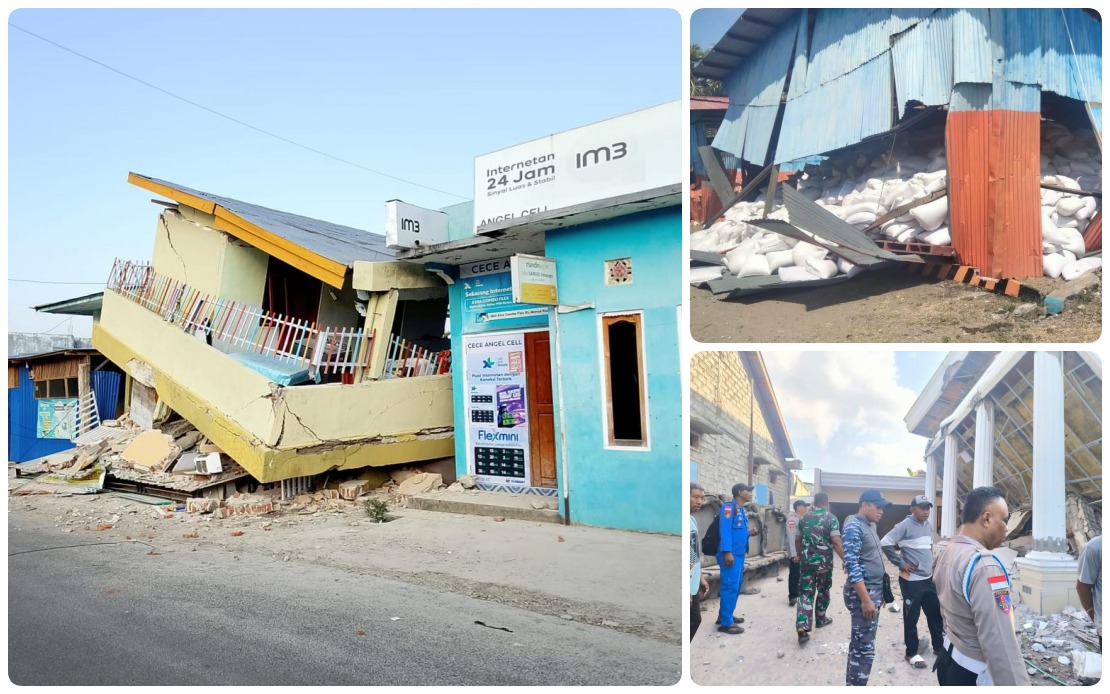
Hundreds of aftershocks are continuing to buffet Flores Island in eastern Indonesia following a devastating magnitude 7.7 earthquake that struck before dawn on Sunday, killing at least 53 people and forcing thousands to abandon their homes. The National Disaster Management Agency (BNPB) reported that the Meteorology, Climatology and Geophysics Agency (BMKG) had documented 995 distinct aftershocks by mid-afternoon, though the vast majority went largely unnoticed by the population. The relentless seismic activity, combined with the psychological weight of historical trauma and widespread structural damage, has kept approximately 9,290 residents sheltering at evacuation sites across the affected region.
The initial quake struck at 4.58 am local time with its epicentre located roughly 30 kilometres offshore near Mbay in Nagekeo district, at a relatively shallow depth of 15 kilometres. This proximity to inhabited areas amplified the destructive force of the tremor, which immediately triggered a tsunami warning. However, authorities lifted the alert at 7.31 am after careful monitoring of sea levels indicated no significant wave surge would occur. The swift cancellation of the tsunami warning helped prevent additional panic, though it provided little comfort to communities already grappling with widespread building collapses and infrastructure damage.
According to Abdul Muhari, the BNPB's Deputy for Prevention, the death toll had climbed to 53 with an additional 135 people suffering injuries across seven affected regencies and cities. Remarkably, no persons have been reported missing at this stage of the emergency response, suggesting that initial casualty assessments have captured most of those directly impacted. Nevertheless, Muhari cautioned that authorities remained engaged in verifying and updating casualty figures as rescue operations entered their second day, indicating that the final count may yet shift as remote and inaccessible areas are systematically checked.
The persistence of evacuation-centre populations reflects more than just immediate fear of aftershocks. For residents of Flores, the earthquake has revived collective memories of the catastrophic 1992 earthquake and tsunami that devastated the same island, killing thousands and reshaping the regional geography. This historical precedent has made many residents reluctant to return to their homes despite official assurances that the danger has passed. Combined with the reality that many structures have been rendered unsafe and numerous residences are partially or wholly destroyed, the decision to remain in communal shelters appears rational to displaced families uncertain about when normal life can resume.
Emergency response efforts have shifted into a multi-faceted operation addressing immediate humanitarian needs while simultaneously restoring critical infrastructure. The BNPB has prioritised victim assistance, distribution of basic supplies including food and water, and systematic assessment of structural damage to determine which buildings can be safely reoccupied and which require demolition. The agency has also begun the arduous task of clearing and repairing transportation networks essential for delivering aid to isolated communities. A key breakthrough came when engineers cleared a landslide that had blocked a critical road section in Reok, Manggarai, enabling fuel tanker trucks to pass and ensuring power-generation facilities could operate normally.
Utilities restoration has proceeded in parallel with safety assessments. Electricity supply has been reestablished in several areas that experienced blackouts immediately following the earthquake, helping to restore basic services and communications infrastructure. These utility repairs carry outsized importance in a region where medical facilities, water-treatment plants, and emergency-coordination centres depend on reliable power. The restoration effort underscores the cascading nature of earthquake impacts: the initial ground movement breaks physical structures, but the resulting power failures and communication breakdowns can compound human suffering if not rapidly addressed.
The institutional response demonstrates Indonesia's layered disaster-management architecture. The BNPB has activated response posts in both Labuan Bajo and Maumere, positioning emergency coordinators and supplies within the disaster zone to accelerate decision-making and aid distribution. Simultaneously, logistics hubs have been established in Jakarta, the capital, alongside forward positions in the two regional cities, creating a supply pipeline capable of rapidly channelling relief resources from the national level down to affected villages. Aircraft and helicopters have been placed on alert to supplement ground-based delivery if access routes remain blocked or if situations emerge requiring rapid evacuation or emergency medical transport.
For readers across Southeast Asia, the Flores earthquake offers sobering perspective on regional seismic risk. Indonesia sits atop one of Earth's most active fault systems, where the Indo-Australian Plate collides with the Eurasian Plate, generating frequent earthquakes and occasionally triggering the tsunamis that have periodically devastated coastal communities throughout the region. Malaysia, though geologically more stable than Indonesia, remains vulnerable to distant megathrust earthquakes that could generate transoceanic tsunamis, a reality starkly illustrated by the 2004 Indian Ocean disaster. The Flores event also highlights the persistent challenge of building resilience in developing nations where rapidly growing populations often inhabit seismically active zones with inadequate building codes and limited financial resources for earthquake-resistant construction.
The social and economic dimensions of this disaster extend far beyond the immediate death and injury toll. Thousands of displaced residents will require medium-term shelter and livelihood support as homes are either repaired or rebuilt from foundation. The destruction of commercial infrastructure, fishing vessels, agricultural land, and small businesses will ripple through a regional economy already strained by development challenges. Insurance coverage for earthquake damage remains minimal across Indonesia, meaning most losses will fall on individual families and must ultimately be absorbed by government assistance programmes. For a nation managing multiple simultaneous crises across its vast archipelago, the Flores earthquake represents yet another demand on limited disaster-relief budgets and emergency-response personnel.
As the aftershock sequence continues its gradual decline, attention will shift toward supporting the longer recovery phase. The fundamental challenge confronting Flores residents and Indonesian authorities alike involves rebuilding communities and restoring livelihoods while simultaneously raising construction standards to reduce vulnerability to future seismic events. This requires not merely clearing rubble and reconstructing buildings, but fundamentally reimagining infrastructure development in seismically active zones. The psychological recovery may prove equally demanding, as multiple generations of Flores residents now carry lived experience of catastrophic earthquakes, shaping their perception of home and safety in ways that endure long after physical reconstruction reaches completion.

