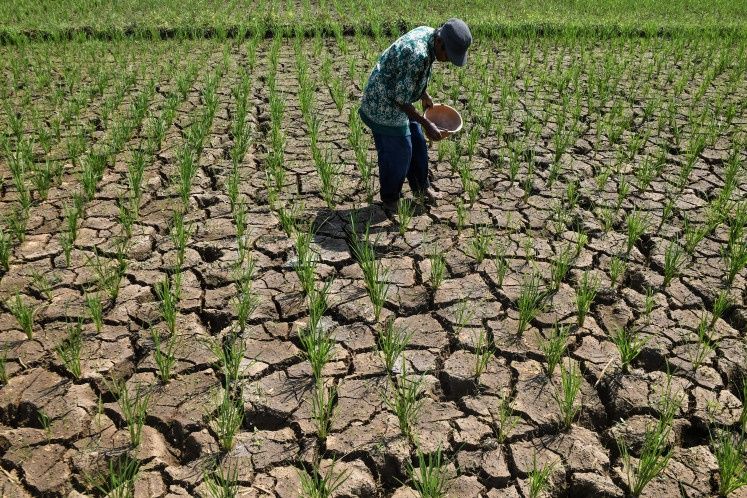
The drought gripping Indonesia is tightening its hold on an expanding number of regions as El Niño weather patterns intensify the dry season, prompting government agencies to escalate preparedness measures and warning that months of below-normal rainfall could trigger cascading crises in water access, agriculture, and food security across the archipelago.
The scale of the immediate crisis became clearer on Friday, July 3, when the National Disaster Mitigation Agency (BNPB) added three more regions to its critical water shortage list: Gunungkidul in Yogyakarta, Semarang in Central Java, and Jember in East Java. This expansion brought the number of newly affected households to approximately 700, requiring local authorities to dispatch tanker trucks delivering emergency water supplies to communities that have endured weeks without meaningful rainfall. The newly designated crisis zones joined an already substantial roster of distressed areas where more than 7,100 households were already struggling to secure clean water, including multiple districts across Central Java, West Java, Yogyakarta, and as far east as Maluku province.
The geographic spread of the water shortage crisis reflects both the intensity and reach of the developing drought. Established drought-affected zones now include Cilacap, Klaten, and Jepara in Central Java; Bantul in Yogyakarta; Karawang, Tasikmalaya, and Sukabumi in West Java; and Seram in Maluku, all requiring ongoing emergency water delivery operations. Several regional administrations have already declared 90-day drought alert statuses, a formal designation that enables rapid mobilisation of emergency resources and administrative flexibility for disaster response. Gunungkidul initiated its alert status in June, while West Java provinces followed suit during early July. In West Nusa Tenggara, authorities in West Lombok declared a full drought emergency on June 15 after approximately 3,600 households faced acute water access problems, signalling the severity of conditions in eastern Indonesian regions typically more vulnerable to seasonal precipitation variations.
Behind these immediate crises lies a broader climatic phenomenon that meteorologists warn could produce genuinely extreme conditions through the remainder of the year. The Meteorology, Climatology and Geophysics Agency (BMKG) has characterised this year's dry season as potentially "extreme" in its intensity, a designation reflecting the strengthening El Niño pattern—the oceanic and atmospheric system characterised by elevated sea surface temperatures across the Pacific Ocean. By mid-June, approximately 37 per cent of Indonesia's climate zones had formally transitioned into the dry season, whilst nearly half the country was already experiencing rainfall levels markedly below historical norms. BMKG projections indicate the dry season will peak during the July through September quarter, with forecasts suggesting that more than 80 per cent of the archipelago will receive below-normal precipitation during this critical period.
These meteorological forecasts carry profound implications for Indonesian agriculture and food production. Agriculture Ministry officials acknowledged the emerging threat, with Agriculture Minister Amran Sulaiman announcing that the ministry had undertaken anticipatory planning to minimise disruption to planting schedules and harvest outcomes. The government has prioritised expanding irrigation pump deployment to maintain water availability for crop production, ensuring that agricultural activities remain viable despite constrained water supplies. Meanwhile, Ardhasena Sopaheluwakan, the BMKG's deputy for climatology, articulated the agricultural adaptations Indonesia must pursue immediately, including adjustments to planting timetables, expanded deployment of drought-tolerant and early-maturing crop varieties, and diversification of food crop portfolios to distribute risk across multiple species with varying water requirements.
Forecast drought impacts on food production have generated legitimate concern about national food security, with independent analysts warning that prolonged moisture deficits could precipitate rice price escalations reaching record levels unless water infrastructure receives urgent reinforcement. The government has attempted to reassure the public regarding food supply stability by emphasising that national rice reserves remain at what officials characterise as a "historically high level," maintaining reserves sufficient to satisfy domestic demand through the succeeding year. Amran reiterated these assurances on Friday, suggesting that carefully managed reserves provide a buffer against production disruptions. Simultaneously, the House of Representatives' Commission IV, which maintains oversight responsibility for agricultural and food security policy, has urged the government to accelerate targeted assistance programmes in vulnerable agricultural communities, encompassing distribution of improved seeds, fertiliser inputs, mechanised equipment, and livestock fodder.
Despite the government's focus on immediate emergency interventions and strategic reserve management, water policy specialists argue that Indonesia must simultaneously pursue transformative long-term infrastructure investments to address the underlying vulnerability of drought-prone regions. Bagas Yusuf Kausan, a researcher affiliated with Yayasan Amerta Air Indonesia, a water policy research organisation, contends that sustainable solutions require establishing affordable piped water service provision through regional water utilities, particularly in chronically water-stressed areas with limited conventional access to clean water. Kausan further advocates that such services should receive government subsidisation as a tangible political commitment to communities experiencing recurring drought impacts, transforming emergency response into foundational service delivery.
Beyond climate variability alone, Kausan identifies systemic environmental degradation resulting from human economic activity as a critical vulnerability multiplier in drought-affected regions. Land conversion activities, principally agricultural expansion and urban development, combined with unsustainable extraction of groundwater reserves, have left numerous areas increasingly fragile and susceptible to water stress during dry seasons. This human-induced environmental degradation amplifies the damage potential of El Niño weather patterns, creating compound risks that exceed what natural climate variation alone would produce. Kausan's analysis suggests that the government should leverage the current El Niño period as a policy opportunity to enforce stricter restrictions on land conversion activities, particularly within water catchment zones and other hydrologically critical areas, establishing protections that would enhance regional water security against future drought cycles.
For Malaysian observers and policymakers, Indonesia's unfolding drought crisis offers instructive lessons regarding regional climate vulnerability and the necessity of proactive water infrastructure investment. As El Niño impacts propagate across Southeast Asia, Malaysia's experience with monsoon variations and localised water stress periods suggests comparable vulnerabilities, particularly in urbanised regions with concentrated water demand. Indonesia's struggle to coordinate emergency response across multiple government levels while simultaneously pursuing long-term infrastructure solutions mirrors challenges that Malaysia may face during future drought episodes, underscoring the importance of pre-positioned contingency planning and cross-agency coordination frameworks established during normal conditions rather than improvised during crises.
The Indonesian government's current approach—balancing emergency water distribution through tanker truck operations with ministerial assurances regarding food supply sufficiency—represents a pragmatic short-term response to immediate humanitarian needs. However, the persistent recurrence of drought impacts across the same vulnerable regions suggests that without structural transformation of water infrastructure and environmental protection regimes, Indonesia will continue cycling through emergency responses to predictable climate events. The political economy of water resource management in Indonesia and across Southeast Asia thus emerges as central to regional development trajectories, with drought resilience increasingly dependent on investment decisions made during periods of water abundance rather than during crisis moments.

