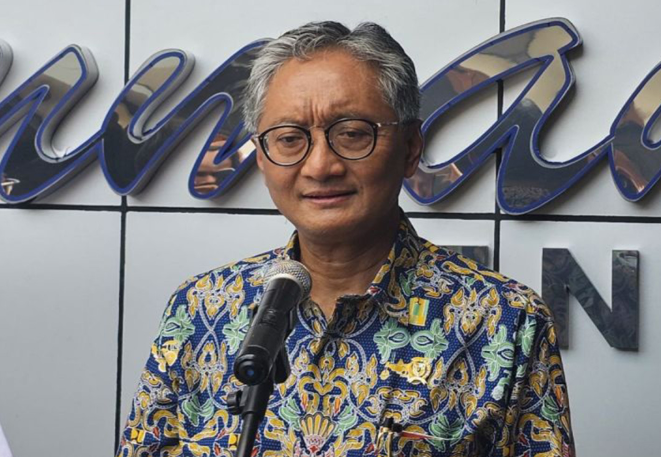
The Indonesian Public Works Ministry has descended into internal chaos following the public disclosure of an official document that listed Minister Dody Hanggodo's wife and daughter among delegates scheduled to travel to New York for a United Nations meeting. The leak, which circulated widely on social media from early July, has exposed tensions within the ministry's bureaucracy and triggered what observers characterise as a wave of retaliatory personnel transfers that now threatens to destabilise the institution's operations.
The controversial document, originally signed by ministry secretary-general Apri Artoto on June 29, detailed plans for eight delegates to attend a UN-organised meeting in New York between July 13 and 19. What sparked intense public criticism was the inclusion of Irma Hermawati, the minister's wife, and their daughter Aurellia Tsabitha Meidirama on the delegation roster. The appearance of family members on an official state travel manifest immediately triggered allegations that public resources were being diverted for private purposes. The resulting outcry forced Hanggodo to cancel the entire trip, marking a significant embarrassment for the minister and his office.
When pressed by journalists, Hanggodo acknowledged that personnel reassignments had indeed occurred but flatly denied these moves constituted punishment for the leak. In a defensive statement, he pointed to his authority over 38,600 ministry employees and questioned why he should not exercise discretion in deploying staff. However, his denial rang hollow for many observers tracking the sudden wave of transfers. Social media quickly became flooded with claims that the minister had systematically reassigned officials to regional offices scattered outside Java, a pattern that suggested retaliation regardless of official denials.
During a subsequent press briefing on July 7, Apri sought to justify the family members' inclusion by explaining that their presence facilitated visa application procedures through the Foreign Ministry. He further asserted that state funding would not have covered their participation costs, a technicality that failed to address the broader propriety concerns. Demonstrating institutional defensiveness, the secretary-general pledged to identify the person responsible for leaking the document and threatened legal prosecution, declaring the material was not intended for public disclosure. The threat itself underscored how seriously the ministry viewed the breach of internal confidentiality.
The current turmoil must be understood within the broader context of Hanggodo's leadership since his appointment in October 2024. The 60-year-old former engineer, whose business background includes ties to South Kalimantan entrepreneur Andi "Haji Isam" Syamsuddin Arsyad, has pursued an aggressive personnel restructuring agenda throughout his tenure. Analysis of social media postings reveals that over 100 ministry employees have been reassigned, spanning from senior director generals to entry-level civil servants. This pattern of wholesale bureaucratic reorganisation suggests a minister intent on reshaping institutional culture at an extraordinarily rapid pace.
The most recent significant reshuffling occurred in May, when Hanggodo elevated seven high-ranking officials, including Apri, to senior positions. Notably, Apri replaced Wida Nurfaida as secretary-general, a position Nurfaida had occupied for less than one year before her own removal during another restructuring in July 2025. The constant churn of leadership positions indicates that institutional continuity has become secondary to the minister's broader agenda. For an organisation responsible for critical infrastructure development across Southeast Asia's third-largest economy, such instability carries serious implications.
The psychological toll on ministry staff has not escaped the attention of lawmakers. During a House of Representatives Commission V meeting in June, PDI-P legislator Yasto Soepredjo Mokoagow raised alarm about disciplinary measures including demotions to non-structural positions, warning that such actions had created a climate of fear among civil servants. His concern proved prescient: employees now reportedly hesitate to implement programmes due to anxiety about potential career consequences. The lawmaker articulated a crucial worry that excessive caution, born from fear of reassignment, would ultimately cripple the ministry's capacity to execute infrastructure projects, many of which carry vital importance for regional development.
Hanggodo's justification for the continuous restructuring rests on his characterisation of a "deep state" allegedly embedded within the ministry. He has compared this internal resistance to termites systematically undermining institutional integrity, using the metaphor to defend his aggressive personnel moves as necessary institutional cleansing. This framing, while emotionally resonant, reflects a worldview that perceives significant portions of the bureaucracy as fundamentally disloyal or obstructionist. For Malaysian observers familiar with similar institutional tensions across Southeast Asia, the rhetoric carries troubling echoes of governance models that prioritise loyalty over competence.
The minister's credibility has been further eroded by the involvement of senior ministry officials in ongoing corruption investigations. The Jakarta High Prosecutor's Office named multiple suspects in June related to water resources projects, including former water resources director general Dwi Purwantoro and former acting irrigation and swamp director Yosiandi Radi Wicaksono. While Hanggodo publicly committed to supporting law enforcement efforts and pledged non-interference, the existence of such high-level corruption investigations raises uncomfortable questions about the institutional oversight mechanisms that supposedly existed before his tenure.
Recent social media revelations have amplified doubts about Hanggodo's management style and temperament. Video footage showing him verbally berating an employee during a school construction site visit in East Java last April has resurfaced, with the minister captured pointing at the worker and dismissing his explanation as "dumb excuses." This documented interaction, now widely shared online, provides visual confirmation of what critics characterise as an abrasive leadership approach that may be contributing to the broader atmosphere of institutional fear and demoralisation.
For Malaysia and the broader Southeast Asian region, the Public Works Ministry turmoil carries implications beyond Indonesia's borders. Infrastructure projects often involve cross-border development initiatives, regional partnerships, and coordinated planning. When a ministry responsible for overseeing such critical functions descends into internal chaos marked by fear-driven personnel movements and unclear accountability structures, the institutional capacity to manage complex transnational projects inevitably suffers. The ministry's current instability therefore represents not merely an Indonesian domestic concern but a factor potentially affecting regional infrastructure development cooperation.
The fundamental tension underlying the Public Works Ministry crisis reflects a wider challenge confronting many Southeast Asian governance structures: how to balance institutional reform with operational stability. Hanggodo appears to have prioritised radical restructuring at the expense of continuity, a choice that may have exposed rather than resolved underlying institutional weaknesses. As the ministry continues navigating the fallout from the travel document leak and the consequent personnel upheaval, the ability of its leadership to restore staff confidence and rebuild institutional trust will determine whether reform efforts ultimately strengthen or further undermine operational capacity.

