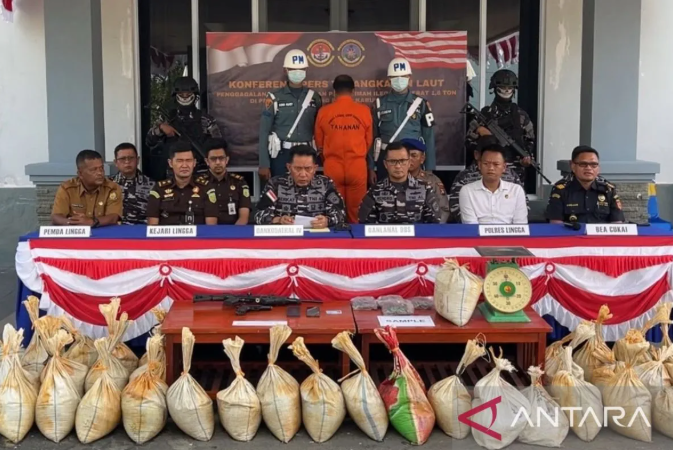
The Indonesian Navy has successfully prevented what authorities believe was a large-scale smuggling operation involving illegally extracted tin sand destined for Malaysia. The intercepted shipment, totalling approximately 75.7 tonnes and valued at Rp76.04 billion (US$79,300), was discovered across several locations in the Bangka Belitung Islands region off Sumatra's eastern coast. Vice Admiral Denih Hendrata, commanding the Indonesian Fleet, revealed during a Wednesday press conference in Tanjungpandan, Belitung, that the operation uncovered a complex network spanning multiple sites and involving coordinated law enforcement action over several weeks.
The investigation began on August 2 when naval personnel discovered a truck loaded with approximately eight tonnes of tin sand at a jetty in East Belitung. This initial seizure proved pivotal, as it led authorities to expand their search methodically across the archipelago. The subsequent raids painted a picture of systematic illegal mining and trafficking. On August 3, officers uncovered around 50 tonnes of tin sand in Lenggang village, representing the single largest cache. Further searches yielded an additional 10 tonnes packaged in 200 sacks just a day later, followed by another five tonnes on August 8, demonstrating that the operation was spread across multiple handling points rather than concentrated in one location.
The scale of the contraband discovery reflects the persistent challenge that tin smuggling poses to both Indonesia and its neighbours. The Bangka Belitung Islands have long been known for their tin reserves, attracting both legitimate mining operations and illegal extraction activities. The fact that criminals attempted to channel such a substantial quantity toward Malaysia suggests a well-established trafficking route and likely demand for illegally sourced tin in international markets. The timing of the discovery also highlights the effectiveness of persistent naval surveillance and the willingness of Indonesian authorities to pursue comprehensive investigations that extend beyond simple seizures.
Denih emphasized that authorities treated the initial intercept not as an isolated incident but as a gateway to understanding a broader smuggling network. The deliberate decision to expand operations rather than conclude investigations after the first seizure has borne fruit. By August 8, when the final cache was recovered, the Navy had activated surveillance and raid operations across five distinct locations, suggesting that the network involved multiple collection points, storage facilities, and potentially different trafficking nodes. This methodical approach contrasts with enforcement actions that terminate after a single large seizure, typically allowing the underlying criminal infrastructure to persist.
The investigation remains in its early stages regarding suspect identification and prosecution. Authorities have not yet announced arrests or named individuals connected to the smuggling attempt. The deliberate pace of the investigation reflects the complexity involved in tracing criminal networks that often span multiple jurisdictions and involve multiple participants with different roles. Some individuals may serve as illegal miners, others as transporters, warehouse operators, or facilitators connecting to international buyers. Laboratory analysis is currently underway to determine the precise mineral composition of the seized materials, a step that could prove essential for forensic purposes and understanding the specific market destination or customer profile.
The acknowledgment by Denih that cross-border cooperation would be necessary to trace the receiving end of the shipment underscores a critical regional challenge. Malaysia's role as the intended destination raises questions about demand drivers and end markets. Tin remains valuable in electronics manufacturing, solder production, and various industrial applications. The Rp76.04 billion valuation suggests that buyers would have been prepared to pay substantial sums for the contraband, indicating either direct purchase by industrial users or intermediary trading networks operating in Malaysia's tin trading hubs. Without Malaysian authorities' involvement in tracing recipients and dismantling receiving networks, the impact of this interdiction may be limited to temporary disruption of a single trafficking attempt.
The Bangka Belitung Islands occupy a unique position in regional tin markets and geopolitics. Once among the world's most significant tin-producing regions, these islands continue to generate both legal and illegal extraction. The concentration of illegal mining activity reflects both the accessibility of remaining tin deposits and the economic incentives driving informal mining operations. Workers engaged in illegal extraction typically earn meagre wages, providing labour supply for criminal operations. The broader supply chain, however, generates far greater profits for middlemen and traders. Understanding whether this 75.7-tonne shipment represented a one-time commercial transaction or part of regular smuggling operations remains unclear.
The investigation's expansion to five locations within just over a week suggests that Indonesian authorities possessed significant intelligence about the smuggling network prior to the August 2 intercept. Naval personnel's readiness to intercept the truck at the jetty indicates either active surveillance of particular routes or informant tips. The rapid discovery of subsequent caches suggests that authorities moved quickly to apprehend the network before participants could relocate materials or flee. This coordination implies cooperation between naval units, customs enforcement, and possibly the Indonesian police and mining regulatory authorities. Such inter-agency collaboration, though sometimes inconsistent across Indonesia's vast archipelago, appears to have functioned effectively in this instance.
For Malaysia, this interception holds implications for tin supply chains and awareness of smuggling risks. Malaysian importers and manufacturers using tin must increasingly expect greater scrutiny of supply chain documentation and origins. International tin trading standards emphasize due diligence regarding conflict minerals and illegal extraction. The discovery of trafficking networks channelling contraband to Malaysian buyers could prompt broader regulatory reviews of how tin imports are verified and audited. Companies sourcing tin from Southeast Asia may face pressure from international standards bodies and customers to ensure supply chain transparency.
Looking forward, the investigation's outcomes will likely shape Indonesian enforcement priorities and may influence bilateral cooperation frameworks with Malaysia. If arrests lead to prosecution and convictions, they could serve as deterrents to other potential smugglers. Conversely, if key network figures escape accountability, the smuggling operation may simply reconstitute under different management. The laboratory analysis findings will also prove significant—if the seized material proves particularly valuable or of superior quality, it might indicate sophisticated illegal mining operations rather than opportunistic extraction, suggesting greater criminal organization and professionalization of the smuggling network.
The broader significance of this case extends beyond immediate law enforcement success. It underscores the vulnerability of Southeast Asian maritime borders to smuggling despite increasing naval capabilities. The illegal tin trade represents just one facet of regional resource trafficking that also encompasses timber, minerals, wildlife, and processed goods. Indonesia's demonstrated capacity to intercept major shipments and pursue network-level investigations offers encouragement for regional security, yet the persistence of such operations despite significant enforcement efforts indicates that root causes—poverty among miners, demand from international buyers, and corruption enabling transhipment—remain largely unaddressed. Sustained cooperation between Indonesia and Malaysia on both enforcement and the underlying economic drivers will likely be necessary to substantially reduce such smuggling attempts.

