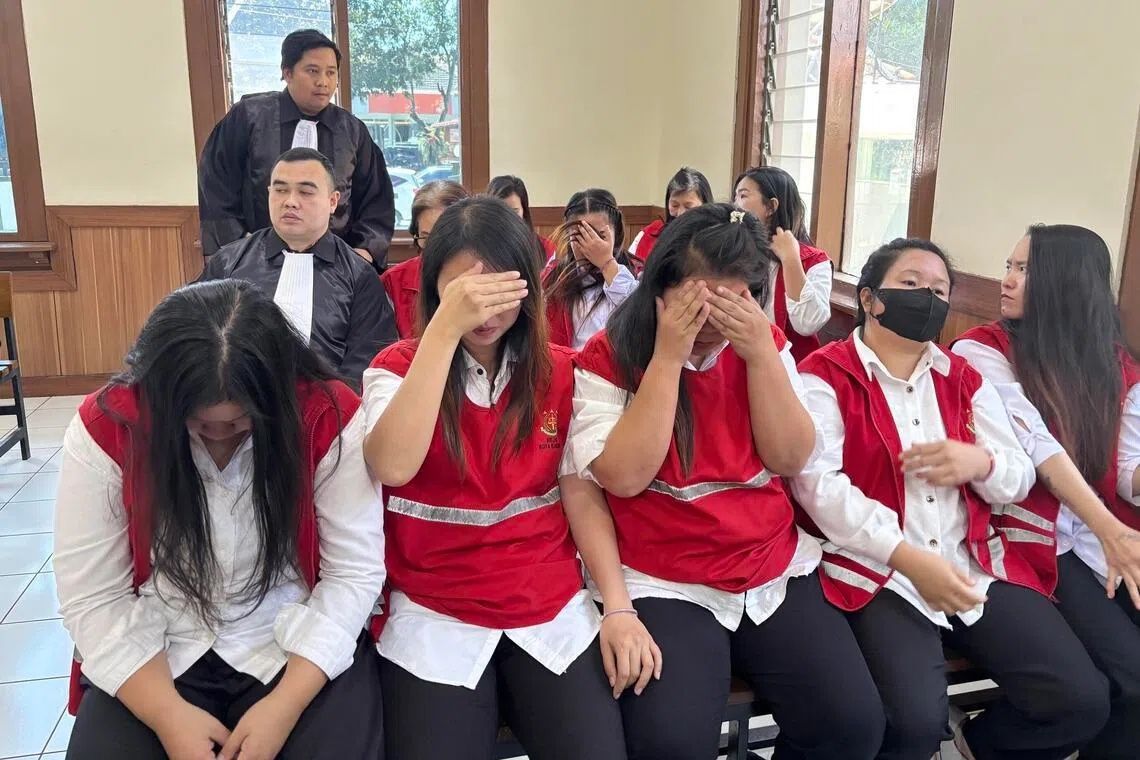
At a hearing in Bandung District Court, Indonesian prosecutors have moved to secure convictions and substantial prison terms against 19 defendants – predominantly women – accused of operating an illicit baby trafficking operation that spanned from 2023 through early 2025. The case represents a major law enforcement operation targeting one of Southeast Asia's most disturbing forms of organised crime, with implications that extend beyond Indonesia's borders into Singapore and potentially across the wider region.
The prosecution's case centres on allegations that the syndicate systematically recruited infants, falsified adoption documentation, and sold babies to prospective parents across borders. Court documents indicate that at least 12 of the 34 infants involved were transferred to Singapore, with each child commanding prices between 200 and 250 million rupiah – approximately S$18,110 per baby. The scale of the operation and the cross-border coordination required to execute it suggest a sophisticated criminal network that exploited loopholes in adoption procedures and regulatory frameworks on both sides of the Causeway.
Authorities have identified 70-year-old Lie Siu Luan, known colloquially as Lily or Popo, as the alleged mastermind orchestrating the entire scheme. Prosecutors allege that Lie wielded centralised control over critical operational functions: recruiting mothers willing to give up their children, managing falsification of state documents required for international adoption, and arranging logistical coordination for infants to be transported overseas. Her alleged role as a nexus point in the trafficking chain suggests careful planning and knowledge of both Indonesian and international adoption requirements.
The prosecution has differentiated culpability levels among the accused. Astri Fitrinika, identified as one of the primary recruiters, faces a 10-year sentence alongside two other alleged recruiters, Djaka Hamdani and Elin, as well as Lai Su Hua, who stands accused of document falsification. This differentiated approach reflects prosecution strategy to hold those with direct involvement in recruitment and administration to maximum accountability. The remaining 14 defendants, characterised as caretakers who maintained the infants during the trafficking process, face sentences of five years each, acknowledging their secondary though still significant roles in perpetuating the scheme.
The case's emergence traces back to July 2025 when Indonesian authorities arrested approximately a dozen suspects in West Java following a tip from Dani Hidayat, a resident who discovered the operation through unusual circumstances. Hidayat had joined an adoption-focused Facebook group while his wife was pregnant, whereupon he was contacted by Astri offering money for the unborn child. This casual recruitment approach – leveraging social media platforms and Facebook's adoption communities – demonstrates how sophisticated modern trafficking networks exploit digital channels to identify vulnerable families and pregnant women.
During testimony, Lie alleged that four Singaporeans functioned as adoption brokers facilitating the sale of babies to clients in the city-state, identifying them by names Petter, John, Mr Tan, and Mr Chew. The involvement of Singapore-based intermediaries underscores how transnational trafficking operations require actors across multiple jurisdictions to succeed, with some individuals functioning as the critical link between supply and demand. The Singapore and Indonesian governments formally acknowledged their collaborative investigation on January 9, indicating both nations' commitment to dismantling cross-border criminal networks affecting vulnerable children.
Defence strategies emerging during the trial reveal subtle but important distinctions in how lawyers are challenging the prosecution's narrative. Lie's counsel, Sendi Sanjaya, does not dispute the core factual allegations but rather contests the legal element of "exploitation" – a critical component of trafficking law. Sanjaya argues that the trial evidence demonstrates the adopted children received adequate care, maintained known locations, and showed no signs of mistreatment, thereby failing to satisfy the exploitation requirement necessary for a trafficking conviction under Indonesian law. This legal challenge highlights how trafficking prosecutions hinge not merely on transfer of children but on proof of abuse or exploitative conditions, a threshold that trafficking defendants frequently attempt to undermine.
Astri's lawyer, Hendri Samuel Tampubolon, adopted a different tactic by emphasising his client's secondary status within the hierarchy while simultaneously leveraging her cooperation with authorities. By contrasting Astri's sentence recommendation with that of the alleged ringleader, the defence implicitly challenges the proportionality of prosecution sentencing demands, arguing that those under coercive control of a dominant figure should receive substantially reduced culpability assessment. Such arguments reflect broader legal principles about coercion and duress, though their viability in trafficking cases varies considerably across jurisdictions.
For Malaysia and broader Southeast Asia, this case illuminates persistent vulnerabilities in adoption frameworks and cross-border law enforcement cooperation. The relative ease with which the syndicate operated across Indonesia-Singapore borders – exploiting adoption processes, falsifying documents, and recruiting participants through social media – suggests comparable risks exist elsewhere in the region. Malaysian authorities monitoring the case should assess whether similar networks might exploit Malaysia's own adoption systems or whether individuals involved in this Indonesian operation maintain connections to Malaysian trafficking ecosystems. The involvement of social media platforms as recruitment venues also highlights how digital infrastructure amplifies trafficking risks in an era of increased online connectivity.
The trial's continuation next week, when defence teams will present their formal responses to prosecution allegations, will determine whether courts ultimately accept the exploitation argument or maintain the trafficking convictions sought by prosecutors. Sentencing outcomes will send important signals about regional commitment to prosecuting human trafficking networks and protecting vulnerable infants from commodification. Beyond the immediate legal proceedings, this case underscores how sophisticated criminal networks have infiltrated what should be protective institutional frameworks – adoption systems designed to provide care for parentless children – thereby corrupting their humanitarian purpose into mechanisms of exploitation and profit generation.

