Indonesian authorities have successfully dismantled an international drug trafficking network with Malaysian connections operating in Batam, Riau Islands, according to an announcement made by the National Narcotics Agency (BNN) on Friday. The joint operation, conducted by BNN enforcement officials and the Customs and Excise Directorate General, resulted in the arrest of six Indonesian suspects while authorities continue searching for two Malaysian nationals believed to be the primary suppliers funnelling etomidate and other controlled substances into the Riau Islands distribution network. BNN deputy for enforcement Insp. Gen. Aswin Sipayung highlighted the sophisticated nature of the criminal enterprise during a press conference held at one of the raided locations in Batu Ampar.
The investigation began when Customs officers stationed at Soekarno-Hatta International Airport intercepted a package arriving from Malaysia that had been deliberately mislabelled as Orange Fiber Xtra food supplement. Subsequent laboratory testing at the Customs and Excise Laboratory in Jakarta revealed the shipment contained 3,4-Methylenedioxymethamphetamine (MDMA), ketamine, and other prohibited drugs. This discovery triggered intensive coordination between the BNN and Customs authorities, who launched a comprehensive tracing operation that would ultimately uncover the full extent of the smuggling network's operations throughout the strategic port city.
The breakthrough came when officers arrested a suspect identified as BAP as he attempted to collect the intercepted package in Batam on Wednesday. Following BAP's initial interrogation, the joint team rapidly moved to apprehend three additional suspects at a hotel in Baloi—ED, who allegedly placed the order; NC; and TFS. The coordinated arrests provided investigators with crucial intelligence that led to further raids targeting the network's distribution infrastructure. Officers recovered four vape cartridges filled with etomidate, three ecstasy pills, sabu (methamphetamine), and ketamine powder during this phase of enforcement activities.
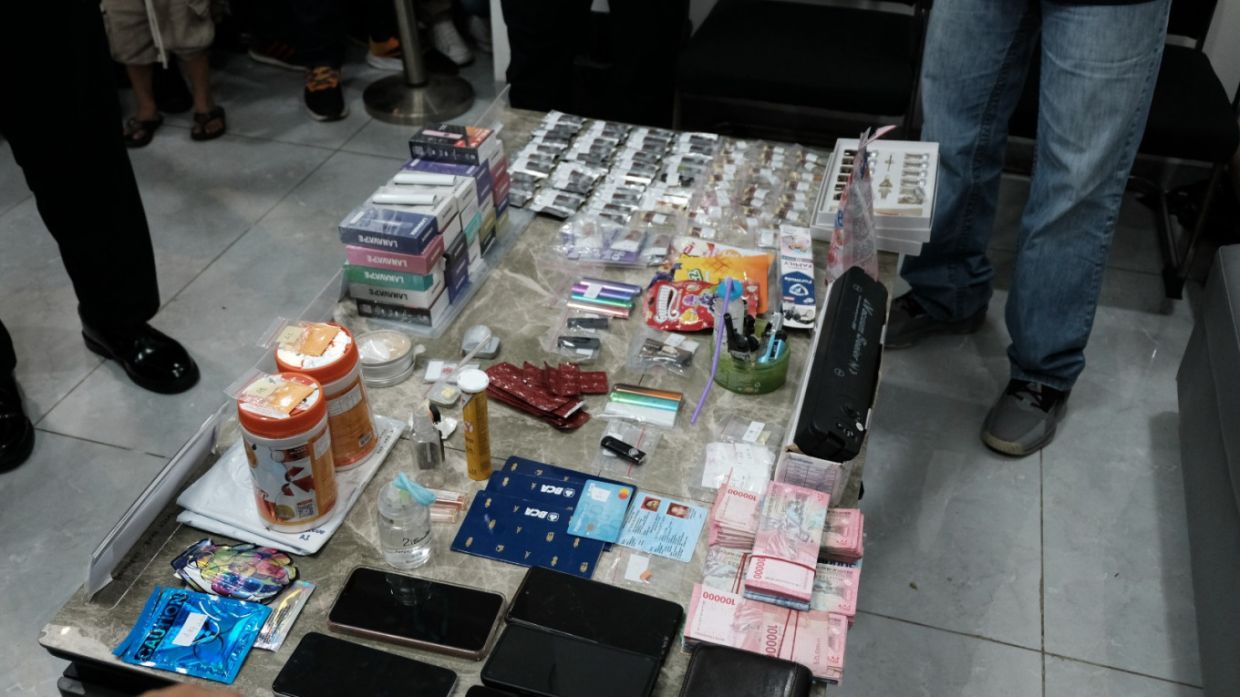
Subsequent raids on an apartment owned by TFS in Teluk Tering and a boarding house in Sakura Garden, Batu Ampar—where suspects AJ and DA were allegedly residing—uncovered extensive stockpiles of narcotics and drug paraphernalia. Authorities discovered dozens of electronic cigarette pods containing etomidate, sabu, Happy Five tablets, and sachets of Happy Water drinks, indicating the network employed sophisticated packaging techniques to disguise controlled substances as legitimate consumer products. The deployment of a K-9 sniffer dog from the Batam Customs and Excise Office during the Batu Ampar operation enhanced detection capabilities and confirmed the extent of drug concealment at the site.
While these raids were underway, Customs officers operating at Batam Centre International Ferry Terminal successfully intercepted a separate smuggling attempt. A Malaysian passenger identified as PS, who had travelled from Stulang Laut International Ferry Terminal in Johor Bahru, was detained while attempting to transport 48 cartridges containing etomidate across the maritime border. This interception demonstrates the persistent attempts by Malaysian nationals to supply the Batam market with etomidate, a veterinary anaesthetic increasingly diverted for recreational drug abuse throughout Southeast Asia.
The confiscated materials reveal the substantial scale of the operation. Authorities seized a total of 1,076.18 grams of MDMA, 50 grams of sabu, 25.6 grams of ketamine powder, 86 H5 tablets, 10 ecstasy pills, and 170 vape cartridges containing etomidate, alongside 12 vials of pure etomidate weighing 226 grams combined. The seizure also included 88 vape devices, nine bongs used for methamphetamine consumption, three plastic sealing devices, and six digital scales utilised in drug processing. Asset forfeiture extended to several vehicles: a Toyota Alphard van, Toyota Agya hatchback, Chery SUV, and two motorcycles believed to have been employed in distribution activities.
The syndicate's operational methodology reflected calculated attempts to evade law enforcement detection. Perpetrators systematically concealed drugs and etomidate-filled vape cartridges within dried food packages and food supplement sachets, then resealed containers using specialised plastic equipment to present them as authentic commercial products. This deceptive approach exploited standard inspection procedures and capitalized on the volume of legitimate food imports flowing between Malaysia and Indonesia through Batam's busy commercial channels. The sophistication of these concealment methods underscores the network's experience in narcotics trafficking and adaptation to border security measures.
Authorities continue to pursue two Malaysian nationals designated as SL and WKC, who have been officially placed on wanted lists for their purported roles as the syndicate's principal suppliers and organisers. The ongoing manhunt for these individuals represents a significant challenge to regional law enforcement, as extradition procedures and cross-border coordination between Malaysian and Indonesian authorities remain complex. The prominence of Malaysian involvement in supplying narcotics to Batam distribution networks reflects broader trafficking patterns affecting the Strait of Malacca region, where geographical proximity and maritime accessibility facilitate regular smuggling operations.
The criminal charges against detained suspects invoke Indonesia's stringent narcotics legislation. Prosecutors have applied Article 114(2) in conjunction with Article 132(1), or alternatively Article 112(2) in conjunction with Article 132(1), pursuant to Indonesia's Law No. 35/2009 on Narcotics. These provisions carry severe penalties, with convicted individuals facing imprisonment sentences ranging from a minimum of five years to capital punishment, supplemented by potential fines reaching Rp10 billion. The severity of potential sentences reflects Indonesia's zero-tolerance approach to large-scale drug trafficking and international smuggling networks threatening domestic security.
Batam Customs and Excise Office head Agung Widodo stated that the enforcement action potentially protected approximately 6,770 individuals from exposure to these harmful substances while preventing estimated rehabilitation costs amounting to Rp10.8 billion (US$599,000) for the Indonesian healthcare system. Beyond the immediate statistics, the operation represents a rare successful interdiction of an established cross-border supply network before its full destructive impact on Batam's youth and vulnerable populations materialised. Widodo characterised the operation as a continuation of routine daily border monitoring efforts, though the scale and sophistication suggest escalating narcotics trafficking attempts through this critical maritime gateway.
Investigators are examining potential connections between this dismantled network and a drug manufacturing facility recently raided by BNN and Customs personnel elsewhere in Batam. Should operational links be established, the case would reveal a vertically integrated criminal enterprise encompassing production, smuggling, and retail distribution. This possibility underscores the evolving complexity of narcotics trafficking in Southeast Asia, where Malaysian suppliers interface with Indonesian manufacturers and Batam distributors, creating a seamless regional network extending across multiple countries and jurisdictions. The investigation's ongoing nature suggests additional arrests and intelligence regarding the broader trafficking ecosystem remain probable as authorities continue pursuing identified leads.
The syndicate's dismantling provides temporary relief to Indonesian authorities combating drug proliferation through Batam's porous borders, yet the case illustrates persistent vulnerabilities in regional maritime enforcement. The continued targeting of etomidate—a legitimate pharmaceutical with widespread recreational abuse potential—indicates shifting patterns in regional drug trafficking as law enforcement restricts traditional narcotics. For Malaysian authorities, the case underscores the consequences of allowing nationals to engage in international drug trafficking, potentially straining bilateral relations and necessitating enhanced coordination mechanisms. The pursuit of SL and WKC will test cross-border enforcement capabilities and determine whether Malaysian authorities can successfully apprehend and extradite these high-priority trafficking suspects to face justice in Indonesia.

