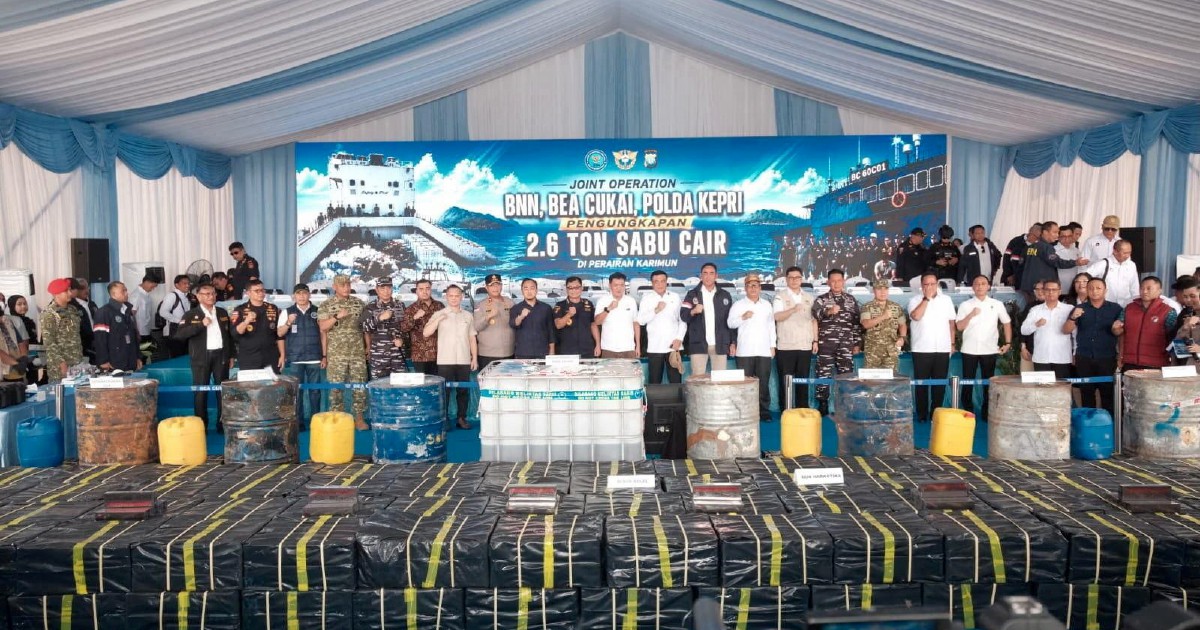
Indonesian authorities have dismantled a major drug trafficking network, arresting 10 Myanmar nationals and seizing an extraordinarily large cache of liquid methamphetamine weighing 2.6 metric tonnes from a vessel operating under Tanzanian registration. The operation represents one of the region's most substantial methamphetamine interdictions in recent years, with officials announcing details of the bust during a public briefing in Jakarta on Friday.
The sheer volume of the contraband underscores the scale of chemical drug production capacity within Southeast Asia's illicit supply networks. Liquid methamphetamine, a precursor chemical and concentrated form of the drug, commands significantly higher prices than powder varieties and represents industrialised-scale narcotics trafficking rather than localised criminal activity. The quantity seized—equivalent to millions of individual doses—highlights how transnational organised crime syndicates operate across Southeast Asia with sophisticated logistics and international shipping routes to move their products.
The involvement of Myanmar nationals in this operation reflects the broader role that Myanmar has assumed in regional drug manufacturing and trafficking networks. Since political instability deepened within Myanmar following the 2021 military coup, ungoverned border areas and territories controlled by various non-state armed groups have become increasingly crucial nodes in the methamphetamine production and distribution chain. Criminal networks exploit weak governance, porous borders, and the availability of precursor chemicals to establish clandestine laboratories that supply markets throughout Southeast Asia and beyond.
The use of a Tanzanian-flagged vessel reveals how international maritime commerce provides cover for narcotics operations. Traffickers frequently utilise flag-of-convenience registries, where vessels register under foreign jurisdictions that may offer weaker regulatory oversight or enforcement mechanisms. This maritime strategy enables drug syndicates to move massive quantities across shipping lanes with reduced visibility compared to overland smuggling routes, though such methods also create opportunities for coordinated international law enforcement interventions.
Indonesia's role as both a transit country and emerging destination market for methamphetamine positions the nation at the frontline of regional drug enforcement challenges. The archipelago's extensive coastline, numerous ports, and maritime geography make it vulnerable to maritime smuggling operations. Additionally, growing domestic demand for synthetic drugs within Indonesian urban centres has transformed the country from primarily a transit hub into an increasingly contested market, where local criminal organisations compete with international trafficking networks for distribution control.
The arrest of the 10 Myanmar nationals demonstrates improved information-sharing and operational capabilities within Indonesian law enforcement agencies. Success in seizing such a substantial quantity requires sophisticated intelligence networks, coordination between maritime authorities and anti-narcotics units, and potentially collaboration with regional partners. Indonesian authorities have increasingly prioritised methamphetamine trafficking as a security threat, recognising that proceeds from drug sales finance other forms of organised crime and violence.
This seizure carries profound implications for Malaysia and the broader Southeast Asian region. Methamphetamine has become the most prevalent synthetic drug across the region, with production facilities concentrated in the Myanmar-Laos-Thailand border region known as the Golden Triangle. Any disruption to trafficking routes or major interceptions potentially redirects supplies toward alternative corridors, including maritime routes through Malaysian waters and ports. Malaysian law enforcement agencies must anticipate possible supply rerouting following this bust.
The case also highlights the transnational character of modern drug trafficking, which transcends traditional bilateral enforcement cooperation frameworks. Myanmar nationals, a Tanzanian-flagged vessel, and seizure in Indonesian waters demonstrate how criminal networks operate as truly international enterprises. Effective responses require ASEAN-wide coordination mechanisms, intelligence sharing agreements, and capacity-building in maritime interdiction capabilities. Malaysia, as an ASEAN member and regional maritime power, has particular responsibility in contributing to coordinated enforcement efforts.
The methamphetamine trade generates enormous profits that finance corruption within state institutions across Southeast Asia. Traffickers employ portions of drug revenues to compromise law enforcement officials, judges, and government administrators, thereby undermining institutional integrity and rule of law. This particular case's successful prosecution will depend partly on whether Indonesian authorities can maintain investigative momentum and prevent suspects from exploiting judicial loopholes or securing premature releases through corrupt practices.
The detained Myanmar nationals face serious criminal charges within Indonesia's legal framework, where methamphetamine trafficking carries severe penalties including lengthy imprisonment and, in specified circumstances, capital punishment. Their prosecution will provide valuable intelligence regarding the organisational structure of trafficking networks, source locations for precursor chemicals, distribution targets, and customer bases across Southeast Asia. Information extracted through proper investigative channels could yield actionable intelligence for law enforcement agencies throughout the region.
Regional authorities have intensified focus on liquid methamphetamine production and trafficking as precursor chemical controls in traditional source countries have tightened. Liquid form allows traffickers to more efficiently transport massive quantities while potentially evading detection by certain screening technologies. This operational adaptation by criminal networks necessitates corresponding innovation in detection and enforcement capabilities by maritime and border authorities.
The success of this interdiction provides temporary disruption to supply chains but does not address underlying structural factors enabling drug manufacturing and trafficking. Myanmar's ongoing political instability, poverty within border communities, weak governance capacity, and substantial international demand for methamphetamine will continue driving trafficking activity. Comprehensive solutions require not merely enforcement actions but also coordinated regional development initiatives, governance strengthening, and demand reduction programmes throughout Southeast Asia and beyond.

