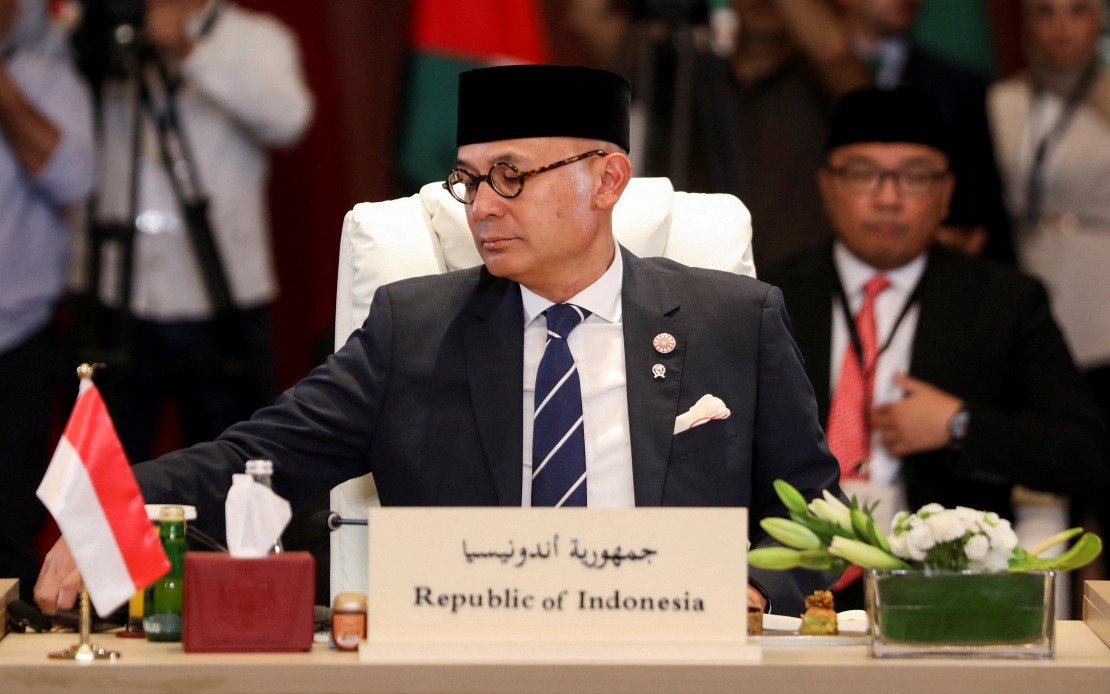
Indonesia has urged the international community to forge a cohesive global coalition backing the Palestinian cause, emphasising that the issue transcends religious boundaries and demands coordinated action rather than fragmented responses. Speaking at the Ministerial Meeting on Jerusalem in Amman, Jordan on Wednesday, Deputy Foreign Minister Arrmanatha Nasir, representing Foreign Minister Sugiono, articulated Jakarta's conviction that disunity among nations opposing Israeli policies has consistently served as an exploitable weakness for Israel's strategic interests.
The deputy minister's intervention at the summit underscores Indonesia's evolving role as a bridge-builder within Muslim-majority nations and the broader Global South on Middle Eastern affairs. His remarks signal Jakarta's frustration with the international community's inability to present a unified diplomatic front despite widespread consensus that Israeli actions—including military operations in Gaza, Lebanon, and Syria, along with expanding settlements in the West Bank—warrant coordinated responses grounded in international law and humanitarian principles.
Indonesia's proposal contained five specific initiatives designed to strengthen Palestinian support mechanisms and reshape the diplomatic architecture surrounding the conflict. The first pillar emphasises developing a common strategic framework rooted in international unity, moving beyond the current patchwork of bilateral and regional statements that lack enforcement capacity. Second, the proposal calls for concrete steps to enforce international law and respect rulings from the International Court of Justice, addressing the perception that Israeli actions operate without meaningful legal consequences. Third, Indonesia advocates for expanding formal international recognition of Palestine as a sovereign state, thereby consolidating its diplomatic standing.
The remaining two components of Indonesia's roadmap address specific vulnerabilities within Palestinian territories and institutions. Strengthening protections for the Al Aqsa Mosque and the broader Al Haram Al Sharif compound represents a priority for Muslim-majority nations, where any perceived threat to holy sites generates profound domestic political reverberations. Simultaneously, Indonesia prioritises support for Gaza's reconstruction and backing the mandate of the United Nations Relief and Works Agency for Palestine Refugees in the Near East (UNRWA), acknowledging that humanitarian needs and institution-building are prerequisite to long-term political solutions.
Arrmanatha's analysis of West Asia's transformed geopolitical landscape provides crucial context for understanding Indonesia's escalated advocacy. The illegal expansion of Israeli settlements in occupied Palestinian territories, combined with military escalations involving multiple regional actors and intensifying US-Iran tensions, has created what Jakarta perceives as an increasingly unstable environment requiring urgent preventive diplomacy. This assessment reflects Indonesia's broader security interests in preventing Middle Eastern instability from destabilising Southeast Asian trade routes and triggering regional spillover effects.
The Indonesian position reaffirms support for Jordan's custodianship over Jerusalem's holy sites, a position aligned with the Organisation of Islamic Cooperation consensus and the Arab League framework. This backing provides crucial diplomatic legitimacy to Jordan's role as guardian of Muslim and Christian holy places, distinguishing between Jerusalem's religious significance and the political question of Palestinian statehood. Indonesia's formulation carefully separates these dimensions, enabling the coalition to accommodate diverse national interests while maintaining focus on core principles.
The Amman summit itself reflected the diplomatic architecture Indonesia seeks to strengthen. Attended by foreign ministers and senior officials from Malaysia, Algeria, Saudi Arabia, Iraq, Egypt, Türkiye, Tunisia, Somalia, Pakistan, Morocco, Palestine, and Qatar, alongside Arab League leadership, the gathering demonstrated the breadth of support for coordinated action. The presence of both Gulf and North African representatives, alongside Pakistan from South Asia, illustrated the truly international dimensions of Palestinian advocacy in the contemporary moment.
The joint statement emerging from the ministerial meeting embraced three core commitments that operationalise Indonesia's strategic vision. First, the coalition committed to strengthening Palestinian institutions in Jerusalem, recognising that institutional capacity forms the foundation for eventual statehood. Second, participating nations explicitly rejected unilateral attempts to relocate diplomatic missions to Jerusalem, framing such moves as violations of international law rather than sovereign decision-making. Third, the coalition endorsed coordinated media campaigns to amplify awareness of Israeli actions and their consequences for regional and international stability, acknowledging that information warfare constitutes a critical dimension of contemporary diplomatic struggle.
For Malaysian readers and Southeast Asian observers, Indonesia's activism holds particular significance. As the region's largest Muslim-majority nation and a major voice within the Non-Aligned Movement and ASEAN, Indonesia's diplomatic initiatives on Palestine shape broader regional positioning on Middle Eastern questions. Malaysia's participation in the Amman meeting indicates alignment with this approach, suggesting that Southeast Asian nations are coordinating responses rather than acting independently on the Palestinian question.
Indonesia's emphasis on international law and ICJ rulings reflects Jakarta's investment in multilateral institutional frameworks as tools for constraining powerful states. This approach, while idealistic, represents Indonesia's strategic calculation that legitimacy derived from international legal consensus provides the only viable counterweight to asymmetrical power relationships. The proposal essentially argues that Palestinian advocacy succeeds only when framed as defending international law itself, not merely advancing a particular national cause.
The call for Palestinian national unity embedded within Indonesia's five-point proposal acknowledges a persistent tension: international support requires unified Palestinian representation, yet internal Palestinian political fragmentation complicates such unity. Indonesia's framing suggests that international coalition-building should proceed regardless of internal Palestinian divisions, implying that external support for institutions and legal rights need not await resolution of internal Palestinian disputes.
Indonesia's positioning ultimately reflects a sophisticated diplomatic calculation: the Palestinian cause requires reframing from a regional dispute toward a universal legal and humanitarian question affecting international peace and security. By emphasising international law, institutional frameworks, and coordinated multilateral action, Indonesia seeks to transform Palestinian advocacy from a geopolitically divisive issue into a matter of defending universal norms that transcend religious and cultural boundaries. This approach holds implications for how Southeast Asian nations navigate between Western and Muslim-majority blocs within an increasingly multipolar international system.

