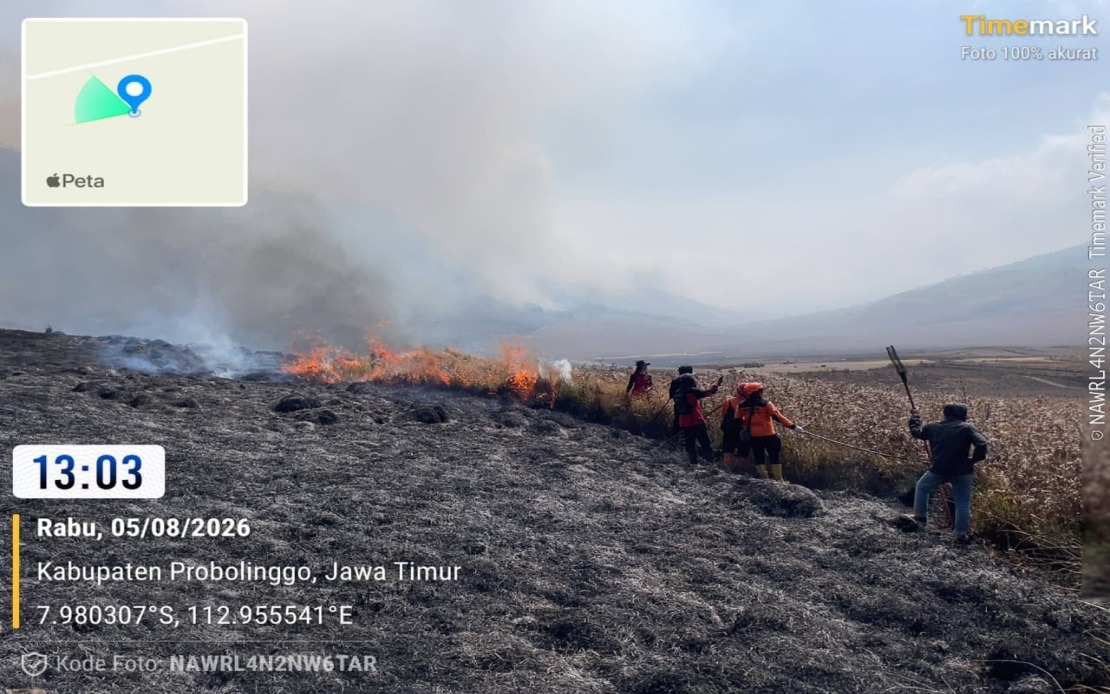
Indonesia has escalated its response to a significant wildfire consuming Mount Bromo's slopes, deploying water-bombing helicopters to reach flames spreading across approximately 60 hectares in East Java's Probolinggo and Malang regencies. The blaze, which ignited on Monday, represents the latest environmental emergency to strike one of the country's most iconic and ecologically sensitive volcanic landscapes, prompting authorities to declare the situation serious enough to warrant aerial intervention alongside conventional firefighting methods.
According to Abdul Muhari, head of the National Disaster Management Agency (BNPB)'s Disaster Data, Information and Communication Centre, the fire has been unevenly distributed across the affected areas. Approximately 10 hectares have been scorched in Probolinggo Regency, whilst the more substantial damage—roughly 50 hectares—has occurred within the Bromo Tengger Semeru National Park situated in the adjacent Malang Regency. This concentration of destruction in the protected national park area raises particular concerns regarding biodiversity and ecosystem preservation in a region internationally recognised for its unique natural heritage.
The decision to deploy aerial resources reflects the inherent challenges posed by Mount Bromo's topography. Ground-based firefighting teams, whilst crucial to containment efforts, face insurmountable obstacles when confronting flames burning across precipitous slopes and ravines inaccessible to vehicles or personnel on foot. The two water-bombing helicopters authorised by BNPB represent a tactical adjustment designed specifically to target stubborn hotspots that have proven resistant to conventional suppression methods. This aerial dimension of the response demonstrates how modern disaster management integrates multiple operational layers to address terrain-specific challenges.
By Wednesday afternoon, Indonesian emergency personnel had achieved substantial progress in bringing the majority of the fire under control. However, the lingering presence of active hotspots, particularly those entrenched in steep and remote sections of the mountain, necessitated continued vigilance and sustained firefighting operations. The resilience of certain fire clusters in difficult-to-reach locations underscores a recurring problem in wildfire management across Southeast Asian volcanic regions, where geographical barriers frequently complicate rapid extinguishment regardless of resource availability.
Beyond helicopter operations, BNPB has initiated preparations for a Weather Modification Operation to further suppress the remaining flames, contingent upon favourable atmospheric conditions developing over the affected area. This technique, involving cloud-seeding and other precipitation-inducement methods, represents an advanced technological approach that complements the simultaneous ground efforts executed by the joint emergency response task force. The combination of conventional and innovative firefighting strategies reflects Indonesia's increasingly sophisticated approach to managing large-scale natural disasters.
The temporary closure of selected Mount Bromo tourist zones, implemented by the Bromo Tengger Semeru National Park Authority, addresses dual imperatives of public safety and operational effectiveness. Restricting visitor access to closed sectors eliminates potential obstruction to firefighting operations whilst simultaneously protecting vulnerable tourists from smoke inhalation and sudden fire expansion. Tourism represents a significant economic driver for East Java's local communities, meaning extended closures carry tangible economic consequences that authorities must weigh against immediate safety considerations.
Investigations into the fire's origin point towards human negligence, with preliminary assessments suggesting that unattended campfires abandoned by trekkers sparked the initial ignition. Whilst cause determination remains technically under investigation, the widely reported hypothesis highlights a persistent challenge facing popular hiking destinations across Southeast Asia: balancing tourism access with environmental protection and wildfire prevention. Mount Bromo attracts thousands of domestic and international visitors annually, many undertaking pre-dawn summit treks that create seasonal fire risk when basic safety protocols are breached.
This incident resonates with broader regional concerns about wildfire escalation across the archipelago. Indonesia's volcanic geography, combined with seasonal dry conditions affecting East Java, creates recurring conditions conducive to rapid fire propagation. The Bromo emergency unfolds amid ongoing discussions about climate change's influence on fire frequency and intensity throughout Southeast Asia, suggesting that such incidents may become increasingly common without enhanced preventive measures.
For Malaysian readers and regional observers, the Mount Bromo situation offers instructive lessons regarding wildfire management in contested zones where conservation, tourism, and emergency response must coexist. The Indonesian response demonstrates both the necessity of advanced technological capabilities and the persistence of fundamental management challenges that technology alone cannot fully resolve. As Southeast Asian nations continue developing shared approaches to environmental emergencies, incidents like the Mount Bromo wildfire highlight the enduring importance of international cooperation, knowledge exchange, and coordinated best practice development across the region's forestry and disaster management sectors.

