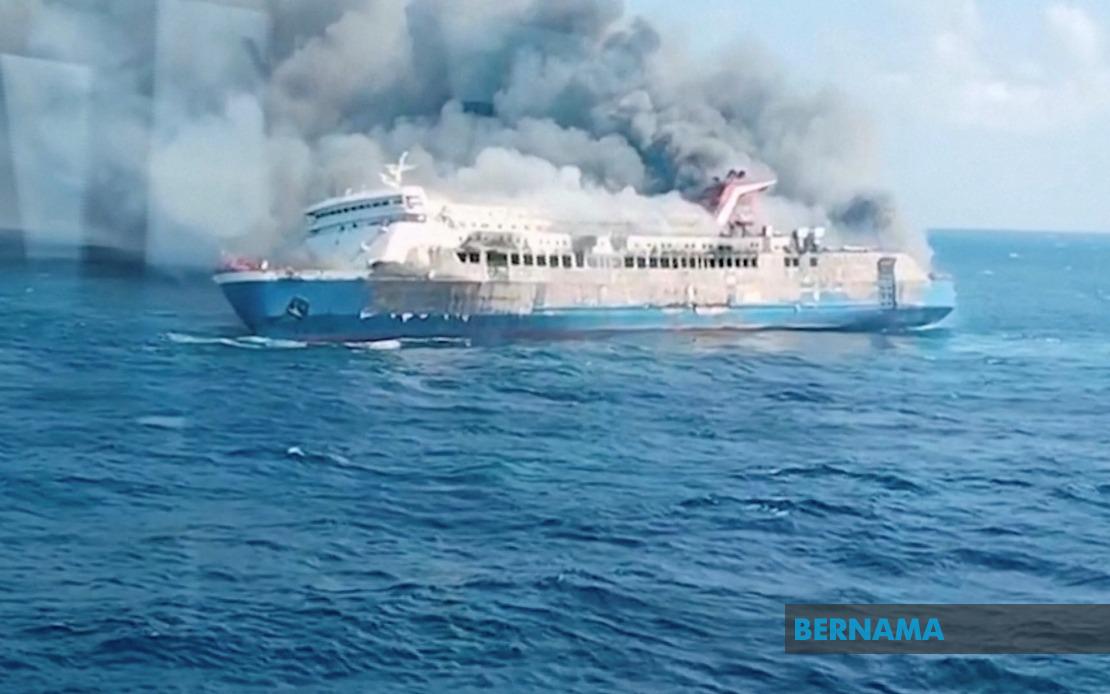
Rescue operations in the waters north of Sumenep, Madura, have been ramped up on their second day following a devastating fire aboard the KMP Mutiara Sentosa II ferry, which erupted early Monday morning and claimed at least five lives. Indonesian authorities have deployed significant naval and aerial resources to locate the dozens of passengers and crew still unaccounted for after the vessel caught fire at approximately 8:24 am local time in the northern waters off the East Java coast.
The ferry was operating with a combined complement of 271 persons aboard—232 passengers and 39 crew members—when the blaze broke out and rapidly consumed much of the vessel. The scale of the emergency has prompted a coordinated multi-agency response involving both civilian maritime authorities and military resources. Among the assets now engaged in the search-and-rescue mission is the TNI warship KRI Bung Hatta-370, reflecting the gravity with which Indonesian defence officials are treating the incident.
The Surabaya Search and Rescue Office, which coordinates operations in this region, has assembled a substantial task force to comb the surrounding waters. Beyond the military warship, the operation includes the State Ship Grantin P.211, the patrol vessel Manyar 5003, and a helicopter provided by the East Java Police. According to Nanang Sigit, Chief of the Surabaya Search and Rescue Office, these additional resources represent a deliberate intensification of initial response efforts as teams work against time to locate survivors and recover those who did not escape the burning vessel.
As of the latest updates, the rescue operation has achieved partial success, with 229 survivors having been evacuated in stages and transported to Tanjung Perak Port in Surabaya for medical assessment and treatment. The survivors represent the vast majority of those aboard, yet the uncertainty surrounding the remaining missing persons continues to drive the urgent response. The evacuation operation itself reveals the complexity of maritime rescue in Indonesian waters, where survivors must be transported significant distances to proper medical facilities.
The human cost of the disaster has so far been confirmed through the recovery of five bodies, which have been transferred to Bhayangkara H.S. Samsoeri Mertojoso Hospital in Surabaya for identification and medical examination. This figure is expected to rise as search teams continue their sweep of the affected waters. The identification process for recovered victims represents an additional challenge, as families await news and authorities work to establish accurate casualty counts.
For Malaysian readers, this incident underscores the ongoing maritime safety challenges that affect the broader Southeast Asian region. Ferry operations across Indonesia, Malaysia, and neighbouring countries carry millions of passengers annually, yet catastrophic incidents like this highlight the vulnerabilities that persist despite regulatory frameworks. The rapid spread of fire aboard the KMP Mutiara Sentosa II, consuming much of the vessel before evacuation could be completed, raises questions about vessel maintenance standards, fire safety protocols, and emergency preparedness that transcend national borders.
The Madura incident also reflects Indonesia's continued reliance on inter-agency coordination during maritime emergencies. The involvement of the TNI, police aviation assets, and dedicated rescue services demonstrates a structured approach to crisis response, yet the sheer number of missing persons suggests that initial containment and evacuation procedures may have been overwhelmed by the speed and intensity of the fire. Such patterns often emerge when vessels lack adequate firefighting equipment or when crew training proves insufficient to manage escalating emergencies.
From a regional perspective, ferry disasters in Indonesian waters carry implications for maritime transport policy across Southeast Asia. The KMP Mutiara Sentosa II operated in one of the world's busiest maritime corridors, where thousands of vessels transit daily. Any incident that exposes systemic weaknesses in vessel design, crew certification, or emergency response protocols generates scrutiny not only within Indonesia but among maritime regulators throughout the region, including Malaysia's maritime authorities.
The psychological and social impact of such disasters extends beyond casualty figures. Families and communities affected by the fire now face an agonising wait for confirmation of missing relatives' fates, while investigations into the cause of the blaze will likely consume months. Early indications suggest the fire spread with remarkable rapidity, yet investigators will examine whether maintenance failures, operational negligence, or inherent design flaws contributed to the catastrophe.
As the search operation continues, the challenge for authorities lies not only in locating remaining victims but in assembling comprehensive data about what occurred during those critical minutes when the fire first ignited. Survivor testimonies, crew records, and maritime investigation findings will eventually shed light on how a ferry carrying more than 270 people could suffer such devastating losses in the waters of one of the world's most heavily trafficked maritime regions. For the families of those still unaccounted for, the intensive search efforts now underway represent their last hope for answers and closure.

