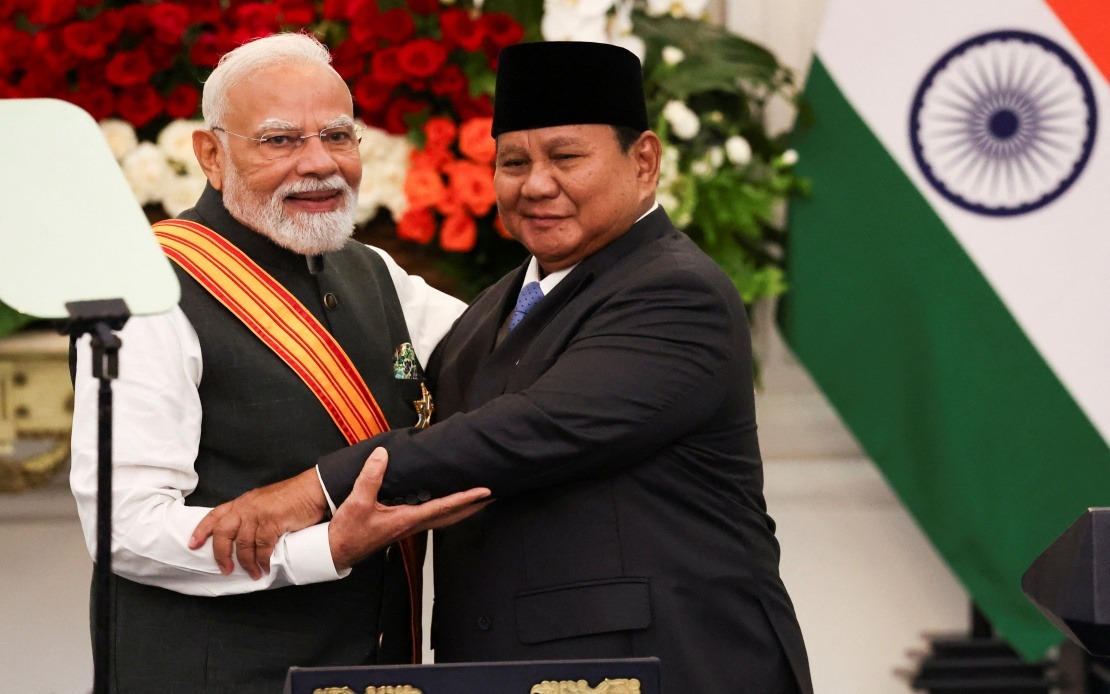
President Prabowo Subianto of Indonesia bestowed the nation's most prestigious award upon Indian Prime Minister Narendra Modi during an official state visit on Tuesday, marking a significant diplomatic milestone in New Delhi-Jakarta relations. The honour came as Modi addressed Indonesian parliament and held substantive bilateral discussions with Prabowo at the Merdeka Palace, with proceedings livestreamed to international audiences. This recognition underscores the depth of engagement between two of Asia's most influential democracies and signals the trajectory of their strategic alignment in an increasingly complex geopolitical landscape.
The Indonesian president articulated that the award represents acknowledgement of Modi's stewardship in elevating bilateral ties to the status of a Comprehensive Strategic Partnership, a designation that encompasses defence, economic, cultural, and technological cooperation. Beyond acknowledging Modi's personal leadership qualities, Prabowo specifically highlighted the concrete developmental initiatives that India has championed in support of Indonesia's own modernisation agenda. The president's framing of the honour suggests that Indonesia views Modi's tenure as having moved the relationship beyond ceremonial friendship into substantive collaboration that delivers tangible benefits to Indonesian development priorities.
This visit represents a reciprocal gesture, as Prabowo himself journeyed to India earlier in the calendar year. The symmetrical nature of these high-level visits demonstrates mutual commitment to maintaining engagement at the presidential level, a practice that strengthens the personal rapport necessary for steering bilateral relations through inevitable complexities. Such consistent exchange of visits at the apex level is relatively uncommon among regional powers and reflects deliberate cultivation of the partnership by both governments.
Historical context adds weight to this moment. Prabowo recalled that India's first Prime Minister Jawaharlal Nehru previously received the identical honour, recognition that stemmed from his pivotal contributions to Indonesia-India cooperation during the Cold War era and his instrumental role in establishing the Non-Aligned Movement. By drawing this parallel, the Indonesian president positioned Modi within a continuum of Indian leadership that has shaped Indonesia's foreign policy trajectory and regional standing. The gesture implicitly validates Modi's approach to engaging Southeast Asia as consistent with independent India's founding principles of strategic autonomy.
A notable dimension of this visit involved Indonesia's pursuit of Indian backing for its bid to secure permanent membership within BRICS, the influential bloc of major emerging economies. Prabowo explicitly thanked Modi for India's support of this objective, underscoring that bilateral relations now extend into competition for elevated status within global institutions. Indonesia's BRICS aspirations represent an effort to amplify its voice in debates surrounding global economic governance and development financing, arenas where India has already established considerable influence.
The foundation of contemporary India-Indonesia cooperation rests upon civilisational connections spanning centuries. Prabowo emphasised the deep historical and cultural underpinnings that distinguish this partnership, alluding to Buddhist and Hindu heritage sites that remain significant to Indonesian national identity and the long centuries of maritime trade and cultural exchange. These civilisational ties provide resilience to the bilateral relationship by rooting it in shared heritage rather than transactional interests alone, insulating the partnership from the volatility that sometimes characterises newer diplomatic relationships.
For Malaysian observers, this elevation of India-Indonesia ties carries regional implications. The consolidation of a robust India-Indonesia axis, particularly given Indonesia's role as chair and primary coordinator of ASEAN, could reshape the regional balance of power. India has increasingly sought to expand its presence in Southeast Asia through its Act East Policy, viewing the region as crucial to its strategic ambitions and economic aspirations. An empowered bilateral relationship with Indonesia potentially amplifies India's capacity to shape regional outcomes on issues ranging from maritime security to economic integration.
The strategic partnership between these two nations also reflects broader concerns about maintaining stability and openness in the Indo-Pacific region. Both countries share interest in preserving freedom of navigation, resisting coercive practices in disputed waters, and ensuring that regional frameworks remain inclusive and non-aligned in character. Modi's visit and the associated honour demonstrate that India has successfully positioned itself as an indispensable partner for Indonesia's vision of regional architecture.
Looking forward, the substance of India-Indonesia cooperation will determine whether this ceremonial recognition translates into meaningful outcomes. Defence cooperation, including naval exercises and technology transfer, economic partnerships in renewable energy and manufacturing, and people-to-people exchanges through educational scholarships represent areas where bilateral commitment can be tested. The success of these initiatives will signal whether the Comprehensive Strategic Partnership represents genuine convergence of interests or remains primarily symbolic.
For Southeast Asian states navigating great power competition, the India-Indonesia model offers instructive lessons. By strengthening ties with India while maintaining engagement with other powers, Indonesia demonstrates an approach to strategic autonomy that resists alignment with any single hegemon. Modi's visit, celebrated through Indonesia's highest honour, validates this balancing act and suggests that regional nations can deepen ties with India without sacrificing their own foreign policy flexibility or commitments to ASEAN centrality.

