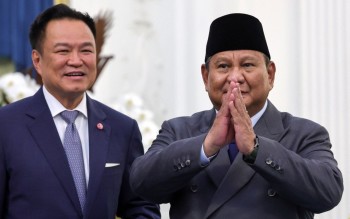
Indonesia has set its sights on achieving US$20 billion in annual bilateral trade with Thailand by 2030, following the formal adoption of a comprehensive strategic roadmap during talks between President Prabowo Subianto and Thai Prime Minister Anutin Charnvirakul at the Merdeka Palace in Jakarta on Monday. The roadmap, covering the 2026-2030 period, represents a significant escalation in ambition for two of Southeast Asia's largest economies and reflects growing recognition that their economic potential remains substantially underexploited despite their proximity and complementary trade profiles.
The meeting marked only the second Leaders' Consultation since Indonesia and Thailand elevated their relationship to a Strategic Partnership during Prabowo's visit to Bangkok last year, signalling the pace at which bilateral engagement has accelerated under the new Indonesian administration. For Thailand, Anutin's visit represents the first official trip to Indonesia since assuming office as the country's 32nd prime minister in September 2025, and it is the first visit by a Thai prime minister to Indonesia in 15 years—a gap that underscores how severely these ties had atrophied in recent years. The symbolic importance of this diplomatic renewal cannot be overstated, particularly as both nations navigate shifting regional dynamics and seek to strengthen ASEAN cohesion in an increasingly complex geopolitical environment.
At the heart of the partnership framework lies the establishment of the Indonesia-Thailand Joint Trade Commission, a mechanism being created to systematically identify business opportunities and dismantle trade barriers that have long constrained bilateral commerce. Prabowo emphasised during the joint press conference that this JTC would function as the primary institutional vehicle for advancing trade and investment goals, with both sides committed to expanding market access and facilitating smoother interactions between their respective business communities. The creation of such a formal structure reflects a deliberate shift away from ad hoc engagement towards structured dialogue designed to produce measurable outcomes and sustained momentum.
Thailand currently ranks as Indonesia's fourth-largest trading partner within ASEAN, a position that Anutin himself acknowledged underutilises the economic scale and complementarity of the two nations. Given Indonesia's vast natural resource wealth and Thailand's established manufacturing and agricultural capabilities, there exists substantial scope for deepening trade relationships across multiple sectors. The ambitious US$20 billion target effectively doubles what analysts suggest current bilateral trade volumes represent, placing significant pressure on both governments to implement the policies and institutional reforms necessary to achieve this expansion within the designated timeframe.
Food security emerged as a cornerstone of the strategic partnership, with both countries identifying agriculture and supply chain integration as critical areas for collaboration. Thailand has committed to serving as a dependable supplier of high-quality rice to the Indonesian market while simultaneously seeking enhanced access for Thai agricultural products, meat, dairy goods, and farming machinery. Perhaps more significantly, Thailand aims to substantially increase imports of Indonesian urea fertiliser, hoping to expand annual purchases from the current level of approximately 60,000 tonnes to several hundred thousand tonnes. This expansion would represent a substantial boost to Indonesian agricultural exports and reflect the type of value-added trade that generates meaningful economic benefits for both nations.
Energy cooperation represents another pillar of the partnership, with both countries moving to establish the Indonesia-Thailand Energy Forum as a mechanism for strengthening energy security and accelerating the transition towards renewable and sustainable power generation. This initiative carries particular relevance for Southeast Asia's broader energy security concerns, especially as the region seeks to balance growing electricity demand with climate commitments and reduce dependence on fossil fuel imports. By facilitating government and private sector collaboration in the energy domain, the forum could catalyse significant infrastructure investments and technology transfer that benefit both economies while contributing to regional climate objectives.
The digital economy has been identified as an emerging area for cooperation, with both nations expressing interest in promoting transactions conducted in local currencies to enhance the efficiency of bilateral trade and investment. This approach addresses longstanding frustrations among businesses regarding currency conversion costs and foreign exchange volatility, and signals willingness to develop financial infrastructure that reduces friction in cross-border commerce. Such initiatives often prove catalytic in expanding trade volumes by lowering transaction costs and improving predictability for smaller and medium-sized enterprises.
The halal industry presents a particularly promising avenue for collaboration, given both nations' established capabilities and substantial Muslim populations. Prabowo highlighted the potential for leveraging respective strengths in halal production to develop integrated regional and global halal value chains, positioning Indonesia and Thailand as major players in what constitutes a rapidly growing global market. Crucially, Anutin pressed for renewal of the mutual recognition agreement on halal certification before its November expiration, recognising that seamless recognition of standards facilitates trade and prevents duplicative compliance burdens on exporters.
Beyond headline trade figures, the partnership roadmap has already generated tangible commercial outcomes. Bilateral agreements have been concluded on education and human capital development, recognising that long-term competitive advantage depends on workforce capabilities and knowledge transfer. Private sector agreements have also been executed, including between the Tourism Authority of Thailand and TransNusa on tourism and connectivity enhancement, as well as between Bio-Axel and Pro Konsilium on organic waste processing infrastructure development. These ground-level partnerships demonstrate how strategic frameworks translate into investment and job creation.
For Malaysia and other ASEAN economies, the Indonesia-Thailand partnership roadmap carries significant implications. Stronger bilateral trade between these two major regional economies could reshape intra-ASEAN trade patterns and investment flows, potentially creating both opportunities and competitive pressures for smaller neighbours. Malaysian businesses operating in food processing, logistics, and digital services may find themselves competing with more integrated Indonesian-Thai supply chains, while Malaysian service providers could benefit from the infrastructure development and technology transfer these initiatives will generate. The partnership also signals Indonesia and Thailand's renewed commitment to regional economic integration, which could either strengthen ASEAN or create concentrated blocs of power within the association depending on how other members respond.

