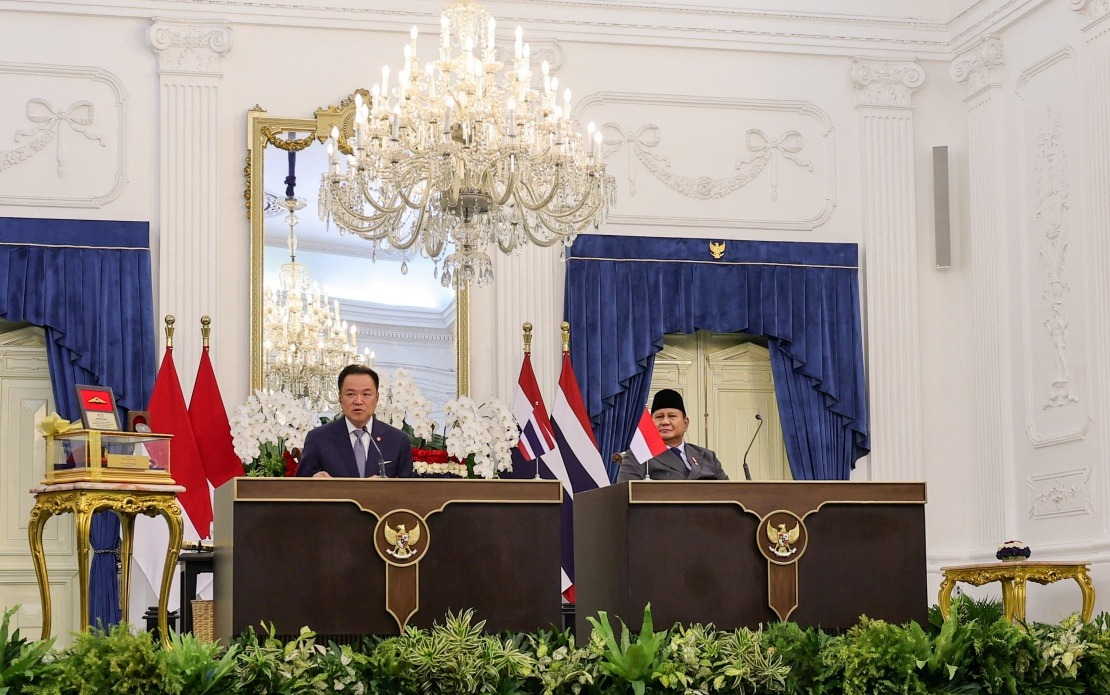
Indonesia and Thailand have reaffirmed their commitment to advancing ASEAN-led peace initiatives in Myanmar during high-level talks in Jakarta, signalling renewed diplomatic momentum for Southeast Asia's most pressing regional stability challenge. The second Leaders' Consultation between Indonesian President Prabowo Subianto and Thai Prime Minister Anutin Charnvirakul on Monday resulted in a joint pledge to accelerate implementation of the Five-Point Consensus through dialogue-based approaches, violence reduction mechanisms, and humanitarian assistance expansion. This coordinated stance reflects both nations' recognition that ASEAN's credibility as a regional institution hinges on demonstrating tangible progress toward Myanmar's political resolution.
The emphasis on ASEAN unity and centrality underscores a calculated diplomatic strategy to prevent external powers from overshadowing the bloc's preferred negotiating role. President Prabowo's public reaffirmation that Indonesia and Thailand would work collaboratively to position ASEAN as a constructive peace architect represents an attempt to strengthen the organisation's hand amid competition from China, India, and other major powers seeking Myanmar influence. For Malaysia and other ASEAN members, this Indonesian-Thai coordination offers some assurance that core ASEAN principles remain operative, though critics within the region have questioned whether dialogue mechanisms have sufficiently pressured Myanmar's military leadership to reverse course on violence against civilians.
Beyond Myanmar, the bilateral relationship has expanded significantly into security domains that reflect evolving transnational threats facing both nations. Indonesia and Thailand have formalised agreements to intensify joint operations against organised crime networks, with particular emphasis on dismantling online scam syndicates that have victimised thousands across Southeast Asia. This partnership encompasses intelligence sharing protocols, coordinated financial investigations, and aligned law enforcement strategies designed to trace criminal proceeds and identify operational hubs. For Malaysian readers, this development carries direct relevance given Malaysia's prominent role as both a hub and transit point for such criminal enterprises, suggesting that regional cooperation architectures may eventually extend to include Kuala Lumpur in a broader Southeast Asian security framework.
The scale of the transnational crime challenge justifies this elevated cooperation level. Thailand's acknowledgement that it had facilitated the repatriation of nearly one thousand Indonesian victims of online scam operations illustrates the human toll and operational sophistication of these criminal networks. These syndicates typically operate from Southeast Asian bases, recruit victims through social engineering across the region, and launder proceeds through cryptocurrency and shadow banking channels that cross multiple borders. The Thai-Indonesian commitment to establish a Transnational Referral Mechanism specifically targeting victim identification, protection, and dignified repatriation addresses a critical gap in existing law enforcement responses.
Thailand's proposed defence industry collaboration, including the supply of thirty-six amphibious wheeled armoured vehicles to Indonesia, signals deepening military interoperability between the two nations. This procurement arrangement transcends routine defence purchases, suggesting longer-term joint capability development and potential standardisation of equipment across their respective forces. For regional observers, such industrial partnerships often precede broader strategic alignments and can influence how bilateral relationships evolve during periods of regional tension or crisis. The military dimension of the relationship thus complements diplomatic cooperation on Myanmar and transnational crime, creating multiple reinforcing layers of strategic engagement.
Prime Minister Anutin's visit carries particular significance as the first official Thai prime ministerial trip to Indonesia in fifteen years, reflecting a diplomatic reset following years of relative institutional strain between Bangkok and Jakarta. Anutin's ascent as Thailand's thirty-second prime minister in September 2025 presented an opportunity to recalibrate regional relationships, and his choice to make Indonesia his early destination signals Bangkok's strategic priority toward strengthening ASEAN's central axis. This visit also marks a generational shift in Thai leadership's approach to Indonesia, potentially indicating Bangkok's recognition that long-term regional stability requires cultivating deeper institutional relationships with its larger neighbour.
The Thai prime minister's explicit proposal for expanded cooperation on wildlife trafficking demonstrates how security frameworks originally designed for counter-terrorism or conventional crime now encompass environmental crime and resource protection. This expansion reflects international recognition that transnational criminal enterprises have become vertically integrated operations exploiting multiple illicit commodities simultaneously. Online scam networks and human trafficking operations often share infrastructure, financing channels, and corruption networks with wildlife trafficking organisations, making coordinated enforcement responses increasingly necessary for effective disruption.
For ASEAN as a collective institution, this bilateral statement provides crucial scaffolding for the bloc's credibility on regional peace efforts. Myanmar's ongoing conflict threatens ASEAN's foundational principle of non-interference while simultaneously exposing the bloc's enforcement limitations against member state military action against civilian populations. By demonstrating coordinated policy positions on both Myanmar and transnational security threats, Indonesia and Thailand model the kind of intra-ASEAN cooperation that could potentially translate into more assertive collective positions. However, the emphasis on dialogue and consensus-building rather than coercive measures suggests that ASEAN's traditional operating principles remain fundamentally unchanged despite accumulating pressure for institutional reform.
The transnational crime cooperation architecture represents a potentially more successful avenue for ASEAN coordination than Myanmar peace efforts, given the technical nature of law enforcement cooperation and relative absence of sovereignty concerns that paralyse Myanmar discussions. Intelligence sharing, financial investigation protocols, and joint operations training can proceed without the political baggage surrounding Myanmar's internal affairs. Successful outcomes in these crime prevention domains could generate political capital and institutional confidence that might subsequently translate into more effective collective action on contentious regional issues. Southeast Asian governments increasingly recognise that organised crime expansion directly threatens their citizens' security and economic welfare, potentially mobilising political will that Myanmar's humanitarian dimensions have not yet achieved.
Looking forward, the Indonesian-Thai partnership on transnational crime may establish precedents for expanded multilateral security cooperation within ASEAN. Malaysia, Singapore, and Vietnam possess significant capabilities and interests in combating online scam operations, human trafficking, and drug networks that could complement Thai-Indonesian initiatives. The establishment of referral mechanisms and victim protection frameworks could eventually evolve into standardised regional protocols, though such institutional development typically proceeds incrementally through bilateral agreements that accumulate into broader arrangements. For Malaysian policymakers and security practitioners, this trajectory suggests opportunities to participate in emerging security cooperation frameworks while maintaining flexibility to adapt as regional threat assessments evolve.
The joint commitment to supporting Myanmar peace efforts through the Five-Point Consensus framework reflects continued Indonesian and Thai faith in ASEAN-led diplomacy despite mounting criticism that dialogue mechanisms have failed to produce meaningful conflict resolution outcomes. Neither leader departed from established ASEAN consensus on Myanmar, indicating that the organisation's founding commitment to non-interference remains politically constraining even as armed conflict generates humanitarian crises attracting international attention. This tension between ASEAN principle and practical engagement limitations will likely persist, with bilateral partnerships like the Indonesian-Thai arrangement potentially offering incremental progress on discrete issues even as broader Myanmar conflict dynamics continue deteriorating. Regional stakeholders must therefore calibrate expectations for what ASEAN-centred approaches can realistically achieve while recognising that transnational security cooperation may ultimately prove more tractable than peace arbitration.

