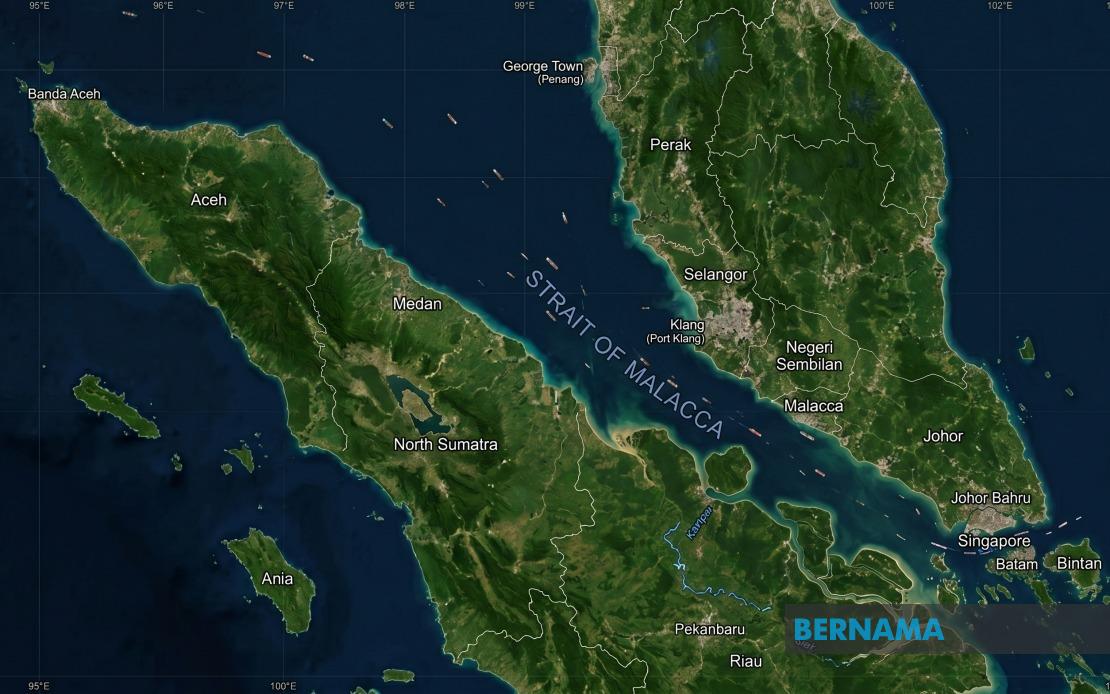
Indonesia and Singapore have jointly recommitted themselves to protecting the Strait of Malacca during high-level talks in Jakarta, with both nations underlining their shared responsibility for maintaining the integrity of one of the world's most strategically vital maritime corridors. The pledge emerged from the annual Indonesia-Singapore Leaders' Retreat between President Prabowo Subianto and Prime Minister Lawrence Wong, during which the two leaders discussed the full spectrum of bilateral, regional, and international concerns affecting their nations and the broader Indo-Pacific region.
The Strait of Malacca represents far more than a simple maritime passage. For Malaysia, Singapore, and Indonesia—the three nations whose territorial waters define the waterway—the corridor handles roughly one-quarter of global maritime trade and remains essential to energy supplies flowing to East Asia. Any disruption to this channel sends immediate ripples through regional economies and beyond, making its security a matter of paramount concern for all three bordering states. Prabowo's emphasis on keeping the strait open to all parties reflects the foundational principle that while the three nations bear primary responsibility for the waterway, international commerce and freedom of navigation remain non-negotiable.
Central to Monday's discussions was the anchoring of both nations' stewardship efforts within the 1982 United Nations Convention on the Law of the Sea, the international legal framework governing maritime rights and responsibilities. By explicitly referencing UNCLOS, Jakarta and Singapore signalled that their approach to strait management respects established international law rather than pursuing unilateral control—a positioning that carries significance given historical tensions and competing interests in Southeast Asian waters. This legal grounding provides a stable foundation for coordinating with Malaysia and Thailand, the other key stakeholders whose cooperation is essential for comprehensive security measures.
Beyond the narrower security dimension, both leaders recognised that safeguarding the Strait of Malacca encompasses an array of interconnected challenges requiring sustained vigilance and cooperation. Prabowo specifically identified pollution and maritime accidents as threats requiring collective attention alongside the more familiar concern of piracy. Environmental degradation in the strait poses serious long-term risks to the ecosystem and to shipping safety, whilst accidental collisions or spills could compromise the waterway's utility and trigger diplomatic crises. This expanded definition of maritime security reflects evolving understanding among Southeast Asian policymakers that traditional military-centric approaches prove insufficient without complementary measures addressing environmental and operational hazards.
The Leaders' Retreat framework itself carries symbolic weight in the Indonesia-Singapore relationship. Prabowo characterised this as the second such annual gathering, indicating the establishment of a structured dialogue mechanism at the highest political level. This institutionalisation suggests both nations view their partnership as sufficiently important to warrant regular engagement on strategic matters, extending well beyond the bilateral commercial and security relationship to encompass regional architecture and international developments. The retreat model allows leaders to move beyond formal agendas and press statements to forge personal understanding and alignment on complex, evolving challenges.
Looking ahead, the two countries will mark six decades of diplomatic relations next year, a milestone that Prabowo identified as a foundation for deeper future cooperation. This backward glance toward shared history serves as prologue to forward-looking partnership building. The Indonesian leader explicitly connected the bilateral relationship to broader regional outcomes, expressing confidence that sustained Indonesia-Singapore collaboration would contribute to overall Southeast Asian stability, economic growth, and prosperity. This framing positions the Strait of Malacca security framework not as a narrow security concern but as integral to regional development and wellbeing.
Wong's journey to Jakarta underscored Singapore's commitment to these high-level engagements, with the prime minister arriving specifically for the annual retreat. For the city-state, dependent on unimpeded maritime access and deeply integrated into regional trade networks, the Strait of Malacca represents a cornerstone of national prosperity. Singapore's willingness to invest diplomatic capital in regular leadership talks with Indonesia demonstrates how both nations recognise the mutual interest underpinning their stewardship responsibilities. The personal relationship between leaders facilitates candid discussions on sensitive matters that might prove more fraught through lower-level bureaucratic channels.
The commitment to resolving regional disputes through peaceful dialogue and diplomacy, referenced during the press conference, carries particular resonance given ongoing tensions elsewhere in Southeast Asia. By explicitly reaffirming ASEAN's position on dispute resolution and emphasising the importance of addressing misunderstandings through open dialogue between friends, both leaders signalled that they view the ASEAN approach as a model applicable beyond Southeast Asia itself. This messaging suggests Indonesia and Singapore see their partnership on the Strait of Malacca not merely as a technical management exercise but as a demonstration that major powers can cooperate effectively on shared interests without threatening sovereignty or autonomy.
For Malaysian policymakers and observers, the Indonesia-Singapore reaffirmation carries clear implications. Malaysia's own critical role as the third bordering nation means that strait security ultimately depends on triangular cooperation among all three states. The emphasis on coordinating with Malaysia and Thailand signals that Indonesia and Singapore recognise the framework cannot function without active participation from these partners. This creates both opportunity and responsibility for Malaysia to shape how collective security measures develop and to ensure that its interests in maintaining sovereignty over its territorial waters are respected within any coordinated arrangements.
The reaffirmation also occurs against a backdrop of evolving maritime security challenges in Southeast Asia more broadly. Piracy, particularly around the Sulu and Celebes Seas, has generated regional alarm in recent years, whilst the rise of unmanned systems and cyber threats introduces new dimensions to traditional maritime security concerns. By anchoring their commitment to the Strait of Malacca within a comprehensive framework addressing multiple hazards, Indonesia and Singapore position themselves as forward-thinking maritime powers responsive to contemporary challenges rather than stuck in Cold War paradigms.
The Leaders' Retreat format, by encompassing bilateral, regional, and global issues within a single high-level engagement, reflects recognition that maritime security cannot be divorced from broader geopolitical and economic contexts. Discussions touching on regional architecture, ASEAN dynamics, and international developments provide essential context for understanding why the Strait of Malacca requires the particular protection and stewardship that Indonesia and Singapore pledge. The waterway's security depends not only on effective patrols and coordination mechanisms but on the broader political-strategic environment in which those mechanisms operate.
Moving forward, the challenge for Indonesia, Singapore, Malaysia, and Thailand will lie in translating these public commitments into concrete, coordinated operational measures. Regular leadership engagement provides the political foundation, but sustained progress requires institutional mechanisms, capacity building, information sharing, and resource allocation at technical levels. The commitment to preserve the Strait of Malacca as a secure, open passage serving international commerce depends ultimately on how effectively the three bordering nations translate their shared interest in stability into practical cooperation.
As the region confronts mounting strategic competition and evolving security challenges, the Strait of Malacca will remain a focal point where national interests intersect with regional stability and international commerce. Indonesia and Singapore's reaffirmed commitment, backed by the structural support of annual Leaders' Retreats and anchored in international law, provides a framework for managing this critical waterway responsibly. For Malaysia and other Southeast Asian nations, this partnership represents both a reassurance that major powers are taking strait security seriously and a reminder that effective regional stewardship ultimately serves everyone's interests in stability and prosperity.

