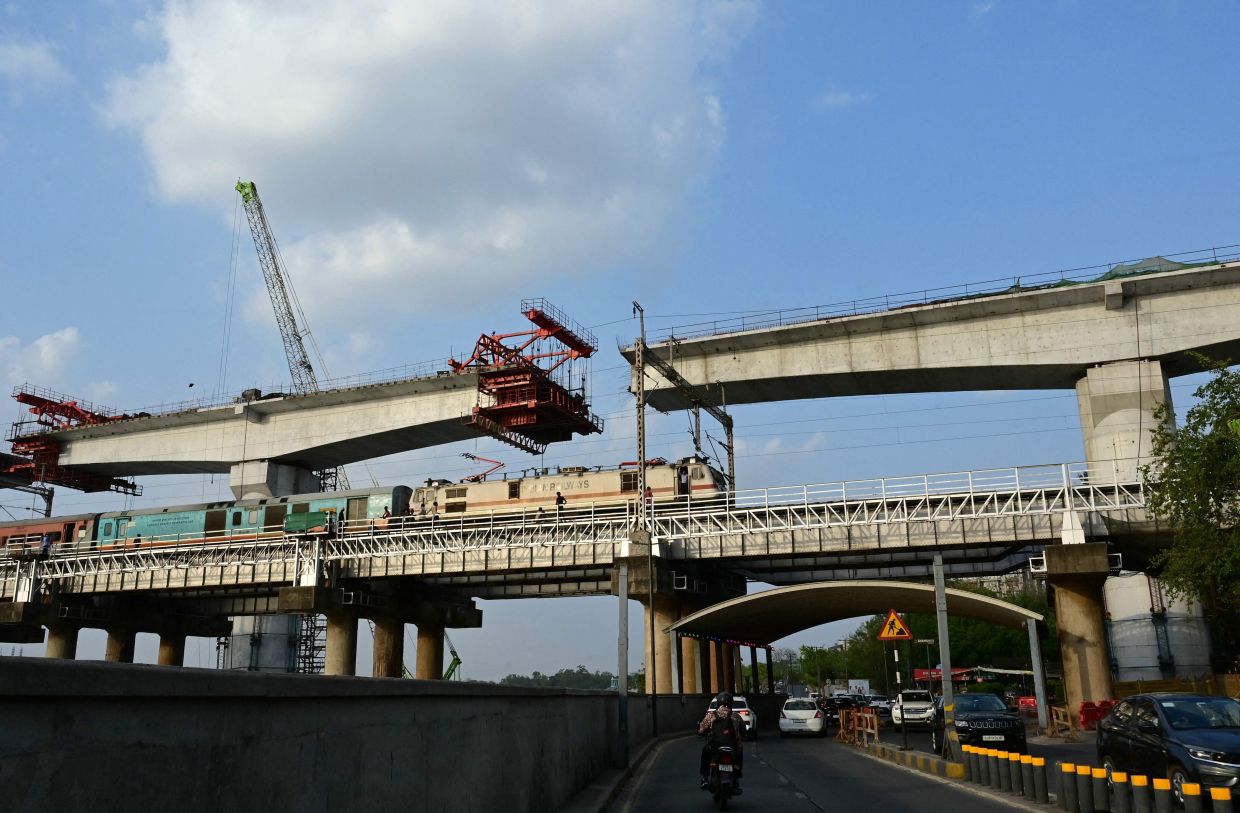
After nearly a decade of fits and starts, India's ambitious first high-speed rail project is approaching a concrete milestone. Railway officials in New Delhi have confirmed that the opening section of the Mumbai-Ahmedabad High Speed Rail Corridor will begin operations in 2027, marking a pivotal moment for a nation that has long struggled to deliver large infrastructure projects on schedule. The inaugural segment will connect Surat and Vapi, two industrial cities separated by roughly 100 kilometres along India's western coast, with services operating at speeds of up to 320 kilometres per hour.
The project represents far more than a single railway line. Indian policymakers view it as a template for broader transformation of the country's creaking transport networks. Dharmendra Tewari, the Indian Railways' additional director general, emphasised that significant progress has already materialised across the entire 508-kilometre corridor, with construction work advancing steadily despite historical challenges. Government planning documents stress that technical knowledge and engineering expertise gained through this flagship project will cascade into subsequent high-speed rail initiatives, potentially reshaping how Indians travel between major metropolitan areas and industrial hubs.
The journey from announcement to operation has been remarkably protracted. Launched with considerable fanfare in 2017 by then-Prime Minister Narendra Modi and Japanese counterpart Shinzo Abe, the project was originally scheduled for completion by 2023. That timeline has since extended by four to five years, reflecting the complexities of land acquisition, environmental clearances, and the engineering challenges inherent in building such infrastructure across populated regions. The delays have inevitably raised concerns about final costs, which the government officially pegs at US$17 billion, with Japan's International Cooperation Agency financing 81 per cent through concessional loans.
Though the government maintains its cost projections, Indian media outlets have flagged mounting expenses tied to land compensation and implementation hurdles. Such cost escalation is hardly unusual in Indian infrastructure development, where property rights disputes, compensation negotiations with affected communities, and bureaucratic approval processes frequently exceed initial budgets. The financial commitment underscores the magnitude of New Delhi's railway modernisation agenda, even as questions linger about whether completion dates will hold firm given the project's history.
When fully operational between Mumbai and Ahmedabad, the bullet train will halve current journey times. The route currently consumes six hours by conventional rail or four to five hours by air when including airport procedures. Under the new service, travellers will accomplish the journey in just under two hours, creating a high-speed corridor linking India's financial capital—a metropolis of 22 million people—with Ahmedabad, a key city in Modi's home state of Gujarat. This reduction matters significantly for business travellers, creating what Indian planners call an "economic integration zone" stretching across India's wealthiest coastal region.
The engineering obstacles encountered during construction reveal the ambition embedded in the project. The route includes a 21-kilometre tunnel burrowing through mountainous terrain and India's first undersea rail tunnel, which remains under construction. These engineering feats demand cutting-edge technology and construction expertise, explaining partly why India has relied on Japanese Shinkansen technology rather than developing indigenous high-speed rail systems. The transfer of such technical knowledge arguably justifies the substantial financial outlay, creating domestic capabilities for future projects.
Government officials target full corridor completion by the end of 2028, conveniently positioning the project for Ahmedabad's hosting of the 2030 Commonwealth Games. That timing is deliberate. The Commonwealth Games represents a showcase for India's infrastructure development before the international community, with planners explicitly viewing it as a stepping stone toward realising the country's broader Olympic aspirations—namely, hosting the 2036 Summer Games. The bullet train's gleaming stations and high-speed services would provide a powerful visual statement about India's technological advancement and modernisation trajectory.
Beyond the immediate Mumbai-Ahmedabad corridor, the government has outlined an extraordinarily ambitious vision encompassing seven high-speed rail corridors totalling 4,000 kilometres. These proposed networks would integrate India's major economic and cultural centres while addressing persistent regional disparities. One projected east-west corridor would link New Delhi to Varanasi—Modi's parliamentary constituency and Hinduism's holiest city—and Siliguri, a strategic junction connecting India's isolated northeastern states to the national mainstream. A complementary north-south network would traverse from Ahmedabad through Mumbai, Pune, Hyderabad, and Chennai, linking the subcontinent's principal technology and financial hubs.
These ambitious expansion plans reveal how Modi's government conceptualises infrastructure as both economic stimulus and nation-binding exercise. By linking disparate regions through rapid transit networks, planners argue these "growth connectors" would facilitate labour mobility, reduce regional economic imbalances, and strengthen national integration. The terminology itself—framing high-speed rail as infrastructure that connects not merely cities but growth itself—reflects how New Delhi positions such projects within broader development narratives.
Yet the gap between vision and implementation remains vast. While the Mumbai-Ahmedabad segment at least possesses concrete timelines and advanced construction status, the proposed seven-corridor network exists primarily as planning documents lacking implementation schedules or committed funding mechanisms. India's railway system, despite substantial government investment, still grapples with fundamental challenges: an 85,000-kilometre network with approximately 80 per cent of lines capable of exceeding 110 kilometres per hour represents progress, yet remains modest compared to developed nations' high-speed infrastructure. The domestically manufactured Vande Bharat trains, capable of 180 kilometres per hour, have attracted nearly 40 million passengers, demonstrating public appetite for faster rail services.
For regional observers, India's bullet train project carries implications extending beyond India's borders. As Southeast Asia grapples with its own high-speed rail ambitions—particularly proposed corridors connecting major metropolitan centres—India's experience offers instructive lessons about implementation timescales, cost management, and technology transfer from established high-speed rail nations. The Myanmar-Kunming high-speed rail project and various Southeast Asian corridors similarly contemplate Japanese or Chinese technology adoption, making India's experience with Shinkansen integration potentially relevant to neighbouring countries navigating comparable decisions.
The 2027 opening of the Surat-Vapi section will represent vindication for Modi's long-standing commitment to rail modernisation, yet it will simultaneously reset expectations about the expanded network's timeline. If the inaugural corridor's decade-long development trajectory continues with subsequent phases, realising the complete vision of integrated high-speed rail connectivity spanning the subcontinent may require patience extending into the 2030s. Nevertheless, the approaching reality of India's first operational bullet train signals unmistakable momentum in modernising South Asia's largest economy's transport infrastructure.

