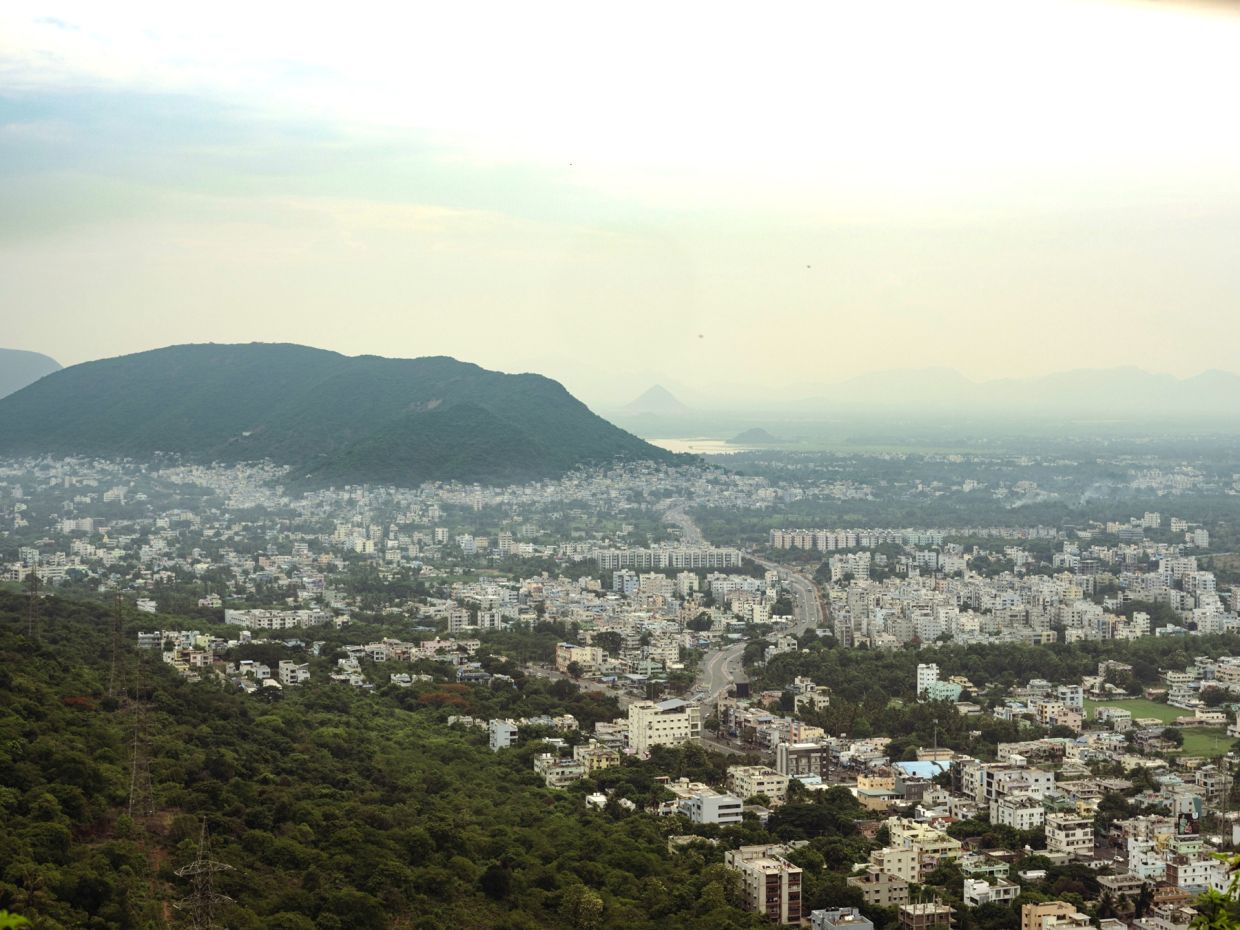
India is moving aggressively to position itself as a serious player in the global artificial intelligence race, with the coastal city of Visakhapatnam emerging as a focal point for this ambitious strategy. Two colossal data centre projects—one involving Google and the Adani Group, the other a joint venture with Brookfield Asset Management and Reliance—are being constructed simultaneously in the region, promising to more than double the country's data centre capacity by the time they become operational. Yet this high-speed industrialisation is triggering alarm among local residents, environmental campaigners, and former government officials who question whether the costs of rapid technological advancement are being fairly distributed.
The urgency driving India's data centre expansion stems from a troubling reality that policymakers cannot ignore: despite possessing roughly one-fifth of the world's data production capacity and a deep reservoir of technology talent, India lags significantly in developing homegrown artificial intelligence capabilities. A Morgan Stanley analysis branded the country a "laggard" in building competitive AI systems, while billions of dollars in investment capital have migrated instead to regional competitors such as Taiwan and South Korea that specialise in cutting-edge semiconductor manufacturing. This structural weakness has pushed India's policymakers toward a more pragmatic objective—establishing the infrastructure to deploy and utilise AI technologies developed elsewhere, rather than pioneering new innovations domestically.
The welcome banners erected in Tarluvada village, featuring the smiling faces of Prime Minister Narendra Modi and Andhra Pradesh's information technology minister Nara Lokesh, reflect the political enthusiasm for these projects. Government officials present the data centre investments as catalysts for broader economic transformation. Lokesh frames the developments not simply as facilities for processing information, but as nuclei for entire industrial ecosystems encompassing power electronics manufacturing, advanced air conditioning systems, and building materials production. The calculation is straightforward: attracting global technology firms will create multiplier effects, generating subsidiary investment and employment across multiple sectors. This narrative has substantial appeal in Andhra Pradesh, where southern Indian states compete intensely for foreign investment against regions perceived as less business-friendly.
Yet the ground-level reality in Visakhapatnam reveals deep community scepticism. Hyperscale data centres impose formidable resource demands that their operators rarely acknowledge publicly. These facilities consume enormous quantities of electricity and water for cooling systems—requirements that become particularly problematic in regions already experiencing water stress and energy supply constraints. India faces this challenge acutely, with Visakhapatnam experiencing seasonal disruptions to water availability. Similar projects have encountered sustained opposition in the United States, where communities have successfully delayed or blocked data centre developments worth billions of dollars, forcing technology companies to confront local environmental and resource concerns previously dismissed as peripheral.
Critics argue that the Indian government, desperate to demonstrate progress in the AI competition, has compromised environmental standards and procedural transparency to accelerate project timelines. They contend that ecological clearances have been granted for construction in environmentally sensitive areas where conventional regulatory standards would normally impose restrictions. The absence of public disclosure regarding water sourcing, electricity supply chains, and subsidy distribution compounds local anxiety. A Human Rights Forum campaigner posed a pointed question about why a developmental initiative of this magnitude should remain shrouded in government secrecy typically reserved for defence matters. This opacity reflects broader patterns in Indian governance, where dissent is often suppressed rather than engaged, preventing communities from meaningfully participating in decisions that will affect their long-term living conditions.
The partnership between Google and billionaire Gautam Adani merits particular scrutiny. Adani's commercial fortunes have expanded substantially during Modi's twelve-year tenure, and his reputation for navigating India's bureaucratic landscape—sometimes through means that raise governance questions—precedes these projects. Government assurances that water and energy demands will not burden local communities contrast sharply with independent analyses suggesting otherwise. Former senior finance and energy ministry official EAS Sarma, who holds a doctorate in energy planning, argues that infrastructure costs inevitably accumulate on residents' utility bills, regardless of formal subsidy structures. The technology of cooling systems matters less than the political economy of cost-shifting, he suggests—transmission line construction alone will generate expenses that ultimately reach households and small businesses.
Government and company representatives counter these criticisms by emphasising technological solutions and regulatory compliance. They emphasise that cooling infrastructure will minimise water consumption and operate independently from potable water supplies, while Google will invest in renewable energy generation and guarantee that subsidies will not transfer costs to the state or local communities. The official narrative promises approximately 120,000 construction jobs and 60,000 permanent positions once operations commence. However, environmental and employment analysts have questioned these projections, noting that they appear inflated relative to staffing levels documented in comparative data centre projects internationally. Environmental clearance documents submitted for official review contain surprisingly granular details about parking space requirements and toilet-flushing water volumes, yet fail to justify employment estimates that seem disconnected from automation levels typical in hyperscale facilities.
India's employment challenge adds another dimension to this controversy. The country must generate productive work for 1.4 billion people while simultaneously embracing labour-displacing technologies like artificial intelligence and automated data processing. The International Monetary Fund has warned that AI adoption could produce a "tsunami hitting the labour market," particularly disrupting India's vital technology support and business process outsourcing industries. Data centre projects exemplify this paradox—they represent India's technological aspirations while offering minimal employment in a nation where job creation remains economically critical. If the Visakhapatnam facilities deliver substantially fewer permanent positions than officially promised, the opportunity costs of prioritising data infrastructure over employment-intensive development strategies will become impossible to ignore.
The competitive dynamics among India's southern states amplify pressure to approve projects with minimal resistance. States like Karnataka, Tamil Nadu, and Andhra Pradesh recognise that attracting global technology investment signals economic modernity and attracts subsequent private sector activity. In this environment, officials become incentivised to downplay environmental concerns and sideline local opposition, characterising resistance as backward-looking resistance to progress. Yet the experience of other countries demonstrates that this framing is false—communities can simultaneously welcome technological advancement while insisting on transparency, environmental protection, and fair cost distribution. Lokesh's assertion that the Google project reflects "due process" and merely eliminates unnecessary bureaucracy rather than circumventing essential protections deserves scrutiny rather than acceptance.
For Southeast Asia and other regions pursuing similar development strategies, the Visakhapatnam situation offers instructive lessons. India's approach prioritises speed and visible foreign investment while deprioritising public participation and environmental caution—a model that many developing economies have adopted or contemplated. Yet the mounting costs of compressed decision-making timelines become apparent only after projects become operational and environmental damage or social disruption materialises. Malaysia and other nations pursuing data centre and technology infrastructure development would benefit from examining whether India's experience suggests that transparency, community engagement, and environmental impact assessments represent obstacles to overcome or essential safeguards that prevent future costly reversals.
The fundamental tension underlying these projects reflects a broader question about who bears the costs of technological advancement. Google, Adani, and other technology firms will capture the economic value generated by data centre operations, while environmental degradation, water scarcity, and displaced employment fall disproportionately on local populations. India's government has essentially chosen to subsidise global technology giants by accepting these externalities, betting that aggregate economic growth will eventually generate offsetting benefits. This calculation may prove correct—or residents of Visakhapatnam may eventually conclude that they subsidised the AI revolution on terms dramatically unfavourable to their own interests.

