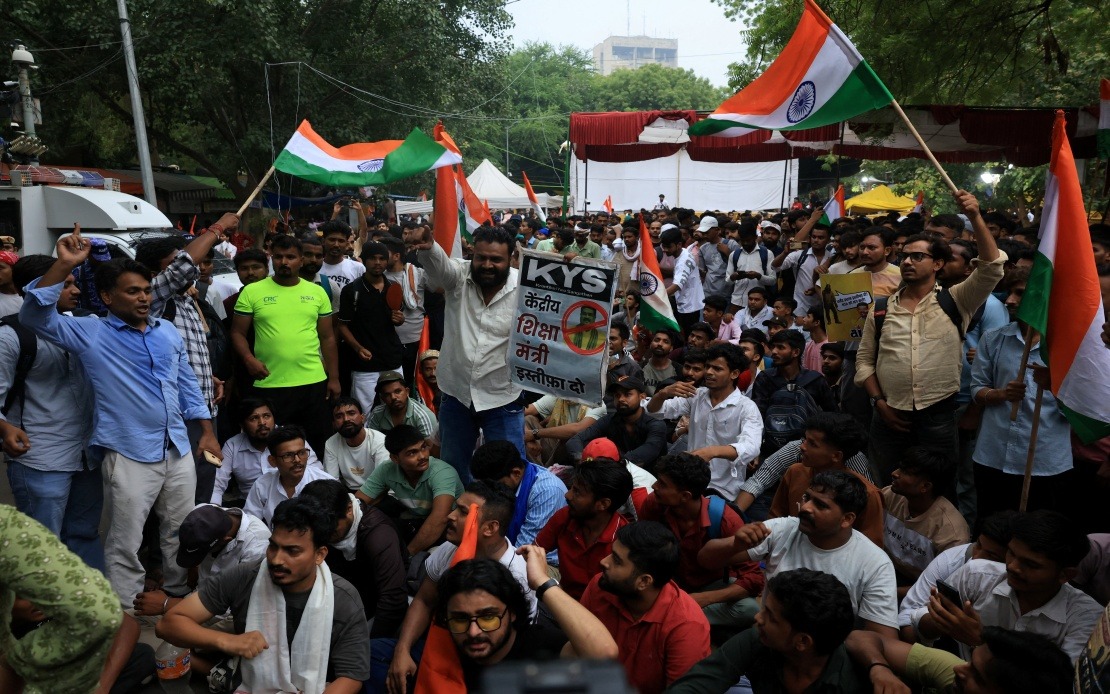
Thousands of demonstrators descended on India's capital on Monday to pressure lawmakers into overhauling the nation's academic system, staging a direct challenge to the government as parliament convened for its Monsoon Session. The "Sansad Chalo" rally—a Hindi phrase meaning "march to parliament"—saw protesters attempt to breach police barricades surrounding the legislative complex in New Delhi, triggering deployment of crowd-control tactics by security personnel tasked with maintaining order in restricted zones around the parliamentary precinct.
The demonstration was organized by a fledgling movement that has recently gained traction among younger Indians, leveraging digital platforms to cultivate what organizers claim amounts to millions of online supporters. Though the movement itself is new, it has successfully channeled youth frustrations into a coordinated street action focused specifically on transforming India's educational framework—a sector that has faced mounting criticism for failing to equip students with skills relevant to the modern economy and employment landscape.
The timing of the protest coincided with Prime Minister Narendra Modi's attendance at parliament, with security reports indicating he departed the complex via motorcade as police worked to manage the swelling crowds gathering in adjacent thoroughfares. The convergence of high-level political activity and large-scale public demonstration created a tense atmosphere throughout the capital, prompting authorities to impose restrictions on public assembly in multiple zones and heighten security screening at checkpoints across New Delhi's central districts.
Indian education has long been a flashpoint for public criticism, with observers arguing that the current system prioritizes rote memorization and standardized testing over critical thinking, creativity, and practical skill development. The protesters appearing in New Delhi are the latest manifestation of broader discontent with what many view as an outdated academic structure that fails to address employment challenges or prepare graduates for rapidly evolving career requirements in sectors ranging from technology to green energy.
For Southeast Asian observers, India's education debates hold particular relevance. Malaysia and other regional nations grapple with similar structural questions about whether their education systems adequately prepare students for the digital economy and global competitiveness. The Indian youth movement's capacity to mobilize millions online demonstrates how social media has become the organizing tool of choice for a new generation of activists across Asia, potentially signaling broader patterns of youth political engagement that may echo throughout the region.
The police response to Monday's march reflected mounting security concerns in New Delhi around large public gatherings, particularly those converging on sensitive governmental locations. Authorities have consistently tightened protocols for demonstrations near parliament, implementing permit requirements and designated assembly zones designed to separate protests from legislative operations. However, youth movements increasingly view such restrictions as obstacles to be overcome rather than respected boundaries, setting the stage for ongoing friction between security imperatives and democratic expression.
The education sector reforms being demanded remain broadly defined in public reporting, though analysts suggest protesters likely seek curriculum modernization, increased focus on vocational training, reduced emphasis on entrance examinations, and greater teacher autonomy in classroom instruction. These demands echo concerns raised by education experts across India who argue that the current system produces unemployable graduates despite record literacy rates and rising university enrollment.
Prime Minister Modi's government has previously announced education initiatives including the National Education Policy rolled out in 2020, which proposed curriculum flexibility and emphasis on skill-based learning. However, implementation has faced resistance from various quarters, and critics contend that systemic change has proceeded too slowly and incompletely. The parliamentary protest suggests that younger Indians increasingly view government proposals as insufficient, demanding more fundamental restructuring than officials have thus far pursued.
The movement's ability to mobilize demonstrators through digital channels represents a significant shift in Indian activism. Traditional protest movements relied heavily on established political parties, trade unions, or civil society organizations as organizing infrastructure. By contrast, this youth movement emerged primarily through social media organizing, suggesting that institutional gatekeepers no longer monopolize the capacity to galvanize collective action. This development carries implications well beyond education policy, potentially reshaping how Indian youth engage with political processes across multiple issue domains.
Security officials indicated that heightened protective measures would remain in place throughout the parliamentary session, with particular attention to routes used by senior government officials. The incident underscores tensions inherent in democratic governance—the state's obligation to maintain order and protect critical infrastructure against the population's fundamental right to petition government through public demonstration. How Indian authorities and policymakers navigate this balance in coming months may offer instructive lessons for other South Asian democracies confronting similar pressures from increasingly assertive youth constituencies.

