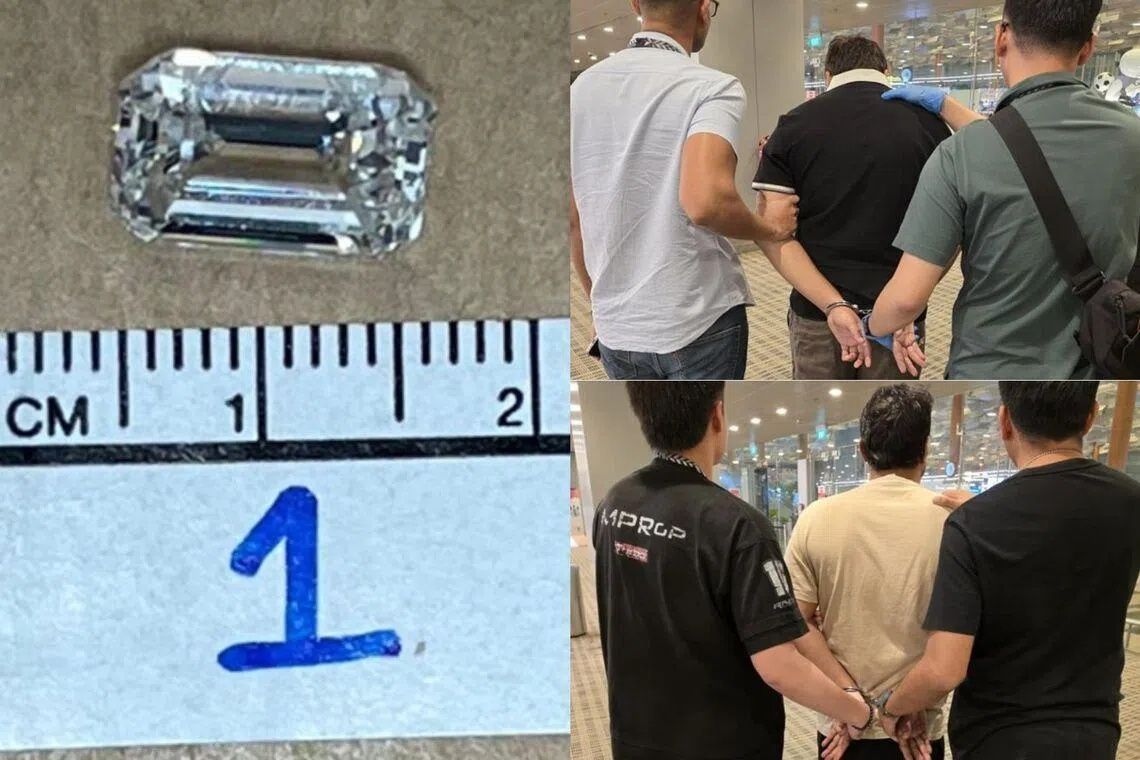
A meticulously planned jewellery heist unravelled within hours when two Indian nationals were intercepted at Changi Airport after executing a diamond swap at a Chinatown store on June 19. Mangroliya Manojkumar Kurjibhai, 41, was sentenced to two years, two months and two weeks' imprisonment on Friday (July 17) after pleading guilty to theft, marking a swift conclusion to what authorities said was a premeditated operation involving a counterfeit stone and careful coordination between the two men.
The crime itself was audacious in its simplicity yet sophisticated in its planning. Mangroliya and his accomplice Serasiya Milan Ramnikbhai, 30, arrived in Singapore on the morning of June 19 with a manufactured fake diamond that had been commissioned in India to precisely match the specifications and serial number of a genuine 4.95-carat stone held at Dianoche jewellery store on Kreta Ayer Road. Although court documents did not reveal how the pair identified the target diamond or obtained its exact details, their preparation suggested considerable research and criminal organisation beforehand.
The execution took place in the early afternoon when both tourists entered the Chinatown jewellery store around 3pm. Serasiya had concealed the counterfeit diamond in his mouth for the duration of the operation, a tactic that highlights the deliberate nature of their planning. Mangroliya then requested to view the genuine diamond, valued at US$154,000, equivalent to over S$199,000. The purchasing request itself served a dual purpose: it appeared legitimate to staff while creating the opportunity for the substitution.
The swap occurred while a sales manager repeatedly left his position to retrieve other items Mangroliya had requested viewing. State Prosecuting Officer Yip Cheng Yee informed the court that Mangroliya signalled his partner to execute the exchange. Serasiya promptly ejected the fake diamond from his mouth and replaced it with the genuine stone, which he then concealed in the same manner. This critical moment, lasting only seconds, transferred the 4.95-carat diamond from the store's possession to the thieves' control without immediate detection.
The pair then casually departed from the store, telling the sales manager they would consider whether to proceed with a purchase. Their apparent nonchalance masked the reality that they were now in possession of a six-figure asset. The entire operation was captured on the store's CCTV system, providing authorities with clear video evidence of the theft. When the sales manager examined the stone left in the display case using an optical gemstone identification machine, the counterfeit nature of the substitute became immediately apparent, triggering an alert to authorities.
What distinguished this case was the criminals' swift exit strategy. Within hours of the theft, Mangroliya and Serasiya checked out of their hotel and booked flights back to India, apparently confident they could clear immigration without detection. This assumption proved fatally flawed. Officers at Changi Airport Terminal 3 arrested both men around 9pm that evening as they attempted to depart. During the arrest, authorities recovered the genuine diamond from Serasiya's haversack, preventing the theft from reaching its intended conclusion across the border.
The speed of law enforcement's response reflected the efficiency of Singapore's security apparatus and the immediate reporting by the jewellery store. The recovery of the diamond within hours of the theft, combined with CCTV evidence and the physical possession of the counterfeit stone, created an overwhelming case against the accused. Mangroliya's decision to plead guilty likely reflected the incontrovertible nature of the evidence arrayed against him.
Serasiya's case remains pending before the courts, with the younger accomplice's ultimate sentence still to be determined. Both men face prosecution under Singapore's theft statutes, which carry potential sentences of up to seven years imprisonment and substantial fines. The disparate stages of their legal proceedings reflect the varying degrees of culpability authorities may pursue, with Mangroliya's earlier guilty plea and sentencing potentially influencing how prosecutors approach Serasiya's trial.
The incident underscores persistent vulnerabilities in the international jewellery trade, where sophisticated criminals routinely target high-value items using increasingly refined techniques. For Malaysian and Southeast Asian readers, the case demonstrates how regional tourism and cross-border mobility create opportunities for organised theft rings to operate across multiple jurisdictions. The planning evident in commissioning a counterfeit diamond with precise specifications suggests criminal networks capable of accessing specialised skills and knowledge.
Singapore's jewellery retailers and regional security analysts will likely view this case as validation of the importance of rigorous authentication procedures and CCTV surveillance. The fact that a counterfeit stone was instantly identified through optical gemstone identification technology suggests that such safeguards, while useful, require vigilant staff implementation. The two-hour window between the theft and arrest at the airport also highlights how modern border controls and real-time information sharing between agencies remain critical deterrents to international jewellery theft.
For potential offenders considering similar schemes, the case offers a sobering lesson: meticulous planning can be undermined by the immediate reporting capabilities of modern retailers and the comprehensive surveillance infrastructure at major airports. Mangroliya's sentence of more than two years reflects Singapore's serious approach to organised retail theft, particularly crimes targeting luxury goods. The relatively swift prosecution and sentencing also demonstrates judicial efficiency in cases where evidence is overwhelming and perpetrators cooperate with authorities through guilty pleas.

