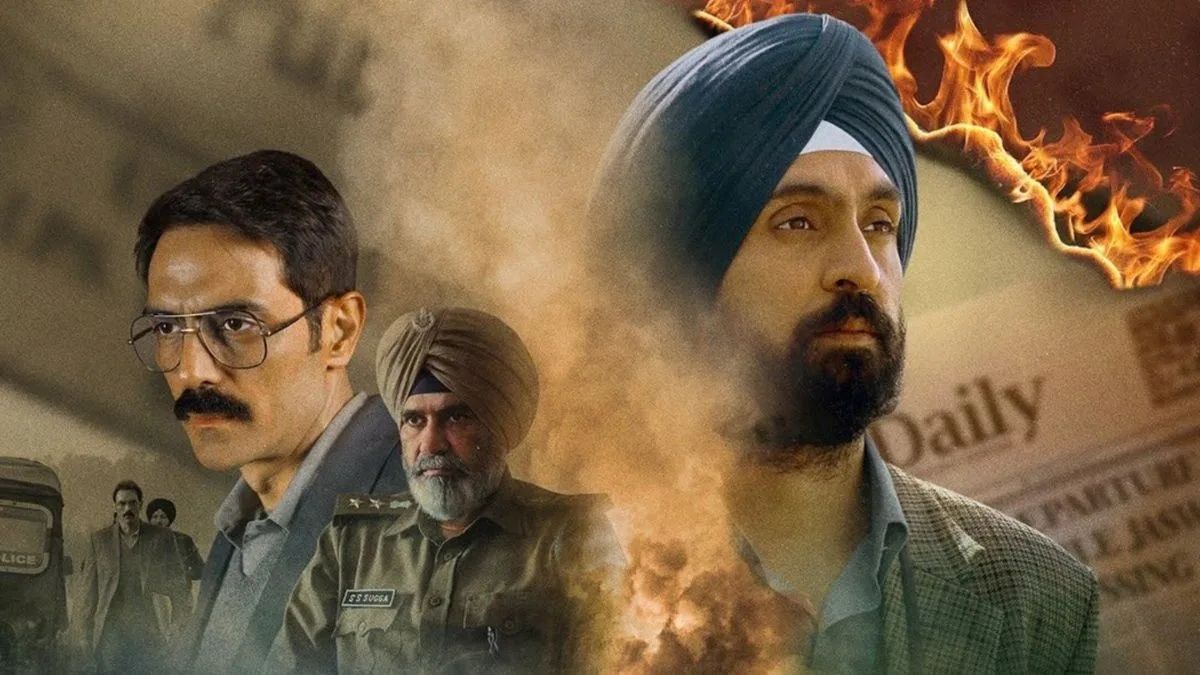
The struggle of Indian filmmaker Honey Trehan to bring his biographical film about Sikh rights activist Jaswant Singh Khalra to audiences encapsulates a deepening crisis in Indian cinema. After enduring four years of negotiations with film regulators who demanded 127 modifications to "Satluj," Trehan finally bypassed theatrical release and placed the movie on streaming platform ZEE5 earlier this month. Within two days, the service removed the film, citing unspecified "current developments." According to Press Trust of India, government officials privately pressured the platform, citing vague "security concerns." The episode underscores what independent filmmakers increasingly perceive as a systematic assault on creative autonomy in the world's largest film-producing nation.
Trehan's experience reflects a troubling pattern in India's regulatory environment. He openly characterised the government's actions as politically motivated censorship, accusing the Ministry of Information and Broadcasting of weaponising content controls to shape national narratives and extend state influence over Bollywood. His frustration carries particular weight given his prominence in Indian cinema, suggesting that even established, well-resourced producers face significant obstacles when tackling controversial subjects. The removal from ZEE5 despite the film's prior theatrical rejection indicates that pressure extends beyond initial certification, targeting content even after it finds alternative distribution channels.
Statistical evidence supports filmmaker concerns about escalating restrictions. Parliamentary data reveals that 3,033 films required cuts or modifications during fiscal year 2025, more than double the figure from four years prior. This dramatic surge suggests a systematic tightening of content standards rather than isolated cases. However, the government and the Central Board of Film Certification (CBFC) maintain opacity about their decision-making processes. The CBFC has not published standalone annual reports detailing its activities since 2017, making it impossible for independent analysts to understand the rationale behind these demands or identify patterns in enforcement. This lack of transparency fuels suspicion that censorship decisions reflect political considerations rather than consistent application of stated guidelines.
India's approach to film regulation diverges markedly from democratic norms elsewhere. Unlike age-based classification systems in the United States and most European countries, India's government-appointed board possesses direct authority to mandate content alterations before public exhibition. This mechanism grants regulators genuine power to shape narratives that reach mass audiences, rather than merely determining age-appropriateness. Observers of South Asian affairs argue this reflects a broader political shift since Prime Minister Narendra Modi's 2014 election victory. Sadanand Dhume of the Council on Foreign Relations notes that "the politics of the country has taken a sharp turn since the advent of Modi in 2014, and Bollywood is facing the downstream effects." The timing suggests that intensified censorship correlates with the consolidation of Modi's political dominance and the Bharatiya Janata Party's cultural agenda.
The particular vulnerability of "Satluj" illustrates which narratives face greatest pressure. The film examines Jaswant Singh Khalra's documentation of extrajudicial killings and police brutality during Punjab's violent counterinsurgency campaign in the 1980s and 1990s. That historical episode resulted in thousands of deaths during a period when security forces employed brutal tactics to suppress a Sikh independence movement. Although that insurgency was ultimately suppressed, contemporary geopolitics have revived sensitivities around Sikh separatism, particularly following Canada's 2023 accusations that Indian government agents assassinated a Sikh activist in Vancouver. The Modi government remains acutely suspicious of any narratives that might rehabilitate historical separatist movements or highlight state brutality, regardless of historical accuracy or artistic merit.
Recent censorship decisions reveal consistent targeting of films engaging with religious, caste, and political sensitivities. In 2025, the CBFC demanded 24 post-release cuts to the Malayalam blockbuster "L2: Empuraan" following objections from Hindu nationalist groups regarding its depiction of 2002 religious riots. Filmmakers working on "Phule," a biographical film about 19th-century caste reformer Jotirao Phule, faced demands to remove caste-related language. "Homebound," India's 2026 Academy Awards submission, gained clearance only after eliminating 11 references to caste and religious themes. These cases demonstrate that censors actively scrutinise content touching on communal tensions, historical injustices, and social hierarchies—precisely the subjects that contemporary cinema worldwide increasingly explores.
Conversely, films celebrating nationalist themes encounter minimal resistance. "Dhurandhar," a 2025 spy thriller depicting Indian intelligence operations against Pakistan, received routine certification with standard violence-related trims and subsequently became the highest-grossing Hindi-language film ever. This disparity reveals that censorship functions selectively rather than according to neutral technical standards. Films reinforcing state narratives or portraying national security establishments positively advance easily through certification, while those interrogating historical trauma, structural inequalities, or state accountability encounter systematic obstruction. This asymmetry transforms the certification process from a content-rating mechanism into an instrument for promoting preferred political narratives.
Established filmmakers testify that demand patterns have worsened considerably. Onir, an acclaimed independent director, reports escalating pressures to cut scenes from his work. His 2023 film "Pine Cone" faced flagging of the word "gay" in a scene involving a nine-year-old child, forcing Onir to remove dialogue before gaining clearance. Such decisions extend censorship into identity representation itself, restricting how filmmakers can portray sexual and gender diversity even in age-appropriate contexts. Onir characterises the current moment as "one of the worst phases of Indian cinema," lamenting that "the variety of cinema, the kind of narratives that one wants to see, all kinds of stories—that is disappearing slowly." His assessment from within the industry carries significant weight, suggesting that even before official demand surges, many filmmakers have internalised constraints and begun self-censoring.
The CBFC and Ministry of Information and Broadcasting maintain that censorship operates within legally defined parameters. CBFC Chairperson Shashi Shekhar Vempati declined to discuss individual film certifications, while the ministry informed Parliament that cuts are limited to content violating "sovereignty and integrity of India, security, public order, decency, morality, defamation, contempt of court or incitement to offence." These categories, however, possess sufficient ambiguity to permit expansive interpretation. Terms like "security," "public order," and "decency" have historically been invoked to suppress inconvenient truths and marginalised voices. The CBFC has certified approximately 72,000 films over five years, yet without transparent publication of decision rationales, it remains impossible to verify that these broad criteria are applied consistently and fairly.
Despite official suppression, "Satluj" demonstrates that determined audiences and filmmakers can circumvent state control. Trehan arranged a private screening during the Cannes Film Festival in May, keeping the film's profile elevated internationally even as domestic theatrical and streaming releases faced obstruction. Within Punjab itself, fans downloaded the film before its removal from ZEE5 and organised screenings in temples, community centres, and village squares. Trehan described witnessing "Hindu, Sikh, every caste, rich, poor, all sitting together," transforming the film's suppression into a grassroots mobilisation that "brought the entire Punjab together." This organic distribution network, while circumventing censorship apparatus, remains vulnerable to technological shifts and does not resolve the underlying problem of state-mandated creative restriction.
The Malaysian and Southeast Asian significance of India's censorship intensification extends beyond cultural concerns. India positions itself as a democratic counterweight to authoritarian governance in the region, yet intensifying restrictions on artistic expression undermine that narrative. If the world's largest democracy increasingly weaponises content regulation against inconvenient narratives, it weakens the region's democratic institutions and suggests that even ostensibly liberal political systems can deploy state machinery to suppress dissent and historical accountability. For Malaysian filmmakers and content creators already navigating their own regulatory landscapes, India's trajectory offers sobering lessons about how ostensibly neutral rating systems can metastasise into instruments of political control when institutional safeguards erode.
The broader implications for Indian cinema are substantial. As censorship demands multiply and enforcement mechanisms expand, risk-averse production companies will increasingly avoid controversial subjects, resulting in homogenised content reflecting state preferences rather than diverse social experiences. Talented filmmakers may migrate to jurisdictions offering greater creative freedom, representing a genuine brain drain from Indian cinema. International film festivals will continue premiering Indian films that face domestic suppression, creating a peculiar situation where Indian cinema achieves global recognition precisely for content that Indian audiences are prevented from viewing. The current trajectory suggests that censorship intensity will continue accelerating unless institutional constraints are imposed and decision-making transparency is mandated.

