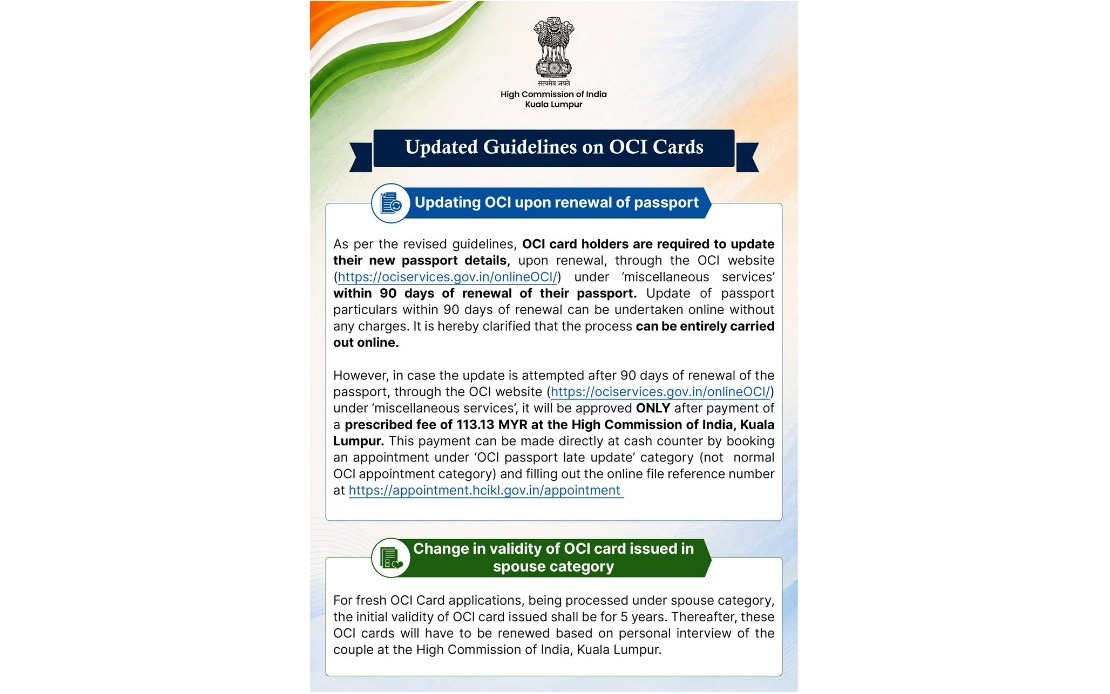
The High Commission of India in Kuala Lumpur has introduced revised requirements for Overseas Citizen of India (OCI) cardholders residing in Malaysia, establishing a mandatory 90-day window for updating passport information following a passport renewal. The directive, communicated through the mission's social media channels, aims to streamline administrative processes and ensure cardholders maintain current documentation with Indian authorities.
Under the new framework, OCI cardholders must lodge updated passport particulars online through the OCI website portal, accessing the feature within the miscellaneous services section. Critically, the High Commission has clarified that the entire update process can be completed remotely without requiring a physical visit to the mission, addressing convenience concerns for the substantial Indian diaspora across Malaysia.
The most significant incentive embedded in the revised guidelines is the elimination of processing fees for updates submitted within the 90-day period following passport renewal. This grace period essentially rewards timely compliance, encouraging cardholders to promptly register their new passport information while the renewal is recent and documentation readily available.
However, applicants who miss this window face financial consequences. Any passport detail updates attempted beyond the 90-day threshold will only proceed after payment of a prescribed fee set at RM113.13, payable directly at the High Commission's cash counter in Kuala Lumpur. This tiered approach functions as both an administrative incentive and a penalty mechanism, designed to discourage procrastination.
The payment process, while requiring a physical visit to the mission, has been partially simplified. Cardholders seeking late updates must first secure an appointment through the High Commission's appointment booking system, specifically selecting the "OCI passport late update" category rather than the standard OCI appointment option. Applicants must then provide their online file reference number when presenting at the cash counter, creating a structured workflow that separates routine applications from penalty-subject cases.
Beyond the passport update protocols, the High Commission has implemented a significant modification affecting the spouse category of OCI applications. Fresh applications filed under the spouse category—typically covering non-Indian spouses of Indian citizens or OCI cardholders—will now receive initial validity periods of five years rather than the longer duration previously granted. This reduction represents a notable policy shift that may affect long-term planning for couples involving one Indian national or OCI cardholder partner.
The compressed initial validity for spouse-category cardholders introduces an additional requirement absent from standard OCI renewals. Upon expiration of the five-year initial period, couples seeking to renew their OCI status must attend an in-person interview at the High Commission of India in Kuala Lumpur. This personal appearance stipulation suggests Indian authorities intend to verify the continuity and legitimacy of the spousal relationship through direct interaction, potentially adding scrutiny to what was previously a more straightforward administrative renewal process.
These regulatory adjustments carry practical implications for Malaysia's significant Indian expatriate community, which includes considerable numbers of mixed-nationality couples. The spouse category modifications may particularly affect families with children, as status changes could influence educational planning and long-term residency considerations. The mandatory interview requirement introduces uncertainty around renewal timelines, potentially necessitating coordinated travel arrangements for both spouses.
The High Commission has consolidated information regarding the revised guidelines on two platforms: the official OCI portal maintained by the Indian government and the mission's dedicated appointment website. This dual-channel availability reflects efforts to ensure broad awareness among the affected population, though the effectiveness of notification may vary across different demographic segments of Malaysia's Indian diaspora.
For Malaysian-based cardholders, the revisions represent a mix of convenience measures and regulatory tightening. While the online passport update facility removes geographical barriers, the financial penalty for delays and the intensified spouse category scrutiny reflect stricter documentation standards. The 90-day window, though generous relative to many government processes, requires proactive calendar management and timely action upon passport renewal.
These changes align with broader modernization trends among Indian consular services across Southeast Asia, where digital platforms increasingly handle routine transactions while in-person interviews concentrate on complex or potentially irregular cases. Malaysia, hosting a substantial Indian diaspora with significant economic contributions, remains strategically important for New Delhi's consular operations in the region.
Cardholders are advised to review the specific guidelines on the OCI and High Commission websites to understand their individual circumstances, particularly those with approaching passport renewals or pending spouse category applications. The distinction between cost-free and fee-based updates creates a clear incentive structure that rewards organizational preparation.

