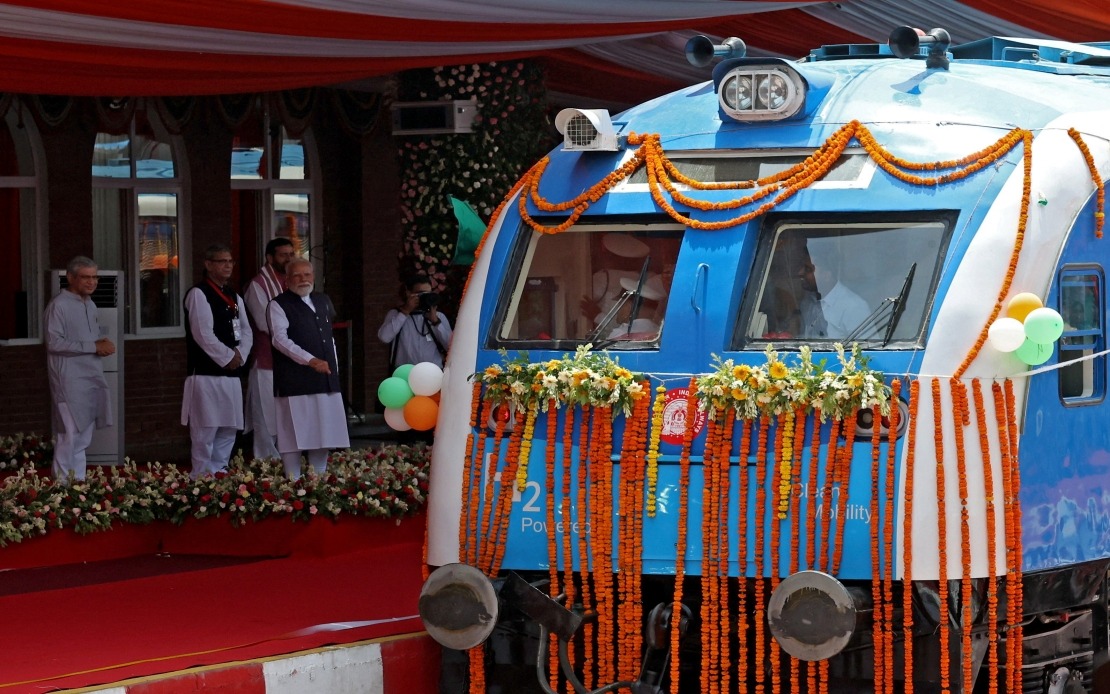
India has entered a new era of railway innovation with Prime Minister Narendra Modi's formal inauguration of the country's first hydrogen-powered train on Friday. The 10-coach service will operate along the 89-kilometre corridor connecting Jind and Sonipat in the northern state of Haryana, marking a watershed moment for the nation's transport infrastructure and environmental commitments.
This development carries particular significance for the Indian subcontinent, which operates one of the world's largest railway networks but has faced mounting pressure to reduce its carbon footprint. The introduction of hydrogen fuel cell technology demonstrates India's determination to modernize its railway fleet while tackling air pollution in densely populated urban corridors. For regional observers, the achievement underscores India's technological ambitions and reflects broader South Asian efforts to adopt cleaner energy solutions across transport sectors.
The hydrogen-powered train represents the first time India has deployed an indigenously developed fuel cell system for commercial railway operations. At its core, the train utilizes a 1,200-kilowatt Proton Exchange Membrane Fuel Cell, which generates electricity through an electrochemical reaction between hydrogen and oxygen. This approach eliminates harmful emissions at the point of use, with only water vapour and heat released as byproducts—a remarkable advantage over conventional diesel locomotives that contribute significantly to air quality degradation in major metropolitan areas.
India's entry into hydrogen rail technology places it alongside an exclusive cohort of advanced economies. China, Germany, Japan, and the United States have already deployed hydrogen trains on various routes, but India's achievement holds particular weight given the scale of its railway system, which carries over a billion passengers annually. The successful transition could open pathways for expanding clean rail technology across the Indian subcontinent, potentially influencing neighbouring countries' transport strategies.
Operational specifications indicate the train will run at a maximum velocity of 75 kilometres per hour, though engineers have designed the system to accommodate speeds up to 110 km/h, suggesting room for performance optimization as the technology matures. This cautious approach reflects standard railway safety protocols while demonstrating confidence in the underlying hydrogen fuel cell architecture. The phased operational framework allows Indian Railways to gather comprehensive performance data before considering wider deployment across other routes.
The hydrogen supply and refuelling infrastructure represents a critical dimension often overlooked in such announcements. Establishing a reliable network for hydrogen production, storage, and delivery along railway corridors requires substantial capital investment and coordination between multiple government agencies and private sector partners. For Malaysia and other Southeast Asian nations monitoring India's experience, the logistical challenges of building hydrogen infrastructure may prove as instructive as the technology itself, particularly as regional governments contemplate similar initiatives.
Environmental implications extend beyond immediate emissions reductions. Hydrogen fuel cells operate with minimal noise pollution compared to diesel trains, offering quality-of-life improvements for communities adjacent to rail corridors. This quieter operation becomes especially valuable in densely populated zones where evening and night-time train services previously generated substantial noise complaints. The cumulative effect of reduced air and noise pollution positions hydrogen technology as a comprehensive urban environmental solution.
Financial considerations underpin the technology's long-term viability. While fuel cell trains require higher upfront capital expenditure than diesel alternatives, operational costs may decline as hydrogen production methods improve and renewable energy integration increases. For India, coupling hydrogen train development with the nation's substantial solar and wind capacity could eventually create a fully decarbonized rail system—an outcome that would position Indian Railways as a global leader in sustainable transport.
The Jind-Sonipat route serves as an appropriate testing ground. The corridor handles significant passenger traffic while remaining sufficiently limited in scope to permit operational adjustments without disrupting critical national rail networks. Success here could catalyze expansion to other commuter routes in metropolitan areas like Delhi, Mumbai, and Bangalore, where air quality remains a persistent governance challenge and public appetite for cleaner transport grows increasingly urgent.
Regional implications warrant consideration. Southeast Asian nations, including Malaysia, face comparable challenges around railway modernization and emissions reduction. India's hydrogen train serves as a demonstration project, showing both the technical feasibility and the implementation pathway for clean rail technology. The project's outcomes will likely influence discussions within ASEAN forums regarding sustainable transport infrastructure standards and may encourage bilateral knowledge-sharing arrangements on hydrogen technology development.
Looking forward, the initiative reflects Modi administration's broader green energy transition agenda, which targets substantial renewable energy capacity expansion and reduced carbon intensity. Railway electrification and hydrogen propulsion represent complementary pathways rather than competing strategies, allowing India to deploy different clean technologies suited to distinct operational contexts. This diversified approach enhances system resilience while maximizing environmental benefits across the entire transport network.

