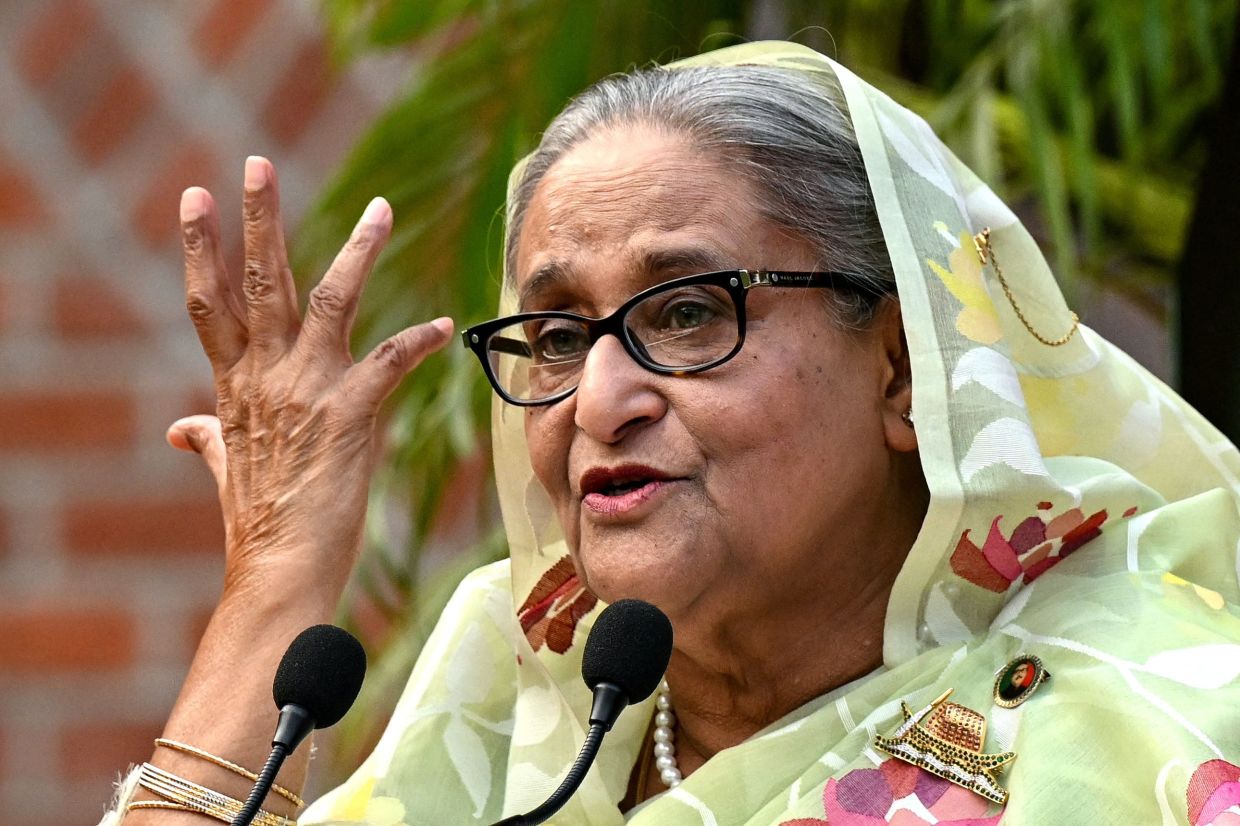
India's foreign ministry has moved to clarify that the Indian government bears no responsibility for an upcoming virtual address by exiled Bangladesh former Prime Minister Sheikh Hasina, attempting to defuse mounting diplomatic friction between New Delhi and Dhaka over the event. Randhir Jaiswal, the ministry's official spokesperson, stated on Wednesday that the speech was being organised independently by a private media entity and that the government neither involved itself in the arrangement nor endorsed any positions that might be expressed during the forum. The statement came after Bangladesh formally requested clarification from New Delhi regarding India's official stance on Hasina's participation in the event, signalling concern that the neighbouring country might be tacitly supporting political activities by the fugitive former leader.
Hasina, who is 78 years old, is preparing to address the Foreign Correspondents' Club of South Asia in New Delhi on August 5, marking two years since the student-led uprising that precipitated her government's collapse in 2024. The address will be delivered via video link from India, marking her first public statement since she fled to the country in the immediate aftermath of the demonstrations. She is expected to be joined by her son, Sajeeb Wazed Joy, and other speakers at the event, though the specific contents of her remarks remain undisclosed by her advisers. The virtual format reflects her continued refuge in India, where she has remained since the upheaval that toppled her administration and forced her into exile.
Meanwhile, Bangladesh's Information Adviser Zahed Ur Rahman has issued a stern warning to the country's media landscape, instructing news outlets and digital platforms to refrain from broadcasting, publishing, or otherwise disseminating Hasina's statements, speeches, interviews, or any audio-visual material featuring her remarks. The directive invokes a December 2024 order issued by Bangladesh's International Crimes Tribunal, which carries legal weight within the country's jurisdiction. This measure represents a significant tightening of information controls and reflects Dhaka's determination to prevent Hasina's messaging from reaching a domestic audience, even as her voice travels across borders through digital means.
The underlying context adds considerable weight to these developments. Hasina was sentenced to death in absentia in 2025 on charges related to crimes against humanity, stemming from the government's response to the student demonstrations that ultimately unseated her. She has publicly dismissed the conviction as legally invalid, maintaining her defiance of Bangladesh's judicial proceedings. The death sentence and exile status have not dampened her political activity; her aides have indicated that Hasina and other Awami League colleagues intend to return from their places of refuge around December of this year, presenting themselves before the courts in what would represent a dramatic test of the interim government's commitment to handling its most significant political opponent through legal rather than extrajudicial means.
Abu Obaidha Arin, an aide to the former Prime Minister, has reaffirmed that the New Delhi event will proceed regardless of Dhaka's objections, framing the address as a matter of principle. In a pointed statement, he declared that Dhaka's "efforts to silence dissent cannot extinguish voices" that operate beyond the country's borders, articulating a stance that directly challenges Bangladesh's information controls and asserts the right to political speech from exile. This defiant position underscores the deep ideological and political chasm that persists between Hasina's camp and the interim government led by Prime Minister Tarique Rahman, which assumed power following February's election.
Bangladesh's State Minister for Foreign Affairs, Shama Obaed Islam, has indicated that Dhaka has repeatedly lodged complaints with New Delhi regarding Hasina and other Awami League figures conducting political activities from Indian soil. The repetition of these complaints suggests an ongoing pattern of concern that has not been adequately addressed through diplomatic channels. Bangladesh has also been actively pursuing Hasina's extradition from India, a process that remains unresolved and continues to complicate bilateral relations between the two neighbouring countries.
The incident arrives at a delicate moment in India-Bangladesh relations. The two countries have experienced considerable strain since Hasina's departure, rooted in questions about India's willingness to host a prominent political exile whose government fell from power in circumstances that generated significant regional attention. However, both New Delhi and Dhaka have signalled in recent weeks a genuine desire to reset their relationship and move beyond the turbulence of the past eighteen months. India's deliberate disassociation from Hasina's address should be understood within this context of cautious diplomatic rehabilitation, with New Delhi seeking to avoid appearing complicit in activities that Dhaka views as provocative or destabilising.
For Malaysian observers, this episode illuminates broader questions about political asylum, media freedom, and regional diplomacy in South Asia. The tension between Dhaka's assertion of sovereign authority to regulate information within its borders and Hasina's ability to speak from abroad reflects a recurring challenge in the contemporary information landscape, where digital technology permits political messaging to transcend geographical boundaries and traditional state control mechanisms. Bangladesh's prohibition on domestic media coverage of Hasina's remarks represents an attempt to enforce informational sovereignty, yet the global reach of the internet means such restrictions face inherent limits.
The diplomatic manoeuvre by India—simultaneously providing refuge to Hasina while publicly disclaiming responsibility for her political activities—represents a careful balancing act that many regional states navigate when hosting significant political exiles. By characterising the Foreign Correspondents' Club event as a purely private affair, India attempts to fulfil its humanitarian obligation to host a vulnerable exile whilst simultaneously avoiding the appearance of sponsoring political opposition to a neighbouring government. This distinction between private initiative and state endorsement has become increasingly important in contemporary bilateral relations, where opaque involvement in neighbouring countries' internal affairs can rapidly escalate tensions.
The broader implications for regional stability warrant attention. Should Hasina and her supporters genuinely return to Bangladesh in December as announced, the country's judicial system and political institutions will face an unprecedented test. The interim government will need to demonstrate whether it can manage the return of its most prominent political opponent through transparent legal processes or whether the death sentence represents a conclusive foreclosure of Hasina's political future. India's handling of this situation—neither openly supporting Hasina nor hastening her extradition—suggests New Delhi is adopting a stance of cautious neutrality, waiting to observe how Dhaka's political transition unfolds before determining its long-term approach to the exile question.

