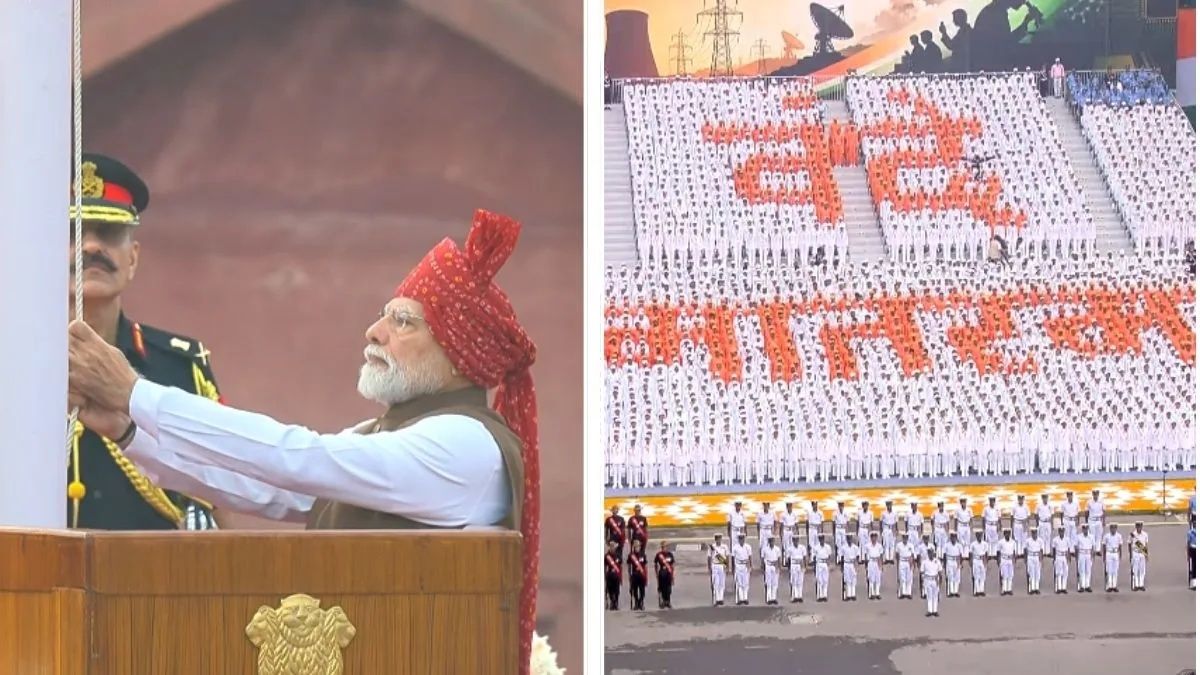
India has committed itself to a transformative national objective: achieving developed-country status by 2047. Prime Minister Narendra Modi articulated this vision during his Independence Day address on Saturday from New Delhi's Red Fort, the ceremonial heart of Indian governance. Speaking to the nation on its 80th year of independence, Modi framed the pursuit of 'Viksit Bharat'—a developed India—as reflective of the nation's deepest aspirations and the collective confidence of its 1.4 billion citizens. The announcement represents a defining moment in India's post-independence trajectory, setting a 23-year timeline for one of the world's most ambitious economic and social transformation programmes.
Modi's rhetoric emphasised that India's shift towards developed-nation status carries profound implications beyond mere economic metrics. The Prime Minister contended that when the world's most populous country pledges to join the ranks of developed economies, it fundamentally alters global perceptions of Indian capability and potential. This framing acknowledges the geopolitical significance of India's rise, particularly in an era of shifting global power dynamics where Asian economies increasingly command international attention. For Southeast Asian nations watching India's trajectory, the announcement signals a regional competitor and potential collaborator gaining substantial economic and strategic weight over the coming decades.
The Prime Minister's address deliberately contrasted India's current standing with its recent past, drawing attention to the country's escape from economic fragility. Modi recalled India's inclusion in the "Fragile Five" grouping—a term coined during the 2013 currency crisis to describe emerging markets vulnerable to external shocks. He positioned this historical moment as a turning point, marking India's transition to a position of substantial economic dynamism and resilience. This narrative serves domestic audiences by demonstrating tangible progress under his administration while reassuring international observers of India's economic stability and growth potential.
To substantiate his development vision, Modi cited concrete sectoral achievements spanning the previous 12 years of his tenure. Defence production has expanded fourfold, reflecting India's ambitions for military self-reliance and reduced dependence on foreign arms manufacturers. Khadi and Gramodyog production—traditional textile sectors representing rural India's economic backbone—has grown fivefold, suggesting inclusive development reaching beyond urban centres. Electronics manufacturing has surged sevenfold, positioning India as an alternative manufacturing hub to China amid global supply-chain recalibration. Mobile phone production has risen by one-third while digital transactions have doubled, indicating rapid digitalisation of the Indian economy and financial inclusion across vast populations.
These statistics carry particular resonance for Malaysia and other Southeast Asian nations engaged in competition for foreign investment and manufacturing capacity. India's accelerating electronics and mobile phone sectors represent direct competition for regional manufacturing hubs. Simultaneously, India's digital transaction growth signals a vast emerging consumer market with increasing purchasing power, presenting opportunities for regional exporters and service providers. The figures suggest that India's development pathway differs markedly from traditional Western models, emphasising simultaneous growth across traditional rural sectors and cutting-edge digital infrastructure.
A significant ceremonial element marked the Independence Day celebrations, adding symbolic weight to Modi's policy announcements. For the first time since India's independence in 1947, the full rendition of 'Vande Mataram'—the national song that resonated during the independence movement—was performed at the Red Fort on August 15. Modi characterised this moment as historic, imbuing the occasion with nationalist significance and connecting contemporary development aspirations to the ideological foundations of India's freedom struggle. The symbolism suggests that development towards 2047 represents the realisation of independence-era dreams deferred by decades of economic constraints.
The flag hoisting ceremony itself reflected India's emphasis on indigenous military capabilities. The 21-gun salute utilised domestically manufactured 105mm Light Field Guns rather than imported artillery, embodying the 'Atmanirbhar Bharat' or self-reliant India philosophy that undergirds Modi's economic policy. The ceremonial battery, commanded by Major Pawan Singh Shekhawat with Naib Subedar Anuthosh Sarkar serving as Gun Position Officer, demonstrated the operational readiness of Indian defence forces while showcasing locally developed weaponry. This emphasis on indigenous defence production aligns with Modi's broader vision of reducing technological and economic dependence on foreign sources.
Modi's address did not remain confined to aspirational rhetoric and economic statistics. He acknowledged immediate humanitarian challenges confronting the nation, referencing recent floods affecting multiple regions. The Prime Minister expressed concern for families impacted by the disaster and promised comprehensive national support. This acknowledgement balanced long-term visionary goals with present-day obligations, signalling that development encompasses both immediate welfare and generational transformation. For Malaysia, where monsoon floods periodically affect both countries, this recognition of climate-related vulnerability resonates across the region's shared environmental challenges.
The broader implications of India's 2047 development agenda extend throughout South and Southeast Asia. An economically developed India would represent a fundamental reordering of regional power dynamics, creating a bloc of substantial economic and strategic weight competing with China for regional influence. For Malaysia, India's growth trajectory presents both opportunities and challenges—opportunities in expanded trade and investment partnerships, challenges in competing for manufacturing and technological leadership. Indian development would likely accelerate migration of skilled professionals across the region, intensify competition for regional infrastructure projects, and reshape strategic alignments across Asia.
Modi's invocation of 'bigger dreams' and expanded ambitions represents more than motivational rhetoric; it signals a deliberate shift in national consciousness towards transformative goals. By explicitly rejecting incremental development models, Modi positioned India's 2047 vision as a departure from previous decades' gradualist approaches. This psychological reorientation towards ambitious targets potentially galvanises institutional focus and resource allocation towards developmental objectives. For competing Asian economies, India's declaration of purposeful, large-scale development ambitions underscores that the regional economic competition will intensify substantially over the coming two decades.
The combination of sectoral growth achievements, technological emphasis, and aspirational framing demonstrates Modi's attempt to construct a coherent narrative linking past progress to future transformation. By highlighting defence production growth, digital transaction expansion, and manufacturing diversification, the Prime Minister positioned India's development as multi-dimensional rather than narrowly focused on GDP expansion. This approach suggests that India's approach to development incorporates military capability, technological sophistication, and inclusive economic participation—a model potentially more comprehensive than traditional development paradigms.
For Malaysian policymakers and business leaders, India's 2047 vision demands careful strategic consideration. India's emergence as a developed economy would fundamentally alter the regional competitive landscape, potentially absorbing manufacturing capacity, talent, and investment flows that might otherwise reach Southeast Asia. Simultaneously, India's development creates substantial market opportunities for Malaysian exporters and service providers. The strategic imperative for Malaysia involves positioning itself as a complementary economic partner to India's development rather than merely a competitor, potentially through enhanced regional integration, joint infrastructure projects, and technology partnerships that harness India's growth trajectory for mutual benefit.

