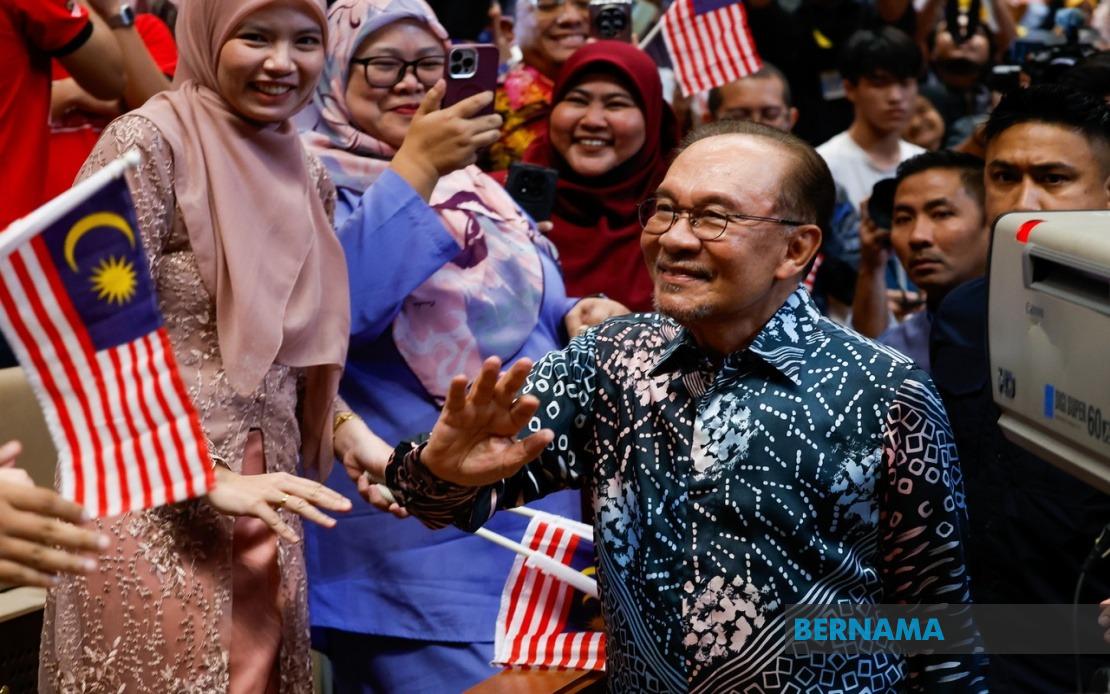
Prime Minister Datuk Seri Anwar Ibrahim has delivered a powerful call for Malaysians to internalize the spirit of independence, framing it not merely as a historical milestone or constitutional framework, but as a lived principle that must guide individual and collective behaviour. Speaking at the Putrajaya International Convention Centre during the National Day address, Anwar emphasised that the essence of independence extends far beyond ceremonial observance or institutional arrangements, requiring instead that every citizen develop and maintain an unwavering commitment to autonomous thought and action in service of national progress.
At the heart of Anwar's message lies a critical distinction between formal independence and the psychological and moral independence that he argues underpins genuine national development. He framed this dual understanding as fundamental to addressing what he characterised as the greatest contemporary challenge facing Malaysia—the need to rebuild from current difficulties by rekindling a foundational commitment to self-determination and principled governance. This framing reflects growing concerns within government circles about ensuring that national cohesion does not depend on external validation or reactive positioning, but rather on Malaysians themselves taking ownership of their collective future.
The Prime Minister's emphasis on unity across all communities represents a deliberate articulation of Malaysia's foundational social contract, one that acknowledges Malays and Bumiputera as the constitutional core while insisting that all other communities bear equal responsibility for the nation's wellbeing and integrity. Rather than treating unity as an aspirational slogan, Anwar positioned it as an operational necessity for the practical defence of citizens' rights and the maintenance of justice systems. This framing suggests that sectarian divisions undermine not merely social harmony, but the very mechanisms through which individual freedoms and legal protections are preserved and strengthened.
The temporal dimension of Anwar's appeal—his invocation of what "forefathers said" about unity—grounds his contemporary political message in historical legitimacy while simultaneously arguing for its renewal by successive generations. This generational framing carries particular significance for Malaysian political discourse, as it implies that independence cannot be treated as a completed historical act to be commemorated annually, but rather as a continuous endeavour requiring active recommitment. Each generation, in this formulation, must rediscover and reaffirm the independence principle rather than simply inheriting it passively.
By locating the challenge of independence within hearts and minds rather than solely in institutional structures or policy frameworks, Anwar's address reflects a shift in how Malaysia's political leadership conceptualises national challenges. Rather than suggesting that legislative reform or bureaucratic reorganisation alone will resolve contemporary difficulties, the Prime Minister points toward the necessity of cultural and psychological transformation. This approach acknowledges the limits of top-down governance and places significant emphasis on individual and community agency in driving meaningful national progress.
The gathering of senior government figures—including Deputy Prime Minister Datuk Seri Dr Ahmad Zahid Hamidi, Communications Minister Datuk Seri Fahmi Fadzil, and Chief Secretary to the Government Tan Sri Shamsul Azri Abu Bakar—underscores the official significance accorded to this message within the current administration. Their collective presence signals that the articulation of independence as both individual and collective responsibility represents a core priority, not merely a rhetorical flourish tacked onto ceremonial proceedings.
For Southeast Asian observers, Anwar's emphasis on the independence principle carries broader regional implications. As several nations in the region grapple with managing diverse populations, balancing security concerns with democratic freedoms, and navigating economic disruption, the Malaysian articulation of independence as requiring both individual commitment and cross-community solidarity offers a distinctive model. The explicit rejection of ethnically or regionally bounded unity in favour of national citizenship-based solidarity represents a countervailing trend to some contemporary global movements toward identity fragmentation or zero-sum community competition.
The invocation of defending rights and upholding justice as corollary obligations flowing from the independence principle addresses ongoing debates within Malaysia regarding institutional accountability, rule of law, and equal treatment. By linking these concerns to the foundational independence ideal, Anwar frames judicial and administrative integrity not as technical matters of good governance, but as essential expressions of the independence that the nation collectively claims to value. This rhetorical strategy potentially strengthens the political legitimacy of reform efforts targeting corruption, judicial independence, and regulatory impartiality.
The emphasis on rebuilding from "ruins" suggests acknowledgement of accumulated governance challenges and social fractures that Anwar's administration recognises as requiring systematic attention. Rather than portraying independence solely as a historical achievement to be defended, the framing positions current national difficulties as opportunities to recommit to foundational principles and rebuild institutional and social arrangements more faithfully reflecting those principles. This narrative allows the government to frame reform efforts as restoration rather than innovation, potentially enhancing their political acceptability.
Anwar's insistence that independence requires united action across all communities, with particular emphasis on the constitutional role of Malays and Bumiputera, attempts to balance competing claims within Malaysian political discourse. By acknowledging the constitutional foundation while simultaneously demanding that all communities participate equally in national defence and justice maintenance, he seeks to articulate an inclusive nationalism that respects historical arrangements while precluding their use to justify exclusionary practices or majoritarian domination.
The practical implications of this message extend to ongoing policy discussions regarding economic justice, educational access, and institutional representation. If independence truly requires that all communities participate meaningfully in defending rights and upholding justice, this frames diversity not as a demographic challenge to be managed, but as a resource essential to robust governance and inclusive development. Such a formulation could provide political space for discussing resource distribution, educational opportunity, and institutional participation in terms of strengthening national independence rather than managing group competition.
Looking forward, the success of Anwar's independence appeal will likely depend on whether government actions demonstrably embody the principles of rights defence and justice that he articulated. The distance between rhetorical commitment to these ideals and their implementation through institutional behaviour remains the critical test. Malaysian citizens across all communities will assess the authenticity of this independence appeal through concrete experiences with judicial fairness, administrative accountability, and equal protection under law.

