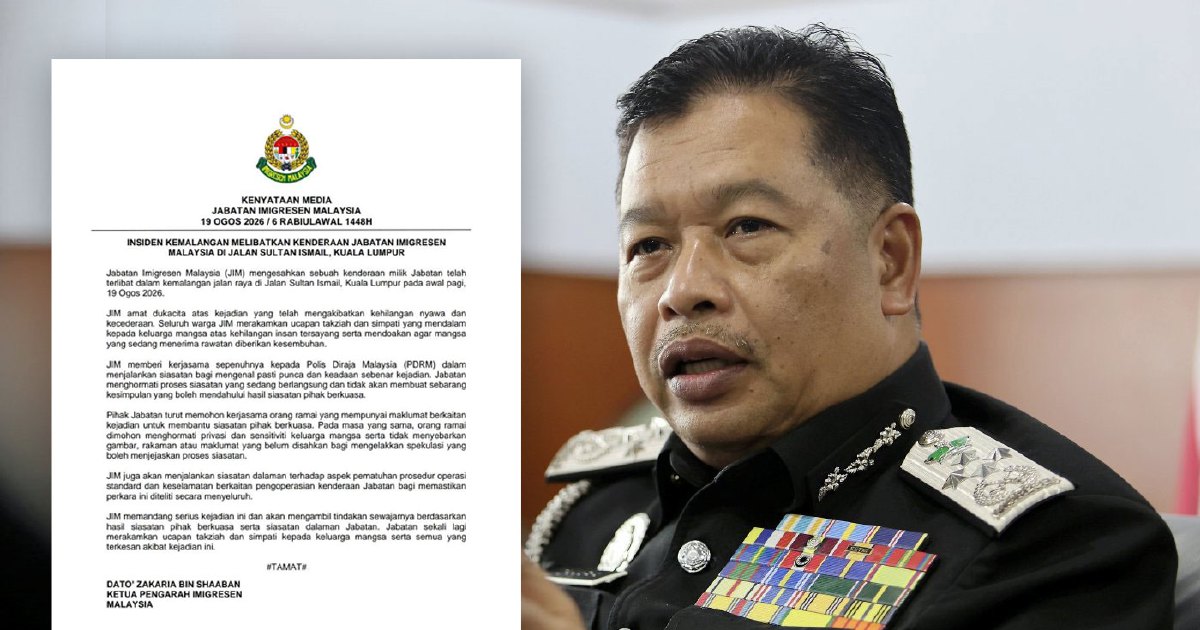
The Immigration Department has announced plans to conduct a comprehensive internal investigation following a fatal traffic accident involving one of its vehicles that occurred along Jalan Sultan Ismail in central Kuala Lumpur in the early morning hours. The incident has prompted immediate scrutiny of the department's adherence to established standard operating procedures and safety measures governing vehicle operations.
The crash represents a significant operational incident for the department, one of Malaysia's key frontline agencies responsible for managing the country's borders and immigration processes. Fatal accidents involving government vehicles often trigger wider questions about fleet management practices, driver training protocols, and the adequacy of safety frameworks across the public service. The decision to launch an internal probe signals the seriousness with which the department views the incident and its commitment to establishing what went wrong.
Internal investigations of this nature typically examine multiple dimensions of departmental operations. These inquiries assess whether drivers had received appropriate training, whether vehicles were properly maintained and roadworthy, whether fatigue management policies were being observed, and whether there were any systemic issues contributing to the accident. The review of SOPs is particularly crucial, as these procedures form the backbone of how government agencies are meant to conduct their business safely and efficiently.
The Immigration Department's swift decision to initiate an internal review demonstrates recognition that public accountability demands transparency when government operations result in loss of life. Malaysia has experienced numerous road fatalities involving both public and private sector vehicles, making traffic safety an ongoing concern across the nation. Each incident provides an opportunity to examine what safeguards exist and whether they are being properly implemented.
For the Immigration Department specifically, this investigation occurs within a broader context of modernisation efforts aimed at improving service delivery and operational standards. The department handles millions of passenger movements annually through Malaysia's airports, land borders, and seaports, making operational efficiency and safety paramount to its mission. Any gaps identified in safety protocols or SOP compliance could have implications extending beyond this single incident.
The location of the accident—Jalan Sultan Ismail in central Kuala Lumpur—is a major thoroughfare frequently used by government vehicles and commercial traffic. Early morning traffic conditions, visibility factors, and road conditions at the time of the incident will likely form part of the investigation. Understanding the circumstances that led to the crash is essential for determining whether this was an isolated accident or symptomatic of broader concerns.
In the Malaysian civil service context, internal investigations serve as the first line of inquiry before any potential referral to the police or other authorities. These reviews help establish preliminary facts, identify procedural failures, and recommend corrective measures. The Immigration Department's investigation will likely coordinate with other stakeholders, including the Road Transport Department if mechanical factors are suspected, and possibly the police if criminal negligence or traffic violations are indicated.
The department may also examine its vehicle fleet management systems, including maintenance schedules, inspection protocols, and record-keeping. Regular audits of government vehicle fleets have become increasingly important as agencies recognise that poorly maintained vehicles pose risks not only to occupants but to other road users as well. Malaysia's road safety record remains a concern, with the nation consistently recording high fatality rates relative to its population.
Beyond the immediate investigation, this incident may prompt the Immigration Department to review its driver selection, training, and continuing professional development programmes. Government agencies increasingly recognise that driver competency extends beyond basic licensing requirements and encompasses defensive driving techniques, fatigue awareness, and route planning. Regular refresher training and assessment of government drivers has become standard practice in many agencies seeking to reduce accident rates.
The timing of the investigation, conducted in the days immediately following the incident, allows the department to gather witness statements while recollections remain fresh and to secure relevant evidence before conditions change. The internal inquiry report, when completed, will likely inform departmental policy adjustments and potentially contribute to government-wide safety improvements if findings reveal systemic issues applicable across agencies.
For Malaysian road safety advocates and civil service efficiency observers, the Immigration Department's investigation provides an opportunity to understand what accountability mechanisms exist when government operations result in fatalities. Transparency in such investigations, including eventual public communication of findings and corrective actions taken, helps maintain public confidence in government institutions while demonstrating commitment to preventing future tragedies.
The outcome of this internal investigation will be closely monitored not only within the Immigration Department but across the broader Malaysian public service. Other government agencies operate vehicle fleets under similar SOPs and safety frameworks, meaning lessons learned from this inquiry could have application throughout the civil service. How the department responds to findings—whether by updating procedures, enhancing training, or improving fleet maintenance—will serve as an indicator of institutional responsiveness to operational failures.
Ultimately, fatal accidents involving government vehicles underscore the critical importance of rigorous safety cultures within public institutions. The Immigration Department's decision to investigate thoroughly sends a message that operational excellence and the safety of staff and the public are non-negotiable priorities, and that when incidents occur, the department will take responsibility for understanding causes and implementing improvements to prevent recurrence.

