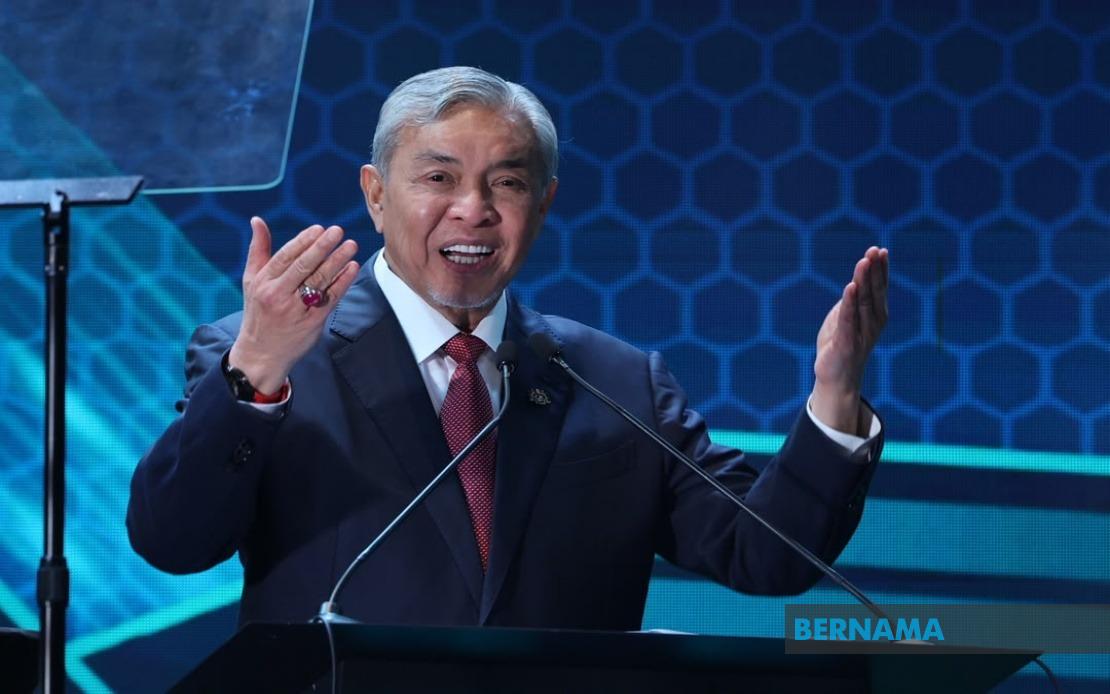
Deputy Prime Minister Datuk Seri Dr Ahmad Zahid Hamidi has called for Malaysia's Immigration Department (JIM) to evolve beyond its traditional gatekeeping function and emerge as a driver of national economic competitiveness. Speaking at the 2026 Immigration Day celebration in Cyberjaya on July 21, Ahmad Zahid articulated a vision where immigration management becomes integral to Malaysia's broader economic strategy, not merely a compliance checkpoint. This reframing represents a significant shift in how senior government figures view the department's role within the nation's development agenda, signalling greater integration between border management and foreign investment attraction.
The Deputy Prime Minister announced a four-point mandate intended to serve as the guiding framework for JIM's transformation journey. These priorities encompass facilitating economic growth, strengthening national security and sovereignty, accelerating digital transformation with service innovation, and enhancing integrity alongside professionalism and humanitarian values. Ahmad Zahid emphasised that this restructuring cannot proceed in fragmented increments or through disconnected initiatives. Instead, the transformation must be comprehensive, embedded across every policy, system and operational action undertaken by the department, creating what he termed "One Direction for Immigration Transformation." This holistic approach suggests recognition that piecemeal reforms often fail to achieve lasting institutional change.
Central to Ahmad Zahid's argument is the notion that immigration bureaucracy directly impacts national competitiveness on the global stage. He highlighted how unnecessary delays, convoluted procedures and excessive administrative layers undermine Malaysia's attractiveness to investors and skilled professionals. The Deputy Prime Minister cited the United Arab Emirates as a benchmark, noting that the UAE's integration of immigration policies with investment attraction strategies, including its Golden Visa programme offering residency for up to 10 years, has yielded substantial results. The UAE achieved foreign direct investment of RM196.6 billion in 2025, securing its position as the ninth-ranked global destination for foreign investment for the fourth consecutive year. This comparison implicitly challenges Malaysian policymakers to consider whether current immigration procedures might be deterring high-value investment flows that could otherwise strengthen the domestic economy.
The economic facilitation angle carries particular relevance for Southeast Asia, where regional competition for foreign capital and talent is intensifying. Singapore, Thailand and Indonesia have each aggressively reformed their immigration systems to attract digital nomads, entrepreneurs and corporate headquarters. Malaysia's positioning relative to these competitors depends partly on how efficiently its border systems can process legitimate travellers and investors while maintaining security. Ahmad Zahid's emphasis on this dual mandate acknowledges that modern immigration systems must be simultaneously welcoming and vigilant—a delicate balance that few countries have perfected. For Malaysian businesses seeking regional expansion or multinational corporations evaluating headquarters locations in Southeast Asia, streamlined immigration processes represent a tangible competitive advantage.
On the national security dimension, Ahmad Zahid warned that contemporary threats operate fundamentally differently from those of the previous decade. Modern challenges including migrant smuggling networks, human trafficking operations and transnational criminal activities disregard traditional borders and temporal constraints. He stressed that JIM's enforcement posture must transition from reactive responses to intelligence-driven, data-informed operations conducted through coordinated action among all national enforcement agencies. This intelligence-first approach represents a maturation of security thinking, moving beyond visible border controls to address underlying criminal networks and organised operations that exploit migration systems. For Malaysia, which has historically grappled with human trafficking concerns and irregular migration from regional neighbours, this strategic reorientation holds substantial implications for both humanitarian outcomes and national order.
Acceleration of digital transformation emerged as the third pillar of Ahmad Zahid's mandate. He advocated for JIM to leverage big data analytics, artificial intelligence, predictive analytics, advanced biometric systems and intelligent border infrastructure that enable faster, more accurate and more secure decision-making processes. The Deputy Prime Minister explicitly stated that the objective extends beyond merely accelerating existing workflows; rather, technology should enable the department to "think smarter, act more precisely and deliver world-class services." This framing suggests recognition that digital tools offer qualitative improvements in intelligence analysis and threat detection, not merely quantitative speed increases. For a nation aiming to position itself as a developed economy, immigration infrastructure modernisation represents both a security investment and an economic facilitation mechanism.
The regional context renders this digital emphasis particularly salient. Southeast Asia has witnessed rising adoption of biometric systems and AI-driven border screening across Singapore, Thailand and Vietnam. Malaysia's commitment to technological integration at immigration checkpoints will influence its capacity to support regional travel corridors and economic zones that increasingly rely on seamless cross-border movement. Furthermore, integration of Malaysia's immigration data systems with ASEAN partner nations would enhance regional security cooperation while facilitating legitimate trade and tourism. Ahmad Zahid's emphasis on technology-enabled decision-making suggests awareness of these broader regional integration imperatives.
Integrity and humanitarian values constituted the fourth mandate element, with Ahmad Zahid stressing that JIM must be recognised for professionalism and ethical conduct alongside firm law enforcement. He called upon departmental personnel to adhere to procedures, exercise sound judgment and demonstrate courage to act rightly, even when circumstances prove complicated. This emphasis on institutional integrity reflects broader governance concerns in Malaysia regarding corruption and abuse of discretionary authority. Immigration officials wielding substantial power over entry, temporary residence and deportation decisions represent potential vectors for corruption or arbitrary action. Ahmad Zahid's explicit framing of integrity as a strategic mandate suggests that government recognises reputational and operational risks associated with perceived corruption within border management agencies.
For Malaysian citizens and businesses, the integrity component carries tangible implications. Enhanced professionalism reduces opportunities for unofficial payments or preferential treatment, creating more predictable operating environments. For individuals seeking to sponsor foreign workers or manage talent acquisition across borders, transparent and principled immigration administration reduces transaction costs and uncertainty. Conversely, for vulnerable populations including migrant workers and asylum seekers, institutional commitment to humanitarian values theoretically provides greater protections against arbitrary treatment or exploitation by officials. The balance between enforcement and humanitarian concern remains inherently tension-ridden, yet Ahmad Zahid's articulation acknowledges that sustainable immigration management requires attention to both dimensions.
Ahmad Zahid's vision for JIM's transformation reflects broader shifts in how developed and developing economies conceptualise immigration management. Rather than viewing border control as purely restrictive, modern frameworks increasingly integrate immigration with economic strategy, security architecture and digital infrastructure development. For Malaysia, pursuing upper-middle-income status and regional leadership, alignment of immigration policy with development objectives becomes increasingly important. The four-point mandate provides institutional direction for JIM to contribute meaningfully to these aspirations while managing complex security challenges and maintaining humanitarian standards. Implementation of this vision will require sustained resource allocation, workforce development and inter-agency coordination across Malaysia's security and economic policy apparatus.
The attendance at the immigration day celebration by Chief Secretary to the Government Tan Sri Shamsul Azri Abu Bakar, Public Service Department director-general Tan Sri Wan Ahmad Dahlan Abdul Aziz and Immigration director-general Datuk Zakaria Shaaban reflected institutional commitment to the announced transformation agenda. Such high-level presence signals that immigration reform constitutes a whole-of-government priority rather than a departmental initiative. For Malaysian stakeholders dependent on efficient immigration systems—from technology companies recruiting global talent to tourism operators welcoming visitors—this senior-level attention may presage concrete improvements in service delivery and processing timelines. Conversely, realising Ahmad Zahid's vision will require sustained political will and resource commitment beyond the announcement phase, a challenge many institutional reform programmes face.

