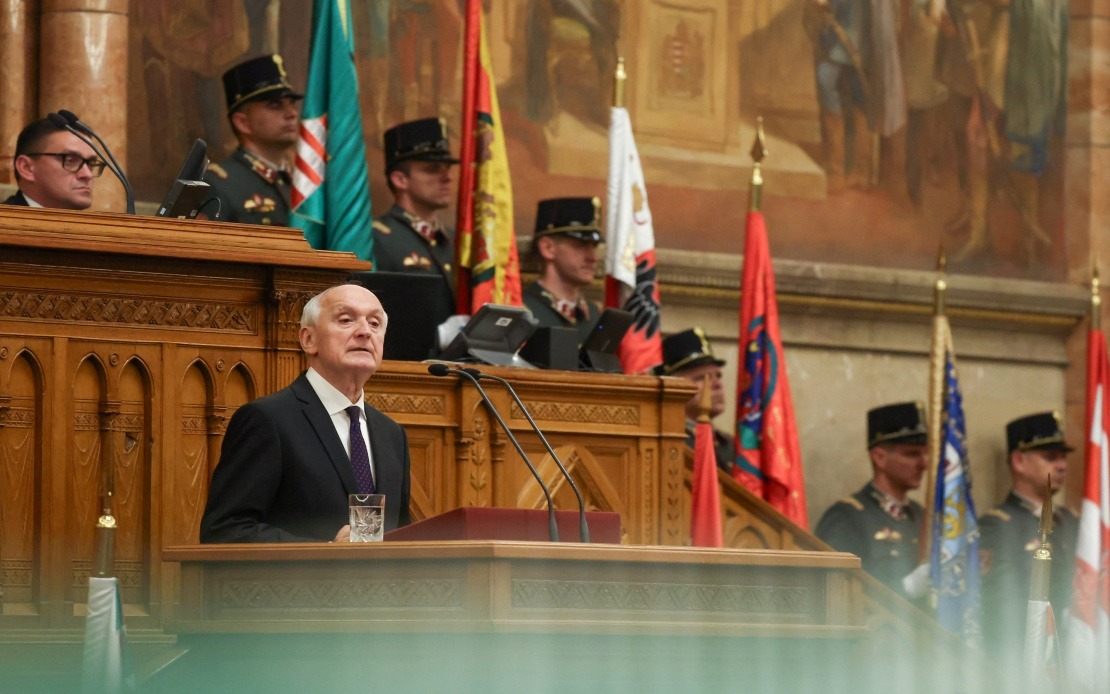
Andras Baka, a former chief justice with decades of experience in Hungary's judicial system, officially commenced his duties as the country's president on August 19, 2026, marking a significant moment in Hungarian politics following parliamentary confirmation just over a week earlier. Prime Minister Peter Magyar publicly welcomed the transition through social media, expressing hopes that the incoming head of state would bring effectiveness, personal wellbeing, and humanitarian values to the position he now holds.
The path to Baka's presidency reflects deeper tensions within Hungary's political landscape. Parliamentary deputies selected him on August 11 after what has emerged as a contested electoral process, one that triggered substantial opposition from several major political factions. The circumstances surrounding his election underscore persistent disagreements over constitutional procedures and the powers vested in Hungary's highest offices, divisions that continue to shape the country's democratic institutions.
Baka brings considerable experience from Hungary's judiciary to his new constitutional role. His earlier tenure as president of the Supreme Court, which he held between 2009 and 2011, positioned him as a prominent judicial figure during a transformative period for the Hungarian legal system. However, this appointment ended under contentious circumstances tied to judicial reforms championed by the Viktor Orban government at that time, revealing the close intertwining of judicial independence and political governance in Hungary.
Before his domestic judicial prominence, Baka worked at the European Court of Human Rights based in Strasbourg, where he gained international exposure to human rights jurisprudence and continental legal standards. This background in European human rights institutions distinguishes his profile from many Hungarian political figures and suggests a perspective shaped by engagement with broader European legal frameworks and practices.
Following his resignation from the Supreme Court presidency, Baka served as chairman of the Hungarian Curia from 2012 to 2020. The Curia itself emerged as part of the judicial restructuring process initiated by the Orban administration, representing the architectural changes that reshaped Hungary's court system during that period. His stewardship of this reorganized institution positioned him as a figure navigating between the judicial reforms of the government and his own previous leadership role in the older system.
The political opposition's response to Baka's election reveals significant fractures in Hungary's parliamentary composition. Both Fidesz, traditionally the dominant centre-right party, and the Christian Democratic People's Party, another established conservative faction, refused to participate in the presidential election itself. Their boycott represented a formal protest against the constitutional amendment process that removed Baka's immediate predecessor, Tamas Szujok, from office—an action the opposition parties viewed as an improper circumvention of normal democratic procedures.
This boycott strategy carries particular significance for understanding contemporary Hungarian politics. Rather than engaging in parliamentary debate or voting against Baka's candidacy, these opposition groups chose to abstain entirely, signalling their rejection of the legitimacy of the entire electoral framework rather than merely disputing the specific candidate. Such tactics often indicate fundamental disagreements about constitutional propriety and the boundaries of acceptable political procedure.
The removal of Szujok through constitutional amendment rather than through standard electoral mechanisms represents a notable departure from conventional presidential transitions. This procedural choice has troubled even opposition parties whose platforms might otherwise align with current government priorities, suggesting that questions about constitutional integrity transcend typical partisan divisions. For Malaysian observers monitoring democratic practices in neighbouring Asian democracies, the Hungarian case illustrates how constitutional amendments can become tools for shifting political power in ways that challenge institutional stability.
For Southeast Asian readers, Hungary's political dynamics offer relevant lessons about the preservation of institutional checks and balances. The tensions between executive authority and judicial independence, exemplified by the Supreme Court reforms that shaped Baka's early career, parallel similar debates occurring across the region regarding the appropriate scope of executive power and the autonomy of courts. Hungary's experience demonstrates how reforms undertaken in the name of modernization can fundamentally alter the balance of institutional power if implemented without robust procedural safeguards.
Baka's assumption of the presidency occurs within a European Union member state experiencing ongoing scrutiny regarding democratic standards and rule of law compliance. His own historical role in navigating judicial reforms positions him as a figure familiar with both defending institutional independence and managing political pressures—capacities that may prove consequential as Hungary addresses international concerns about democratic governance while managing domestic political divisions that extend far beyond the presidential office itself.

