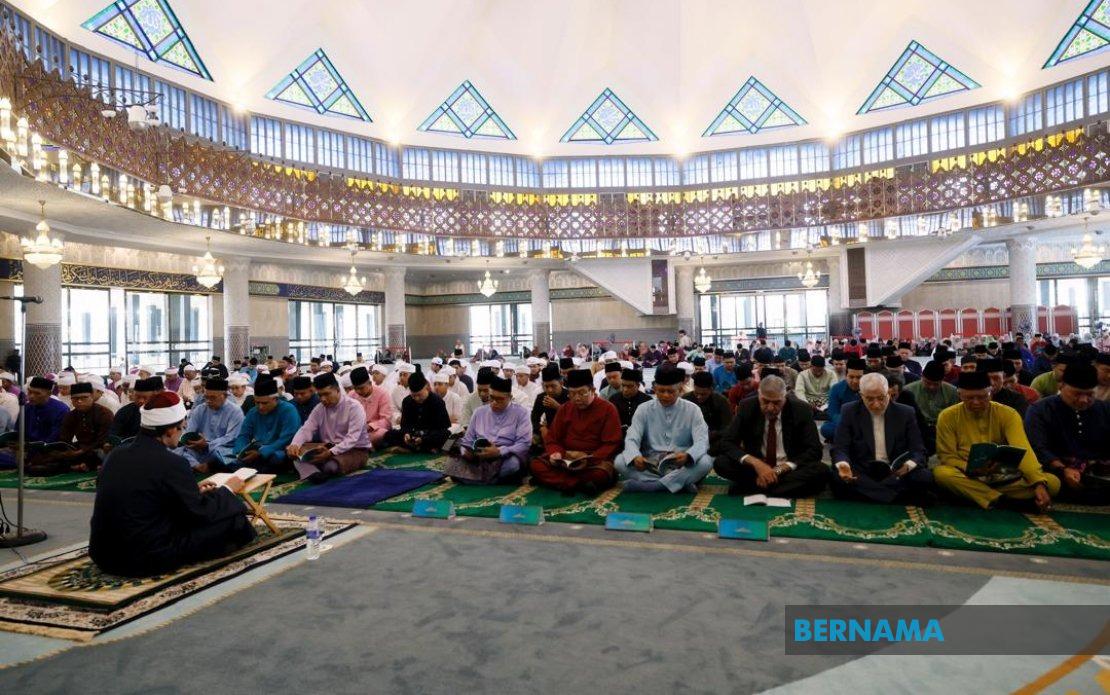
Malaysia's security forces and government officials gathered in Kuala Lumpur on Tuesday for a solemn religious service commemorating the nation's defenders, with about 500 participants joining a traditional Yasin recitation and tahlil ceremony ahead of the formal Warriors' Day observance. The event, coordinated by the Prime Minister's Department, served as a spiritual prelude to tomorrow's main celebration at Dataran Pahlawan Negara in Putrajaya, reflecting Malaysia's custom of honouring those who have sacrificed in safeguarding national sovereignty.
Chief Secretary to the Government Tan Sri Shamsul Azri Abu Bakar underscored the inclusive nature of the commemoration, emphasising that all security personnel—whether currently serving or fallen—merit recognition as national heroes deserving of the nation's gratitude. His remarks highlighted the broad spectrum of Malaysia's security apparatus, whose members face daily risks to maintain public safety and territorial integrity. The framing of all security workers as national heroes reflects a deliberate policy choice to elevate the status and public appreciation of often-underappreciated frontline personnel.
The gathering drew representatives from across Malaysia's security and public service establishment. Personnel from the Malaysian Armed Forces, Royal Malaysia Police, Fire and Rescue Department, Immigration Department, and the Prime Minister's Department itself attended, creating an unusually unified show of force and solidarity. This cross-agency participation underscores how Warriors' Day has evolved into a cornerstone event for reinforcing institutional bonds within Malaysia's security infrastructure and demonstrating coordinated commitment to national defence objectives.
The religious component of the ceremony—led by National Mosque Grand Imam Dr Amru Alhaz Adnan—blended Islamic spiritual traditions with civic commemoration. The Yasin recitation, followed by tahlil (remembrance of God) and doa selamat (prayer for safety and blessing), represents Malaysia's characteristic fusion of religious observance and state nationalism. This approach resonates particularly within Malaysia's Muslim-majority Muslim-majority context, where Islamic rituals provide culturally resonant frameworks for expressing collective national sentiment and honouring sacrifice.
Senior government figures' attendance demonstrated the gravity with which the administration treats Warriors' Day. Beyond Tan Sri Shamsul Azri, the ceremony included Army Chief Gen Tan Sri Azhan Md Othman and Auditor-General Datuk Seri Wan Suraya Wan Mohd Radzi, signalling that security force commemoration commands attention at the highest administrative levels. Such high-level participation sends clear signals about governmental priorities and the political importance attached to maintaining morale and public appreciation within defence and security ranks.
Warriors' Day itself, observed annually on July 31 since 1968, marks over five decades of institutionalised remembrance within Malaysia's calendar of civic occasions. The establishment of this fixed observance reflected post-independence nation-building efforts to forge collective identity around shared commitment to territorial defence. Over the decades, the commemoration has weathered Malaysia's various security challenges, from communist insurgency to contemporary counter-terrorism operations, evolving while maintaining its core purpose of recognising sacrifice.
The tradition of alternating ceremonial leadership between the Malaysian Armed Forces and Royal Malaysia Police demonstrates how Warriors' Day functions as a mechanism for rotating institutional prestige and ensuring both pillars of Malaysia's security state receive formal recognition. This structured rotation prevents any single agency from monopolising the commemorative narrative and reinforces concepts of balanced, complementary security responsibilities across different branches of the state apparatus.
For Malaysia's regional standing in Southeast Asia, Warriors' Day reflects broader patterns of how post-colonial nations construct narratives of state legitimacy through security force veneration. As regional tensions periodically flare—whether maritime disputes or transnational security threats—occasions like Warriors' Day reinforce domestic cohesion and psychological preparedness for collective defence. The solemn religious dimension particularly resonates across Malaysia's diverse population, offering shared symbolic space transcending ethnic and religious divisions.
The scale of Tuesday's ceremony, drawing five hundred participants across multiple agencies, demonstrates that Warriors' Day remains institutionally robust despite Malaysia's shifting political landscape over recent years. Institutional continuity around security force commemoration suggests these observances function as stabilising rituals within the broader apparatus of state governance, providing predictable occasions for reaffirming collective commitment to national defence regardless of electoral outcomes or political transitions.
Tomorrow's main celebration at Dataran Pahlawan Negara promises larger public participation, with the physical relocation to Putrajaya's symbolic centre amplifying the ceremonial significance. The progression from Tuesday's intimate religious service to the sprawling public commemoration reflects Malaysia's tiered approach to national ritual, moving from spiritual preparation through government circles toward broader civic engagement. This escalating format ensures multiple entry points for Malaysian citizens and institutions to participate in honouring national defence, whether through formal government participation or public attendance at the flagship event.

