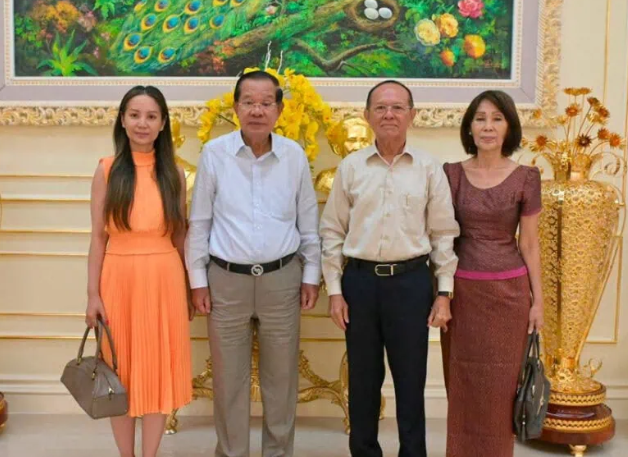
Cambodia's political landscape is witnessing an extraordinary rapprochement between two figures who stood on opposite sides of the country's fiercest partisan divide. Senate president Hun Sen welcomed former opposition leader Kem Sokha to his residence on Sunday morning for a three-hour conversation that signals a dramatic thaw in their relationship. The meeting, which included Sokha's wife and daughter, has become the latest indicator of a broader realignment unfolding within Cambodian politics as Sokha gradually re-enters public life following years of legal constraints and imprisonment.
The substance of their lengthy discussion remains undisclosed, with Hun Sen declining to reveal what topics dominated the three-hour exchange that ran from 9 in the morning until noon. However, the very fact of the meeting and Hun Sen's subsequent public commentary about it carry symbolic weight in a political culture where such gatherings between rivals are carefully choreographed messages to the broader political community. The timing and tenor of Hun Sen's announcement through social media underscored the significance he wished to attach to the encounter.
Particularly striking was Hun Sen's effusive praise for Sokha's daughter, Kem Monovithya, whom he described as an 'excellent human resource for the nation.' The Senate president noted that he had devoted considerable time during the meeting to conversations with Monovithya, a detail that appears carefully chosen for public consumption. Such language from Cambodia's longtime leader carries weight precisely because it signals potential opportunity for individuals within the country's political ecosystem. The specific invocation of her value as 'human resource' hints at possible future roles, whether in public service, governance, or other state functions, though Hun Sen has offered no explicit confirmation of such intentions.
Sokha's remarkable journey from imprisoned dissident to Hun Sen's household guest cannot be understood without examining the legal and political constraints that had bound him. The former co-founder and president of the Cambodia National Rescue Party, which emerged as the country's most formidable opposition force challenging Hun Sen's Cambodian People's Party, was convicted in 2023 of treason-related charges involving alleged conspiracy with foreign powers. He received a 27-year sentence and spent years under house arrest with severe restrictions on his movement, political activities, and international travel. The Phnom Penh Appeal Court upheld this conviction on April 30, 2026, initially appearing to cement his continued isolation from public life.
The trajectory shifted dramatically when King Norodom Sihamoni granted Sokha a royal pardon on May 25, effectively ending both his remaining prison sentence and house arrest conditions. While the pardon removed immediate physical constraints on his liberty, the restrictions on his political activities remained stubbornly in place, suggesting that complete rehabilitation within the system remained conditional. A subsequent royal decree issued on July 24 further relaxed his circumstances by lifting the five-year overseas travel ban that had been imposed alongside his original conviction, yet the prohibition against political participation endured, creating an ambiguous status for the former opposition figure.
Sokha's re-emergence into public visibility has been carefully calibrated and gradual. Days after the July 24 decree eased his travel restrictions, he made a significant public appearance in Banteay Meanchey province, where he visited displaced civilians affected by the ongoing Cambodia-Thailand border conflict. During this visit, Sokha took pains to characterise his actions as those of a private citizen rather than a political representative, a circumspect approach that acknowledges the legal constraints still formally binding him whilst simultaneously demonstrating his capacity to engage with public issues. He indicated that he had raised concerns about the displaced Cambodians' circumstances with members of the international community, positioning himself as an advocate for humanitarian concerns rather than partisan politics.
The historical context of Hun Sen and Sokha's relationship lends particular gravity to their recent meetings. For years, these two figures represented the fundamental fault line in Cambodian politics. The Cambodia National Rescue Party, under Sokha's leadership alongside co-founder Ung Sam Ol, achieved remarkable electoral gains in 2013 national elections and again in the 2017 commune elections, establishing itself as a genuine challenger to the ruling Cambodian People's Party's three-decade dominance. This electoral success fundamentally alarmed the ruling establishment, ultimately leading to the Supreme Court's controversial dissolution of the CNRP in November 2017, a decision announced shortly after Sokha's arrest and that effectively eliminated the country's primary opposition force at a stroke.
Hun Sen's public statement that Sokha had visited his home 'several weeks' earlier, before travelling to meet troops and displaced persons affected by border conflict, reveals a pattern of private engagement between the former adversaries. The repeated private meetings suggest ongoing dialogue on matters undisclosed to the public, whilst Sokha's humanitarian visits and Hun Sen's receptiveness to these activities indicate tacit acceptance of his gradually widening public role. This choreography demonstrates a political process unfolding beneath the surface of official announcements, one in which constraints are progressively loosened in exchange, presumably, for demonstrated political quiescence.
The question of Monovithya's potential role assumes particular importance given her own political background. As the daughter of Cambodia's most prominent opposition figure, she carries symbolic weight within opposition circles whilst simultaneously being subject to the political restrictions that have bound her father. Hun Sen's decision to single her out for praise in a public statement suggests either a genuine assessment of her capabilities or, more likely, a deliberate signal about prospective opportunities for her within Cambodia's political or governance structures. The absence of any announcement regarding actual political roles or agreements between the parties maintains the ambiguity that characterises much Cambodian political negotiation.
Regional observers monitoring Cambodia's political evolution will recognise in these developments a pattern consistent with the country's approach to integrating erstwhile opposition figures into the established order. Rather than confrontational suppression, Hun Sen's government appears willing to offer pathways to re-emergence for former rivals willing to accept existing power arrangements and refrain from reviving organised political challenges. Sokha's acceptance of house arrest conditions, his muted return to public life, and his characterisation of his activities as private citizen initiatives all demonstrate the unwritten rules governing such reintegration.
For Malaysia and other Southeast Asian nations observing Cambodian developments, these meetings underscore the resilience of Hun Sen's political dominance even as he appears magnanimous toward former opponents. The rehabilitation of Sokha and potential advancement of his daughter occur entirely within the parameters Hun Sen's government has established, with no indication that fundamental power arrangements face contestation. This reflects a broader Southeast Asian pattern wherein strong executives accommodate opposition figures through controlled mechanisms that preserve ruling party supremacy whilst offering sufficient flexibility to prevent destabilising confrontation.
The implications for Cambodia's democratic trajectory remain ambiguous. Whether Hun Sen's apparent warming toward Sokha represents genuine reconciliation, tactical incorporation of opposition energy into the system, or strategic preparation for a managed political succession remains unclear. What is evident is that the relationship between Cambodia's most prominent former political rivals has entered a new phase, one characterised by private meetings, public praise, and Sokha's gradual normalisation within public discourse. The lifting of restrictions and Hun Sen's remarks about Monovithya suggest that further evolution in this relationship can be expected, though the ultimate destination of this political journey remains deliberately obscured from public view.

