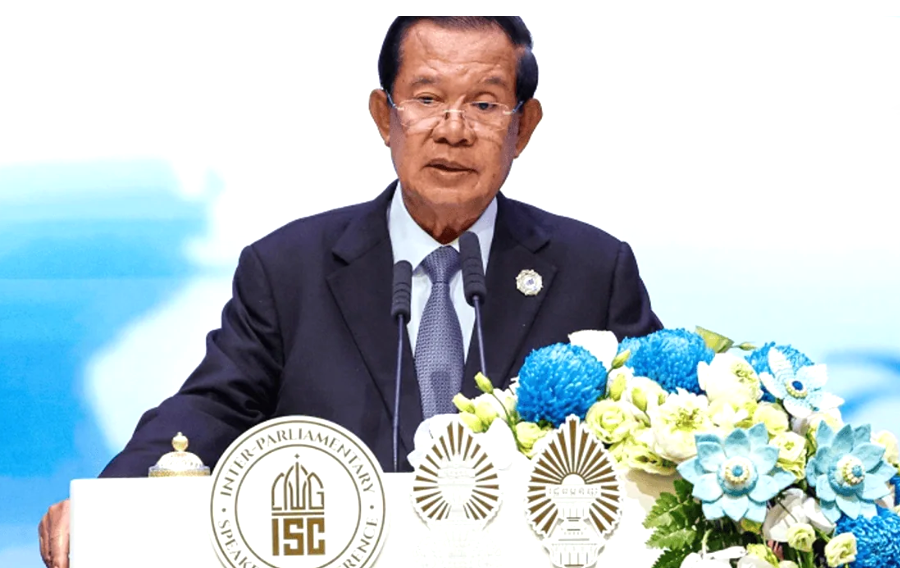
At the 2nd Inter-Parliamentary Speakers' Conference in Phnom Penh this week, Cambodia's Senate president Hun Sen delivered a forceful critique of what he characterised as Thailand's misuse of international law to advance territorial claims. Speaking before legislative leaders from Pakistan, Malaysia, Myanmar, Australia, Russia and other nations, Hun Sen argued that the border dispute between the two countries exemplifies a troubling modern phenomenon: the deployment of ostensibly legitimate global concerns—in this instance, the international crackdown on online fraud networks—to provide political cover for what he described as military occupation of sovereign territory.
The Cambodian leader's remarks strike at the heart of longstanding tensions along the Cambodia-Thailand frontier, where disputes over demarcation and control have periodically erupted into armed confrontation. Hun Sen contended that framing territorial disputes within the language of crime prevention represents a novel form of warfare designed to circumvent traditional international legal constraints. By repackaging what amounts to territorial seizure as a law enforcement operation targeting transnational criminal enterprises, he suggested, powerful nations can pursue expansionist agendas while maintaining a veneer of legitimacy within the international community.
Hun Sen positioned this specific dispute within a broader analytical framework about the weaponisation of international relations in the contemporary period. He identified multiple vectors through which nations now conduct conflict outside traditional military channels: trade wars that employ tariff regimes and revocation of preferential access to markets; technological competition for dominance in semiconductors and cyber infrastructure; and resource nationalism that uses control over energy supplies and rare earth minerals as geopolitical leverage. Each of these domains, he suggested, represents territory in which the formal rules-based international order has increasingly broken down, replaced by ad-hoc power dynamics favouring wealthier and militarily stronger nations.
Particularly significant in Hun Sen's diagnosis is his assertion that Cambodia and other developing nations face systematic double standards in how international law is applied. He highlighted how wealthy nations impose stringent expectations regarding human rights compliance, environmental protection, and cross-border crime control—standards often calibrated to the capacity and resources of developed economies—while simultaneously exempting themselves from equivalent scrutiny. For emerging economies still managing the aftermath of prolonged conflict and limited by constrained development resources, such asymmetrical application of international norms creates what Hun Sen termed a "web of systemic insecurity."
The Senate president also raised concerns about the erosion of the global non-proliferation framework, arguing that mounting security anxiety among vulnerable nations is driving a destabilising arms race. When countries conclude that international treaties and multilateral security arrangements cannot reliably protect them from external aggression—particularly when powerful actors claim exclusive rights to conduct preemptive strikes—the incentive structures shift dramatically. Nations increasingly view nuclear or other advanced weapons systems not as regrettable necessities but as essential insurance policies, a calculus that threatens the post-Cold War security architecture.
Hun Sen's critique extends to what he characterised as the selective application of international law by established powers. He pointed to instances where powerful states launch military interventions they classify as self-defence while denying smaller nations equivalent rights to respond to external pressure. This contradiction, he argued, has already "utterly destroyed the dream of collective security" that underpinned post-1945 international institutions. The resulting security vacuum pushes developing nations toward hedging strategies that undermine broader stability.
Central to his argument is the observation that those who originally established the international rules-based order are now systematically dismantling it. Hun Sen contended that economic and trade relationships have become weaponised, with rule changes occurring unpredictably and commitments providing no reliable guarantees. This creates profound uncertainty for nations dependent on stable international commerce and investment flows, fundamentally altering calculations about strategic alignment and security partnerships.
The timing of Hun Sen's remarks reflects persistent tensions within Southeast Asia regarding border disputes and spheres of influence. Malaysia, which shares not only a land border with Thailand but also maritime boundary disagreements, has direct interest in how international law addresses such conflicts. Similarly, Myanmar's ongoing political instability and Australia's strategic concerns in the Indo-Pacific mean that questions about the legitimacy of territorial claims and the enforceability of international agreements carry weight for multiple conference participants.
Hun Sen's call for restoration of the UN Charter, ASEAN Charter, and other multilateral frameworks reflects a recognition that smaller nations have limited capacity to compete in raw power terms but retain stake in maintaining institutional constraints on great power behaviour. ASEAN's commitment to non-interference and respect for sovereignty—principles enshrined in the ASEAN Charter—forms the theoretical foundation for regional coexistence despite significant disparities in military and economic capability. When Hun Sen warns of the rules-based order's collapse, he implicitly signals that alternatives favouring larger powers would prove catastrophic for Cambodia and its peers.
The Cambodian position also reflects broader anxiety within the region about external powers weaponising internal governance issues. Human rights criticism, environmental standards, and law enforcement concerns have all been employed in recent years as rationales for varying degrees of international pressure on Southeast Asian governments. Hun Sen's charge that such tactics represent weaponised standards deserves serious consideration, even as Cambodia's own human rights record remains contentious. The question of whether international norms are applied consistently or instrumentally to serve great power interests remains genuinely contested.
Ultimately, Hun Sen's intervention at the parliamentary conference articulates a sophisticated critique of contemporary international relations that resonates across the developing world. His argument that modern conflicts proceed through regulatory capture, economic coercion, and legal manipulation rather than conventional military means reflects observable reality in numerous disputes. Whether listeners accept his specific characterisation of the Cambodia-Thailand dispute or his interpretations of international law, his broader warning about the deterioration of multilateral institutions and the emergence of norm-erosion as a strategic tool carries implications well beyond Phnom Penh's conference halls, shaping how Southeast Asian nations approach their own security challenges and international commitments.

