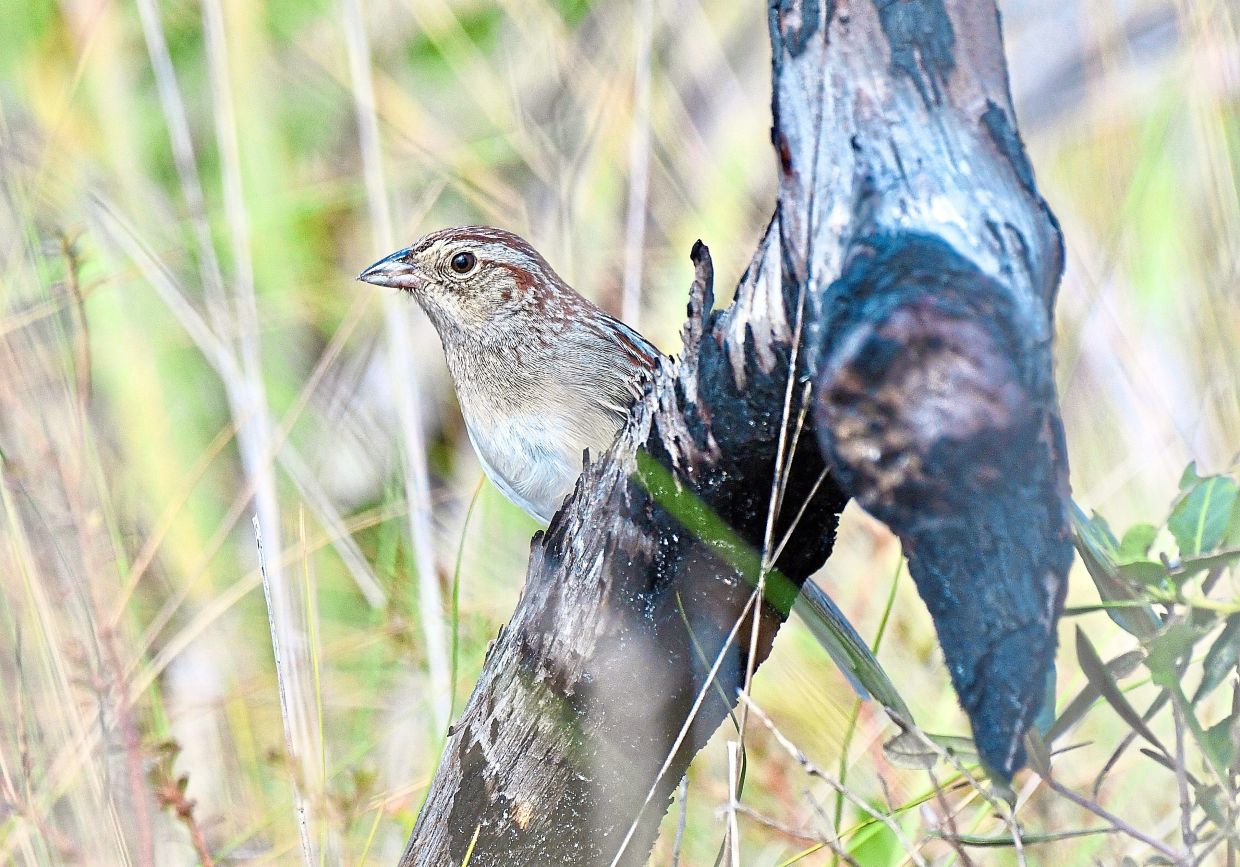
A new study of Bachman's sparrows in South Florida's flatwoods has identified an overlooked factor in how songbirds transmit their communication systems across generations: the physical environment itself. The research, led by behavioral ecologist Rindy Anderson at Florida Atlantic University and published in March 2026, demonstrates that geographical and climatic conditions shape not only how songs sound, but also which songs survive in a population's cultural repertoire.
These small brown birds, which perch among pine trees to sing, present a fascinating case study in animal communication. Within any given population, Bachman's sparrows employ up to 120 distinct song types, yet an individual bird typically masters only about 48 of these during its lifetime. To external listeners, the variations may seem subtle, but the acoustic diversity reflects a sophisticated communication system that researchers have spent decades trying to understand. Like human languages, bird songs are learned behaviours passed from generation to generation, and each new cohort of young birds makes deliberate choices about which songs deserve preservation and which should fade from use.
Traditional research has concentrated on social and cultural drivers of song selection. Scientists observed that young songbirds during critical developmental windows tend to imitate adult males who succeed in courtship or possess elaborate visual features, suggesting that reproductive success and aesthetic appeal guide learning choices. This framework paralleled human cultural transmission, where prestige and status often determine which innovations spread through a population. However, Anderson's team suspected something more was at play, a factor rooted in the acoustic properties of the landscape itself.
The investigation centred on a simple hypothesis: physical surroundings affect how sound travels. Trees, dense vegetation, wind patterns, and other environmental features scatter, absorb, or block sound waves. If certain song types naturally degrade when transmitted through particular habitats, young sparrows encountering degraded versions might find them less attractive or even fail to recognize them as songs worth learning. Over generations, this preference would gradually eliminate weaker-transmitting songs from the population's active repertoire, creating observable patterns in song prevalence.
To test this theory, researchers recorded both rare and common Bachman's sparrow song variants and then replayed them in various natural settings frequented by the birds—dense forests, open windy plains, and transitional zones. The acoustic analysis revealed a striking pattern: rarer songs consistently failed to propagate as clearly as common ones when filtered through these realistic environmental conditions. The degradation was measurable and significant, suggesting that habitat acoustics genuinely disadvantages certain song types during transmission.
This finding aligns with earlier experimental work on other songbird species, where researchers documented that birds preferentially learned undegraded versions of songs when exposed to both clean and degraded recordings. Anderson noted that this pattern reveals "the idea of cultural evolution" driven by environmental forces—a mechanism distinct from sexual selection or social learning. The mechanism essentially acts as a natural filter, where the landscape itself determines which information gets transmitted clearly enough for the next generation to acquire and preserve.
The broader principle underlying these results is the acoustic adaptation hypothesis, which proposes that habitats and climates shape the evolution of animal vocalizations. The hypothesis finds support across multiple taxa. Low-frequency bellows from rainforest primates, for instance, travel more effectively through dense vegetation than high-pitched calls would. Similarly, frogs inhabiting noisy streams have evolved shrill croaks that cut through running water, whereas forest frogs use different frequencies. These examples suggest that environmental pressures systematically mould communication signals, creating a feedback loop between habitat and behaviour.
Yet the picture remains complex and incomplete. A comprehensive analysis of 5,085 songbird species suggested that sexual selection—the preference for attractive mates—might be the dominant force shaping song variation, rather than acoustic properties alone. Anderson herself cautioned that environmental degradation represents "one small piece of a big puzzle." Social and cultural transmission almost certainly carry equal or greater weight in determining which songs persist. Young sparrows do not mechanically select for acoustic clarity; they respond to multiple cues, including the success and status of singers and the complexity or novelty of the songs themselves.
Moreover, field research inevitably confronts messier reality than laboratory settings allow. As ornithologist David Wheatcroft from Stockholm University observed, numerous variables beyond simple acoustic degradation influence which songs become rare or common in wild populations. Demographic shifts, competitive interactions, and unpredictable events can all alter transmission patterns independent of environmental acoustics. Despite these complications, Wheatcroft acknowledged the logical appeal of the mechanism: for a song to be learned, it must first be perceived, and songs that degrade during transmission should indeed be learned less frequently.
For Malaysian and Southeast Asian researchers studying bird behaviour and ecology, this work carries particular relevance. The region's diverse habitats—tropical rainforests, mangrove swamps, agricultural lands, and urban environments—create variable acoustic conditions that likely influence vocalization patterns in local bird populations. As habitats undergo rapid transformation through development and land use change, the acoustic properties of the soundscape shift, potentially accelerating changes in bird song repertoires. Understanding these mechanisms helps predict how bird communication systems might adapt or deteriorate under anthropogenic pressure.
The findings also underscore a fundamental principle in conservation biology: environmental modification affects not merely the presence or absence of species, but the quality and nature of their behavioural repertoires and cultural practices. When humans fragment or simplify habitats, we do not simply reduce bird numbers; we alter the acoustic environment in ways that may suppress certain songs and favour others, effectively reshaping the cultural inheritance passed between generations. This layer of impact often escapes attention in standard conservation assessments.
Looking forward, the research invites further investigation into how specific habitat features—forest density, wind regime, seasonal vegetation changes—correlate with song diversity in different populations of Bachman's sparrows and other species. Comparative studies across populations experiencing different environmental pressures could illuminate the relative strength of acoustic adaptation versus other evolutionary drivers. Such work might ultimately help explain the rich variety of bird songs observed across the world's diverse ecosystems, where every landscape seemingly produces its own distinctive acoustic signature.

