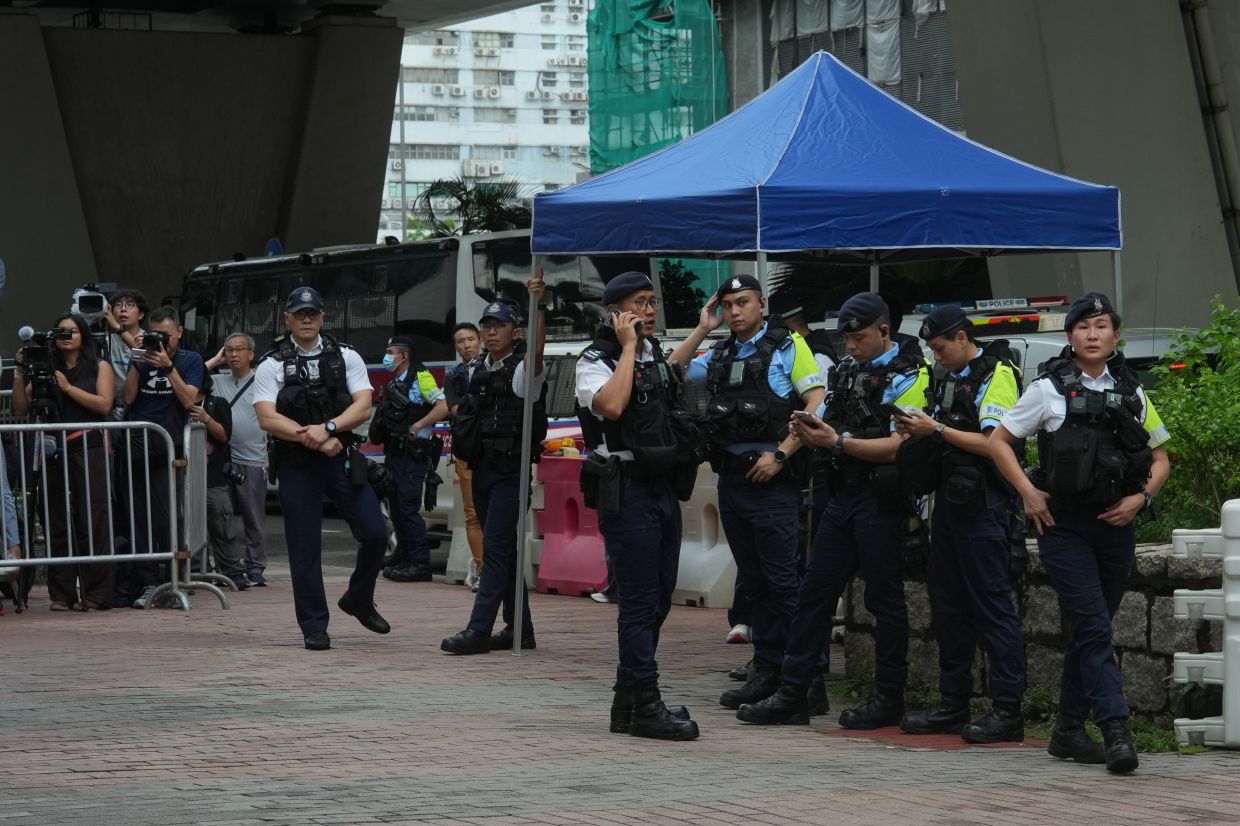
Hong Kong police arrested a woman last week for allegedly wearing a T-shirt bearing a seditious message outside West Kowloon Court, raising fresh concerns about the scope of national security enforcement in the territory. The detainee faced charges of disorderly conduct, obstructing officers and acting with seditious intent, according to a police statement released Monday evening. Authorities declined to elaborate on the specifics of what made the garment problematic, citing operational sensitivity and the need to protect public order and safety.
The arrest timing proved particularly striking, occurring just hours before a High Court panel issued guilty verdicts against Lee Cheuk‑yan and Chow Hang‑tung, the former chairman and vice-chairwoman of the Hong Kong Alliance in Support of Patriotic Democratic Movements of China. The now-disbanded organisation had organised Hong Kong's annual Tiananmen Square vigil, a ritual that commemorated the 1989 crackdown and had operated for decades with minimal interference until recent years. Both defendants faced charges of inciting subversion under the national security law, stemming from their calls to end "one‑party dictatorship" in mainland China.
The incident unfolded in the early morning darkness of Friday when more than 50 people gathered outside the courthouse before dawn, keen to observe the judgment or gather outside in solidarity. An officer working in civilian clothes reportedly identified the woman based on her black T-shirt, which witnesses said displayed Japanese characters. Rather than engaging with other observers, the plainclothes officer escorted her directly to a police vehicle while media cameras documented the removal. Officers then reportedly instructed journalists to leave the vicinity as she was taken away, suggesting official awareness of how the detention might appear to observers and the international community.
The three-judge panel, in a comprehensive 216-page ruling, adopted an expansive interpretation of subversion that extends far beyond traditional definitions. The judges determined that any action intended to overthrow or undermine the leadership of the Communist Party of China constitutes subversion under the territory's legal framework. Critically, the court held that Hong Kong's constitutional arrangement does not permit Western-style democratic systems, effectively narrowing the space for legitimate political discourse. This reasoning transformed what activists viewed as calls for democratic reform into prosecutable offences under national security statutes.
For Malaysia and the broader Southeast Asian region, Hong Kong's evolving legal landscape carries significant implications. As a regional financial hub and a gateway for international commerce and investment, Hong Kong's security regime influences how foreign companies, journalists and civil society groups operate throughout Asia. The expanding definition of sedition means that even symbolic protest—such as wearing particular clothing—now carries legal peril. This creates a chilling effect on freedom of expression that extends beyond the territory's borders, as regional professionals and international observers become increasingly cautious about their conduct and speech.
Lee Cheuk‑yan, a former legislator with decades of public service, and Chow Hang‑tung, a qualified barrister trained in the common law tradition, have been in custody for nearly five years awaiting this verdict. Their prolonged detention without resolution reflects the resource intensity of Hong Kong's national security prosecutions and the consequences for defendants navigating an increasingly adversarial legal environment. A fourth defendant, Albert Ho Chun‑yan, who served as vice-chairman of the alliance, remains in detention for over four years. Ho pleaded guilty in January and awaits sentencing, suggesting that even cooperative defendants face indeterminate timelines for resolution.
The case demonstrates how national security laws, introduced in Hong Kong in 2020 following pro-democracy protests, have evolved into tools for prosecuting political speech and association. The alliance itself operated openly for three decades before being deemed subversive, illustrating the retroactive application of these standards. Organisations that functioned within legal boundaries under the previous regime suddenly found themselves criminal enterprises overnight, forcing members to confront impossible choices between their convictions and personal safety.
For Southeast Asian observers, particularly those in Malaysia where concerns about sedition law enforcement periodically surface, Hong Kong's trajectory offers instructive lessons. The territory's experience suggests that security legislation, once enacted, tends to expand in scope and severity rather than contract. Judicial interpretations that begin narrowly often broaden over time, particularly when political pressure mounts or authorities seek to demonstrate commitment to national interests. The speed with which Hong Kong transformed from a relatively open society to one where T-shirt slogans trigger police detention occurred within a single legislative cycle.
The broader context of the T-shirt arrest within the judicial pronouncements on that same day reflects a coordinated effort to reinforce new political boundaries. The removal of the woman occurred not randomly but at a moment of maximum visibility, when media attention focused on the courthouse and the international press monitored developments. This choreography suggests deliberate messaging: that Hong Kong authorities will police expression across multiple domains simultaneously, and that even passive display of unapproved messages invites state intervention.
International responses to the case will likely prove muted, as few foreign governments openly confront China on Hong Kong matters. However, the incident reinforces concerns among international human rights organisations that have documented the systematic narrowing of freedoms in the territory. For Malaysian professionals, investors and civil society representatives with connections to Hong Kong, the case underscores the importance of understanding how political risk in the territory has fundamentally shifted. What once appeared as a stable, rules-based jurisdiction now operates under fluid security standards that criminalise conduct and expression that previously carried no legal consequence.
The conviction of Lee, Chow and the alliance marks a symbolic endpoint for Hong Kong's pro-democracy movement in its original form. These figures represented an older generation of activists who worked within legal frameworks and believed that persistent, peaceful organisation could effect political change. Their prosecution and conviction signals that such approaches no longer enjoy legal protection. For the wider region, the message carries implications for how political movements organise, how international solidarities function, and how activist networks calculate risk when operating across Asia's complex political landscape.

