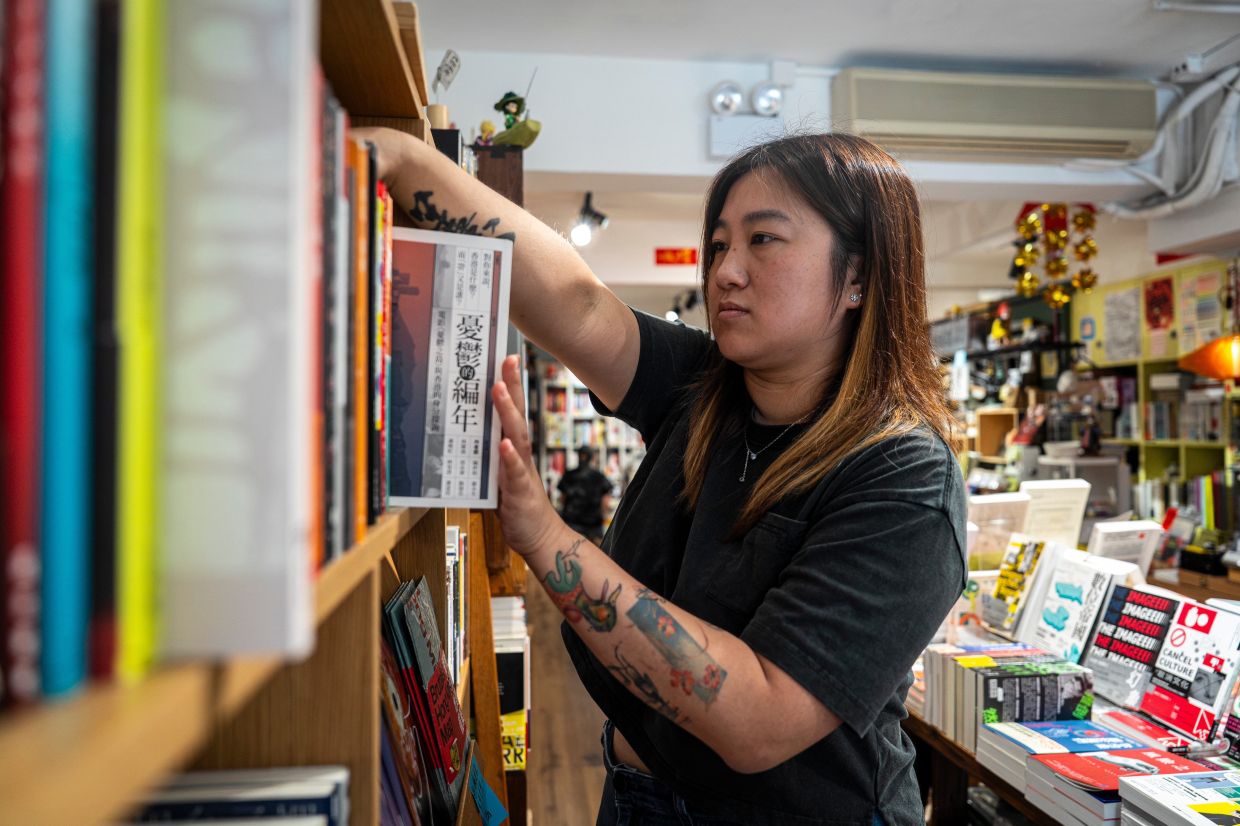
Hong Kong police have arrested two individuals on suspicion of distributing seditious publications and accepting financial support from overseas political entities, moving swiftly under the enforcement of a contentious national security law enacted in 2024. The Wednesday arrests, announced by the government on Thursday, have drawn significant attention in the Asian financial hub, where concerns about press freedom and civil liberties continue to mount amid Beijing's tightening grip on the former British colony.
While authorities have not officially named those detained, local media reports, notably from Ming Pao newspaper, have identified one arrestee as Leticia Wong, the proprietor of Hunter Bookstore located in Sham Shui Po district. Wong, who previously served as a pro-democracy district councillor, has maintained her vocal stance on political freedoms even as prominent activists have faced imprisonment following the pro-democracy demonstrations that swept the city in 2019. Should the reports prove accurate, her detention would represent a significant escalation in the authorities' campaign to suppress dissenting voices throughout Hong Kong.
The timing of these arrests carries symbolic weight, arriving just days before Hong Kong's June 30th anniversary marking the handover from British to Chinese sovereignty in 1997. Critics argue that the commitments made by Beijing to preserve Hong Kong's distinct legal system and democratic institutions have progressively eroded, transforming the city's governance model into one increasingly aligned with mainland Chinese controls. The law under which the booksellers were detained represents precisely the kind of security legislation that observers warned would fundamentally alter the city's character as a bastion of free expression in Asia.
According to the police statement, the two detainees—who manage the bookstore in Sham Shui Po—face charges of sedition under the 2024 national security law and of handling assets suspected of originating from criminal activity. Police allege the pair displayed seditious materials and sold publications with content designed to incite animosity toward the Hong Kong government, judiciary, and law enforcement. Investigators further contend that the individuals received remittances originating from foreign political organisations, though the statement provides no specifics regarding which publications or organisations were implicated.
Hunter Bookstore has become a focal point in Hong Kong's intensifying battle over intellectual freedom. Last year, a pro-Beijing newspaper characterised an independent book fair hosted at Wong's shop as embodying "soft resistance," specifically criticising the store's intention to distribute a biography of imprisoned pro-democracy figure Jimmy Lai. This incident illustrates how the authorities and their allies are increasingly scrutinising what they perceive as coded or indirect challenges to their authority, expanding the definition of seditious content well beyond explicit political speech.
Wong has publicly described the mounting harassment her business faces from government entities. In a conversation with international media last year, she disclosed that between July 2022 and June 2025, her bookstore experienced ninety-two separate government interventions, encompassing inspections, conspicuous police deployments outside the premises, and warning letters alleging regulatory violations. Beyond official pressure, she noted that an anonymous letter discouraged an organisation from hosting an event at her shop, demonstrating how intimidation operates through both state and informal channels.
The detention of bookstore proprietors reflects a broader pattern of enforcement against independent booksellers in Hong Kong. In March, authorities arrested the owner and staff of another bookshop on comparable allegations of distributing seditious publications, including the same Lai biography. Though those individuals were subsequently released on bail, the incident signalled that authorities would systematically target booksellers perceived as promoting pro-democracy narratives or international attention to Hong Kong's political situation.
For Malaysia and the wider Southeast Asian region, these developments carry significant implications. As the world's most-populous Muslim democracy and a nation balancing multiple competing interests, Malaysia has historically championed regional stability and diverse governance models. However, the Hong Kong template demonstrates how security legislation can expand dramatically beyond its stated purposes, creating a chilling effect on legitimate commercial and intellectual activity. Malaysian policymakers observing Hong Kong's trajectory may find cautionary lessons regarding how broadly interpreted national security laws can corrode the business environment and civic participation.
The Hong Kong government maintains that both the national security law and related legislation are indispensable for maintaining order and that freedom of expression remains robustly protected. This assertion, however, sits uneasily with the mounting evidence of pressure on booksellers, journalists, and activists who explore politically sensitive subjects. The government's refusal to specify which publications constitute seditious material or which foreign organisations are considered problematic leaves citizens and business owners operating in considerable legal uncertainty, effectively creating a system where self-censorship becomes rational behaviour.
The international response to such enforcement actions will shape perceptions of Hong Kong's future trajectory and whether the city can maintain its historical role as a global financial and cultural centre. Investor confidence, expatriate retention, and Hong Kong's competitive positioning all depend partly on preserving the rule of law and transparent governance structures that distinguished the city for decades. As enforcement continues against independent bookstores and other cultural institutions, stakeholders worldwide are reassessing whether Hong Kong remains a jurisdiction where intellectual freedom and business operation can coexist with government security imperatives.
Regional observers will be watching closely how these cases develop through the legal system and whether courts provide meaningful scrutiny of the sedition charges or defer substantially to executive determinations of security threats. The outcomes will likely influence how other Asian democracies and semi-democracies approach the balance between security concerns and civil liberties, making Hong Kong's experience a critical reference point for Southeast Asian governance debates.

